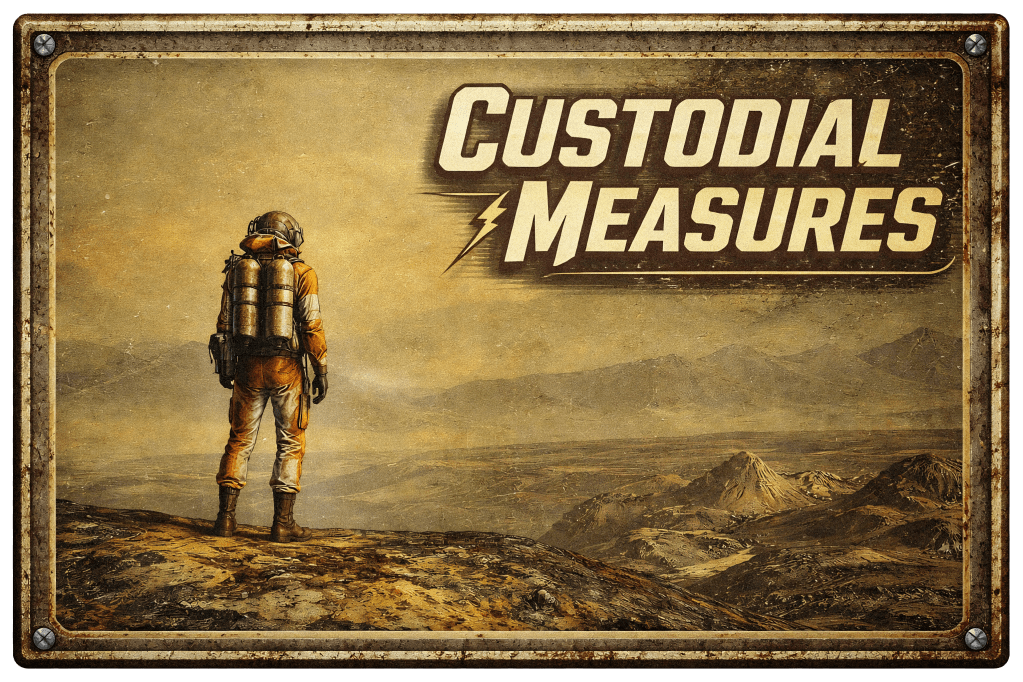
The following story is the first installment in a limited series set in the Commonwealth wasteland world of Fallout 4.
The Glowing Sea didn’t start at a line on a map. It started in your throat.
A few clicks south of the ruined town of Natick Banks, the air went from dusty to metallic in three steps. Rook pulled her scarf higher and smelled salt, old sweat, and the faint chemical tang of the filter puck she’d jammed into her improvised respirator.
A wind came up from the southwest, carrying ash and something worse–ozone, lingering like a static charge just under the soil. Her Geiger clicked politely at first, then found its courage.
Tick… tick… tick-tick-tick.
“Yeah,” Rook muttered. “I hear you.”
Behind her, the Commonwealth’s last scrub grass gave up and turned black. Ahead, the land slumped into a cratered basin of busted rock and warped concrete. Half-buried houses sagged. A highway sign stuck up out of the dirt at an angle, its face sandblasted down to an apparition of letters.
She’d promised herself she’d never come back here. Then Mamaw Della coughed red into a rag and the settlement’s well started tasting like pennies and rot, and “never” became “now.”
Scavenging anywhere in the wasteland was dangerous, but stepping into the Glowing Sea was suicide. And yet some had survived, returning with stories of preserved pre-war tech, caches of RadAway, and other buried secrets.
Rook crept along the edge of an old service road, picking her steps between fissures. Every crack in the ground disappeared in fog.
She saw the body when the wind shifted.
It lay face-down in a drift of gray dust, one boot half buried, the other kicked out at an angle like it had tried to sprint and died mid-stride. The clothes were recent–patchwork leather, plastic armor plates, a cheap shoulder pauldron.
Rook’s hand went to her pistol. Old habit. It didn’t stop her from approaching, slow and careful, eyes on the horizon.
Flies weren’t buzzing. The silence was complete enough to make her ears ring. She nudged the corpse with the toe of her boot.
The head lolled, and the face turned just enough to show the mouth open wide, lips peeled back in a stiff scream. The cheeks were blistered in patches, like the skin had tried to crawl off the bone. One eye was gone, the socket a wet dark pit full of ash.
Rook swallowed hard. “Sorry,” she said, reflexively.
The corpse’s hand was clutching something flat. A map. Not a crumpled paper scrap, but a tough, laminated polymer sheet, edges sealed, surface glossy in a way that felt obscene out here. It had the faint grid lines of an old USGS survey, and over that, in newer ink, someone had drawn a route with a steady hand.
She took it carefully.
The ink was dark and fresh enough to shine. The markings were specific: rad pockets circled with “NO,” sinkholes marked with little teeth symbols, and a thick line running in a careful curve, avoiding the worst of the Sea.
At three points along the route, someone had written the same phrase: FOLLOW THE BROKEN TOOTH.
At the end, a box labeled LANTERN.
Under that, a final note in tight, angled letters: IF YOU HEAR SINGING, YOU’RE TOO CLOSE.
Rook frowned. Singing?
Her Geiger’s clicking spiked. The wind shifted again, and she felt a crawling warmth on her skin.
She glanced back at the corpse. Recent, but already cooked.
“Why were you carrying this?” she asked the dead scavver, not expecting a response. “And why weren’t you wearing any protection?”
Rook folded the map once, almost reverently, like folding a flag, and slid it into the inner pocket of her coat. Then, like a hundred times before, she checked the dead person’s pockets.
A few caps. A bent spoon. A single Rad-X vial, empty. A note in shaky handwriting: “Tell Wren I’m sorry.”
Rook stopped with the note between two fingers, then tucked it back where she’d found it. She stood, and the wind tried to push her forward. “Alright,” she said to nobody. “Let’s see if you’re a liar.”
She followed the map’s route, the thick line guiding her around a low basin where her Geiger screamed even from twenty paces away. The air there shimmered faintly, heat distortion like a mirage. A rad pool, maybe. Or something worse.
She skirted it, boots crunching glassy grit. Her throat burned under the scarf. The old radiation scars on her forearm itched.
Twenty minutes in, she hit the first “impossible” landmark. It was a pre-war utility pole, snapped and charred, leaning at a drunken angle. Someone had painted the number ‘19’ on it.
The map had a circle around that spot, with a note: “TURN AT 19. DON’T CROSS THE BASALT.”
Basalt? What is that? Rook looked at the ground. The patch of sediment was darker, smoother. It looked solid. Her Geiger clicked faster when she stepped toward it.
“Yeah,” she whispered. “No.”
She stayed on the route, and for a while, God help her, it worked.
She moved from landmark to landmark: the corner of a foundation with a twisted rebar “hook” sticking up like a finger, the bent spine of a billboard half buried in ash, a cracked culvert that exhaled warm air like something breathing. Each one matched the map.
Then the radstorm hit.
The sky went from pale sickly gray to bruised green and yellow in under a minute. The wind gained teeth. Ash turned to needles. Her Geiger went from chatter to a steady rattle like someone shaking a jar of pebbles in her ear.
Rook sprinted, head down, eyes watering. She scanned for shelter–anything. A culvert, a truck, a crumbling wall.
She found an old bus on its side, half-buried, with its windows blown out. The metal was warped like it had been in a fire. Still, it was better than open air.
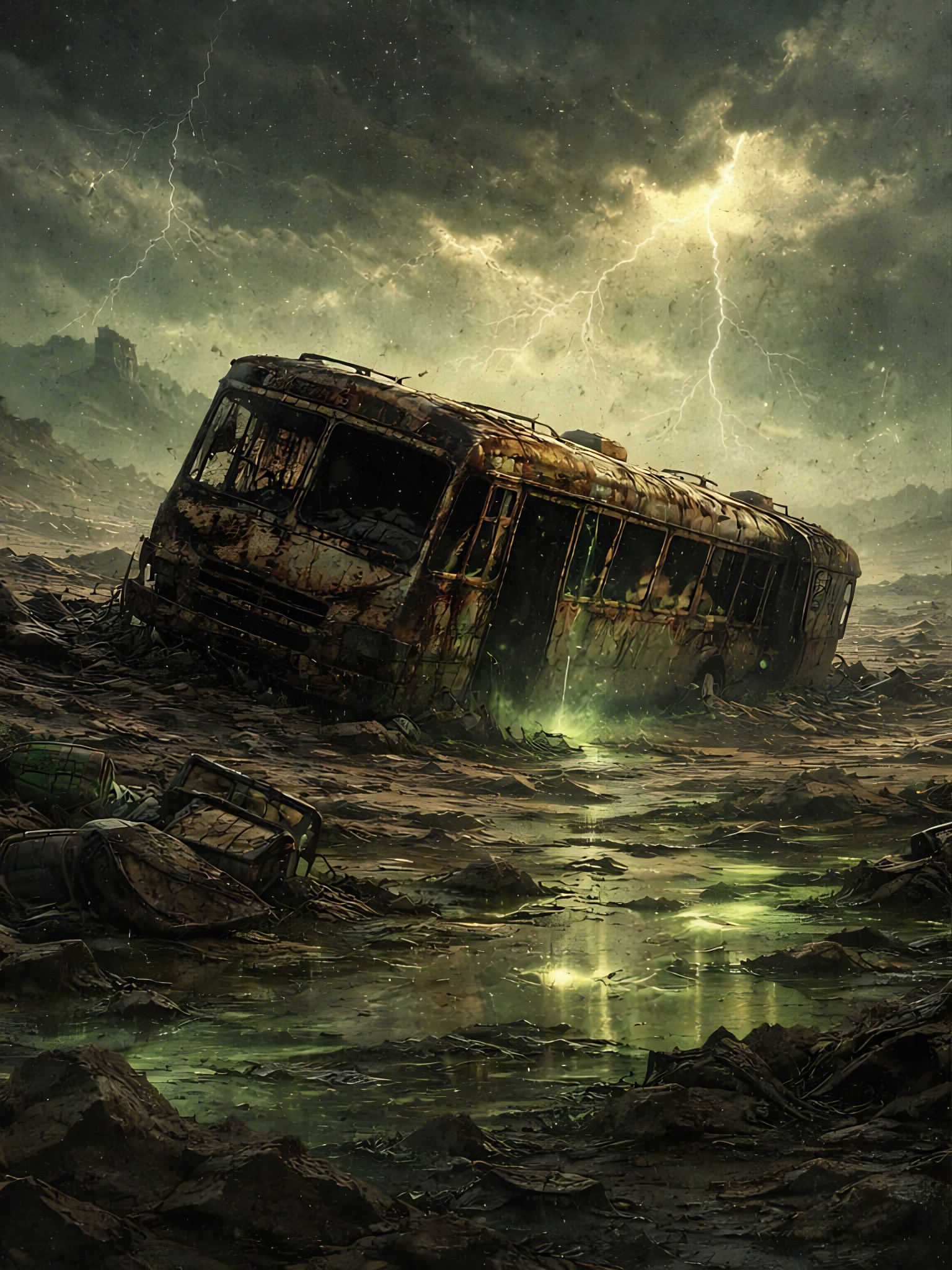
She dove inside and curled up against the floor, pulling her coat tight around her ribs. The bus smelled like rust and old smoke. The wind roared through broken seams.
Lightning flashed in the ash cloud outside, blue-white and wrong. For a second the world lit up and she saw her own hands shaking. She counted her breaths. In. Out. In. Out.
A sound came from outside the bus.
Heavy footsteps.
Rook froze, hand on her pistol, heart thumping loud enough she thought it would draw attention.
The footsteps stopped.
A shadow fell across the bus opening. Enormous. Broad shoulders. A silhouette framed in radstorm lightning like something from a child’s nightmare.
“Human… in my bus,” a voice rumbled, low and thick.
Rook’s mouth went dry. Her pistol felt like a toy, but she raised it anyway, just because. “Keep walking,” she said. “Find your own rust bucket.”
The shadow stepped closer.
Lightning flashed again.
A super mutant filled the opening–green skin mottled with scars, heavy brow, thick lips pulled back just enough to show big, square teeth. He wore a harness of scavenged straps and metal plates, and his hands were big enough to crush her skull without effort.
He looked at her face, and his nostrils flared. “You smell like…” He squinted, thinking hard. “Edge people. Not city. Not Diamond.”
“Congratulations,” Rook said, trying to keep her voice steady. “You can smell.”
He didn’t lunge. He didn’t laugh. He just stared, as if deciding whether she was worth the trouble of killing. Behind him, the radstorm screamed. He stepped inside the bus, ducking his head. The metal frame groaned.
Rook’s pistol tracked him.
He lifted both hands, palms out–not surrender, more like don’t do anything stupid. “Not here,” he said. “Storm kills both.”
“Storm doesn’t eat people,” Rook shot back.
He frowned, offended. “I no eat people.”
Rook blinked. “Sure, you don’t.”
The super mutant leaned closer. He stank of oil, grime, and fresh blood. His gaze dropped to her coat pocket. “You have something,” he said.
Rook’s grip tightened. “No.”
He tilted his head, listening–not to her, but to something beyond the bus, something she couldn’t hear over the storm. Then he reached forward shockingly fast and hooked two fingers into her coat, yanking her toward him.
Rook slammed her pistol into his chest and fired. The shot was deafening inside the bus.
The mutant jerked back. The bullet flattened against a metal plate in his harness and fell with a tink.
He stared at the plate, then back at her, eyes narrowing. “Rude,” he said.
Rook scrambled backward, boots slipping on the bus’s tilted floor. “Get the hell away from me!”
The mutant reached again, but not for her. This time for her coat pocket. He grabbed the map.
Rook lunged, clawing at his wrist that was as thick as her thigh.
He flicked her off like an annoyance, and Rook hit the bus wall hard enough to see stars. The mutant unfolded the map with surprising care, big fingers gentle on the plastic. His eyes moved over the ink.
His breathing changed.
A sound escaped him that wasn’t a laugh. It was a sick, bitter little grunt. “Stupid,” he said. “Stupid map.”
Rook pushed herself up, dizzy. “Give that back.”
He didn’t look at her. He stared at the phrase FOLLOW THE BROKEN TOOTH like it had insulted him personally. Then his eyes found the label LANTERN. For a second, just a second, the mask slipped.
Something old and human flickered behind those beady eyes. He swallowed. “No,” he said, voice rough. “No, no. Not again.”
Rook’s stomach tightened. “You know what it is?”
He held the map up between them like evidence in a trial. “This map,” he said, and his voice gained weight, “is liar’s map.”
“Seems pretty accurate so far,” Rook said.
He bared his teeth. “Not same as true.”
Outside, lightning cracked again, and for a moment the ash glowed green. The bus rattled like it wanted to come apart.
The mutant squeezed closer until he was too close, and Rook had to fight the instinct to press herself into the wall.
“You go to LANTERN,” he said quietly, “you don’t come back same. Maybe not at all.”
Rook lifted her chin. “I’m already not coming back the same.”
He studied her. Was that a trace of sympathy in his yellowed eyes?
Then, from somewhere in the storm, a different sound carried faintly through the howl of wind. Not thunder. Not Geiger clicks. A distant, tinny melody–thin and warped, like a speaker underwater.
Singing.
Rook’s blood went cold.
The mutant’s eyes narrowed to slits. “That,” he said, voice like gravel, “is why.”
The song drifted closer, broken by static, a cheerful pre-war tune wobbling on the wind.
Rook stared at the map in the mutant’s hands, and for the first time since she’d stepped into the Sea, she wondered if the route wasn’t leading to something. Maybe it was leading away from something.
The mutant folded the map, shoved it into his harness, and looked past her into the storm as if he could see through it. “We leave,” he said.
Rook swallowed. “You’re not taking my map.”
He looked down at her like she was a child arguing over a toy in a house fire. “I am,” he said. “You go alone, you die.”
“And if I go with you?”
His mouth twitched–almost a smile, but not kind. “Maybe we both die,” he said. “But slower.”
The song outside sharpened for a second, louder, and then cut off like someone had flipped a switch. In the sudden absence of it, the silence felt worse.
Rook realized her hands were shaking again. “Fine,” she said, hating the word as it left her mouth. “Lead.”
The mutant nodded once. “Name,” he demanded.
“Rook.”
He grunted. “I am Graft.”
Rook stared at him. “That’s a name?”
Graft shrugged, as if names were just things you used until they broke. “It works.”
Outside, something heavy moved through the ash. It was too big to be a person, too low to the ground to be a building shifting. Rook’s Geiger began to scream.
Graft’s head snapped toward the sound. He put a hand on the bus frame, bracing, and his voice dropped to a warning. “Quiet,” he said. “Broken Tooth is close.”
Rook’s throat tightened. The Glowing Sea’s cliff edge yawned wider.
Somewhere out in the ash, something listened.
Continued in Part II…


 M.A. Kleen
What are your thoughts?