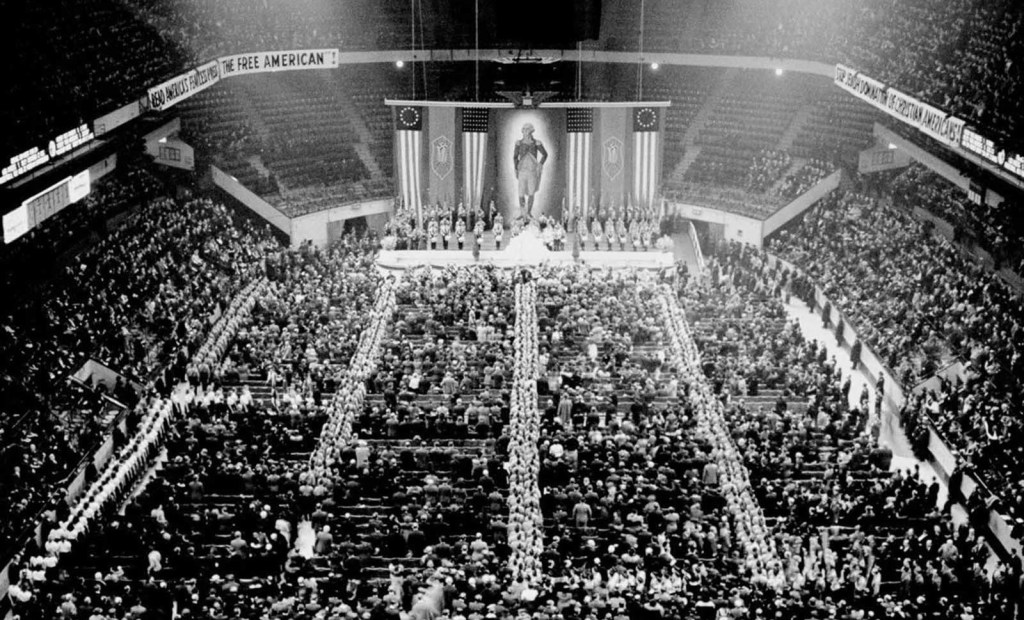
The Trump campaign’s recent rally at Madison Square Garden has sparked controversy, with some Democrats comparing it to the infamous 1939 pro-Nazi event held by the German American Bund. How relevant is this historical analogy, and what does the Bund’s brief and troubled history actually reveal about America’s openness to fascist ideology?
On Sunday, the Trump Campaign held a rally at Madison Square Garden in New York City, featuring speakers like former Democrats Tulsi Gabbard and Robert F. Kennedy, Jr., Elon Musk, and the candidate himself. As soon as the event was announced, Democrats went on the offensive, comparing it to an obscure event held at the same venue by the German American Bund, a pro-Nazi group, in the 1930s.
Hillary Clinton, whose husband Bill Clinton held his own campaign event there in 1992, went so far as to claim Trump was “actually reenacting the Madison Square Garden rally in 1939.” Which is a comparison akin to saying that, because Adolf Hitler was a vegetarian, anyone who enjoys broccoli must admire Hitler.
Unless you’ve studied interwar American history, you’ve probably never heard of the German American Bund or its 1939 rally in New York City. What was once a historical curiosity has been elevated to a significance it didn’t even have at the time, let alone 85 years later.
Given the recent interest in the subject, it’s worthwhile to learn what the Bund was and what, if any, impact it had. Like many countries during the interwar period of the early twentieth century, quasi-fascist or proto-fascist groups cropped up in the United States, mimicking their European counterparts. Even in the 1930s, however, fascism remained far outside the acceptable range of American politics.
The relative success of its 1939 Madison Square Garden rally belied the fact that the Bund was not popular among Americans and it was even repudiated by Hitler’s regime as harmful to German-American relations. Its leader, Fritz Kuhn, was ultimately arrested and imprisoned for tax evasion and embezzlement, stripped of his citizenship, and deported.
In the third decade of the twentieth century, as the Great Depression dragged on and the unemployment rate climbed above 20 percent, the United States faced a social and political crisis. Franklin Delano Roosevelt was swept to power in the election of 1932, forcing a political realignment that would put the Democratic Party in the majority for decades. In 1933, President Roosevelt proposed a “New Deal” that he claimed would cure the nation of its economic woes. His plan had many detractors, however, and at the fringes of mainstream politics, disaffected Americans increasingly looked elsewhere for inspiration.
But did European-style fascism have widespread appeal? Did it ever present a real threat to our liberal democratic institutions? In short, the answer is “no”. Groups like the Bund made a lot of noise but little else.
Of the several quasi-fascist or proto-fascist groups to crop up in the United States prior to World War 2, the German American Bund (not the “American Nazi Party”, which was an entirely different group in the 1960s) is the most well-known. The Ku Klux Klan of the 1920s, while a racist nativist group, shared little else in common with fascist ideology.
Fascism of the 1930s opposed representative government, advocated a revolutionary, authoritarian, nationalist state, merger of corporations and government, and was characterized by the presence of a charismatic leader and a militarized mass movement. Benito Mussolini’s National Fascist Party, Hitler’s National Socialist German Worker’s Party, Plínio Salgado’s movement in Brazil, the Revolutionary Union of Peru, and Oswald Mosley’s British Union of Fascists are all historical examples.
In the 1930s, the Nazi party’s pleas for money from American contributors like Henry Ford and the Ku Klux Klan fell on deaf ears. Teutonia, one of the first pro-Nazi groups in the United States, numbered less than one hundred members in 1932, and the typical members of those groups were, according to Leland V. Bell, author of In Hitler’s Shadow: the Anatomy of American Nazism (1973), “young, rootless German immigrants,” and “arrogant, resolute, fanatics.”
When a German immigrant named Heinz Spanknoebel formed the Friends of the New Germany in July 1933, the first American Nazi group officially-sanctioned by Hitler’s regime, a storm of public protest greeted them. Four months later, Spanknoebel fled arrest in the United States and returned to Germany. The Friends of the New Germany failed to attract significant support from German Americans, who by that time “were accepted, respected citizens and easily assimilated into American life,” Bell explained.
In 1936, Fritz Kuhn, a naturalized American citizen who had served in the German army during the First World War, became head of the organization. He renamed it the German American Bund to attract more American nationals. Most of the constituency of the Bund was made up of recent German immigrants, despite Adolf Hitler banning German citizens from becoming members of the organization. It was an urban lower-middle-class movement that, at its height, had less than 6,000 members.
The German government even requested that the Bund cease using National Socialist emblems in 1938, but most Americans still believed the organization was a foreign entity. “The Americans on its rolls were all of them recent immigrants” from Nazi Germany, historian Joachim Remak explained. “German-Americans had no use for the Bund… the president of the highly conservative Steuben Society called on the [German] embassy to say that his group felt compelled to issue a public repudiation of the Bund.”
Remak’s article “‘Friends of the New Germany’: The Bund and German-American Relations” (1957) chronicled the near-universal American condemnation of the Bund. Joachim Remak fled Germany for the United States in 1938, so he had firsthand knowledge of the rise of fascism, and was an expert on German-American relations during that period.
Remak argued that the German American Bund, rather than fostering pro-fascist sympathy in the United States, ended up harming relations with National Socialist Germany by demonstrating to Americans the ugly nature of European fascism. “Naziism, with its brutality and its suppression of basic liberties and decencies, could hold no greater appeal for the German-Americans than for the rest of the nation,” he argued. The real supporters of fascism in the United States were few and far between.
It is clear from Joachim Remak and Leland Bell’s analysis of the German American Bund that Americans were generally suspicious of overtly fascist groups along the European model. Even the ethnic Germans who had established themselves in the Midwest as farmers and craftsmen, who generally supported isolationism before both World Wars, were not sympathetic to the anti-Democratic, outspokenly pro-Hitler Bundists. By 1941, no public supporter of fascism survived long in the public eye.
Fascist groups in the 1930s relied on a certain cultural undercurrent for support, yet the American democratic tradition they opposed ultimately undermined that support. In the political climate of 1930s America, it was nearly impossible to be a genuine fascist and still gain backing from most Americans, who viewed fascism as a direct threat to their democratic institutions. The experiences of groups like the German American Bund demonstrate that fascism remained, at its core, a fundamentally foreign phenomenon in the United States.
Leland V. Bell, In Hitler’s Shadow: the Anatomy of American Nazism (Port Washington, NY: Kennikat Press, 1973).
Joachim Remak, “’Friends of the New Germany’: The Bund and German-American Relations,” The Journal of Modern History 29 (March 1957): 38-41.


 M.A. Kleen
What are your thoughts?