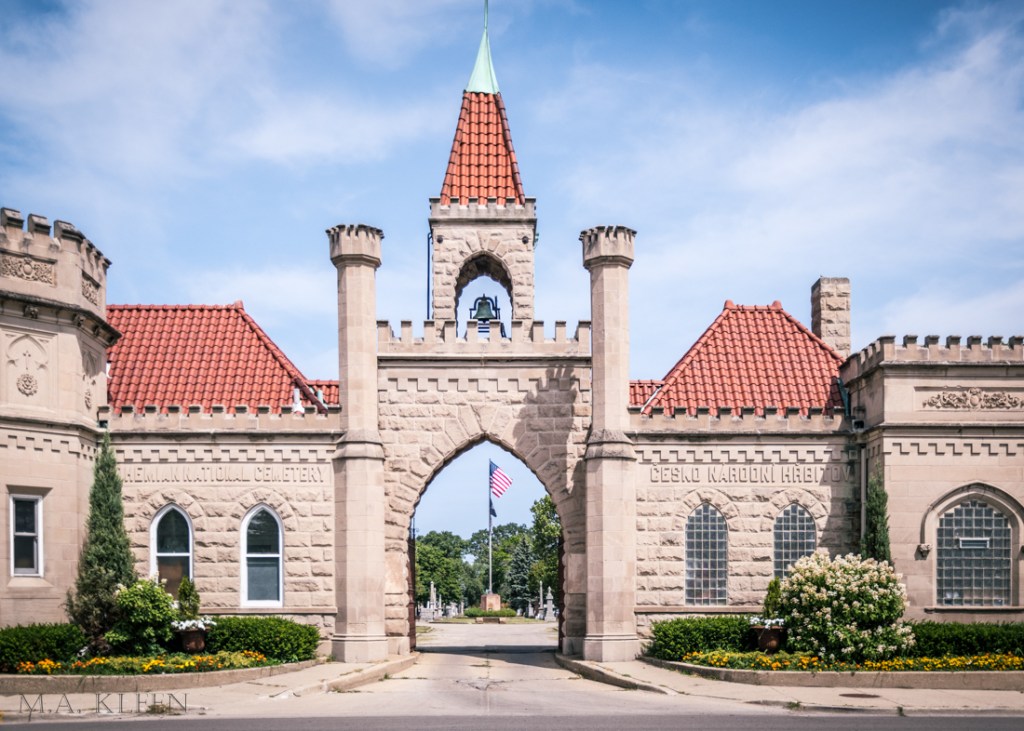
Bohemian National Cemetery, at 5255 N. Pulaski Road in Chicago, Illinois, was created in 1877 by Chicago’s ethnic Czech community, and has since expanded to 126 acres. Approximately 120,000 of the city’s former residents are buried here, including victims of the SS Eastland shipwreck. It was added to the National Register of Historic Places in 2006.

Erected in 1892, this bronze statue of a private in the Union Army holding an American flag is dedicated to the 18 Civil War veterans buried in Bohemian National Cemetery. It was designed by sculptor Joseph Klir and called the Bohemian Soldiers’ and Sailors’ Monument. Its inscription reads “Pro Novou Vlast”, or “for the new country”. Like many immigrant groups, Czechs fought on both sides, though primarily for the North.

This beautiful neoclassical granite statue of a cloaked woman is a tribute to Vincencie Kropacek (1863-1944) and her husband, Jan Kropacek (1860-1906). The woman stands next to a pedestal with a vase or urn. She appears to be holding reeds or palms in her right hand.

Designed by sculptor Theodora Ruggles Kitsen and dedicated in 1926, this bronze monument of an American soldier commemorates veterans of the Spanish-American War and Philippine Insurrection. Called “The Hiker,” he stands on a 25-ton red granite boulder from Wausau, Wisconsin. “The Hiker” was mass-produced, and there are dozens of identical statues across the United States. There are at least 45 Spanish-American War veterans interred at Bohemian National Cem.

On a hot July day in 1915, over 800 people lost their lives when an excursion steamer called the Eastland capsized on the Chicago River. Although the Eastland had recently passed inspection, it was too top heavy to handle the more than 2,700 passengers who crowded on board. Many passengers were trapped inside when the Eastland capsized; many more drowned. After the disaster, the Eastland was purchased by the US Navy and renamed the USS Wilmette. This memorial to the Eastland victims, many of whom are buried in Bohemian National Cemetery, was erected in 2015.

Monument to Joseph Jerry Jarolim (1901-1920), son of Anna and Anton Jarolim. The statue is a likeness of the young man, who wears a post-First World War U.S. Navy white dress uniform. It bears a striking resemblance to his photograph, attached to the monument’s base. Members of Chicago’s Czech community were proud of their military service, and many such statues can be found in this cemetery.


 M.A. Kleen
What are your thoughts?