The following story is the fourth and final installment in a limited series set in the Commonwealth wasteland world of Fallout 4. Read Part 1, Part 2, and Part 3.
Rook didn’t have time to be clever—she had time to be fast.
When she ventured into the Commonwealth’s Glowing Sea to save her settlement, she had no idea what she would find, or if she would ever come home. Her search led her to a mysterious map and an unlikely companion: a super mutant named Graft. He shared a strange connection with the map, recalling places and landmarks from a forgotten past.
A warbling song ushered them deep underground, where they discovered a secret pre-war facility called LANTERN. It appeared to have been a detention center, complete with a functioning farm and a system labeled “CLEANSPRING.” Before they could secure their discovery, Gunner mercenaries stormed the facility, triggering a long-dormant lockdown and containment protocol.
Above the door to the AGRICULTURAL SUPPORT UNIT, a red light blinked: LOCKDOWN ACTIVE. Rook stared at the door, its handle broken, then at the wall beside it. The wall was older concrete, poured thick, but not meant to stop someone like Graft.
“Do it,” she snapped.
Graft nodded once, stepped back, and drove his oversized shoulder into the concrete. The impact boomed down the corridor. Dust puffed out like breath. He hit it again, and cracks spiderwebbed.
A Gunner’s voice barked from behind them: “Flash—NOW!” A canister clattered on the tile and spit white light.
Rook turned her face away, eyes squeezed shut, and blindly fired her pipe pistol toward the sound, not sure if she would even hit anything.
Graft roared, more in anger than pain, and slammed the wall again.
This time it broke.
A jagged hole opened into a room beyond, and cold, nitrate rich air rolled out, clean enough to make Rook’s lungs ache with how different it was. Inside the cavernous space, amidst rows of hydroponics stations and raised beds bathed in dim emergency lighting, sat the CLEANSPRING unit.
It wasn’t beautiful.
It was a squat, modular system strapped to a pallet: a soil scrubbing tank the size of a refrigerator, a bundle of filter housings, two sealed cartridge canisters stamped with pre-war logos, and a small water-treatment unit with hoses coiled like sleeping snakes. A faded manual lay in a plastic bin labeled FIELD MAINTENANCE.
Rook’s heart lifted, then immediately dropped when she saw the floor. There were bones here too.
A skeleton lay curled beside the unit, arms around the manual bin like it had tried to protect it. Another lay near the hose reel, ribs cracked outward. The floor was stained dark in places where old blood had soaked into concrete and never fully left.
Rook swallowed. “They died trying to keep this running.”
“Or died trying to take it,” Graft growled, grabbing the unit’s strap harness.
Rook lunged for the manual bin and yanked it up. The back cover was plain, bureaucratic, but contained the following disclaimer in bold letters:
OUTPUT CAPACITY: LIMITED — SUPPORTS UP TO 30 PERSONS WITH PROPER MAINTENANCE.
Thirty. Not salvation, but a future.
The Gunners rounded the corner. Four of them in patched, dirty combat armor, each piece crudely stenciled with a faded white skull symbol. Their leader, a man with a scar running down his cheek, moved with a menacing calm.
He didn’t shoot immediately. He simply aimed, assessing the threat: one young woman and an unarmed super mutant. They hardly seemed worth the ammunition expenditure.
“Easy,” he called out. “Don’t make any sudden movements.”
“We got here first!” Rook protested.
The leader smiled like she’d told a joke. “That’s cute.”
His eyes flicked to Graft. “Big guy—step away from the filtration unit and keep those paws where I can see ’em. You’re a lot of trouble, and trouble’s expensive for me.”
Graft’s lips peeled back. “You are in wrong house.”
The Gunner leader’s smile tightened. “But it’s got valuable furniture.”
He nodded, and another Gunner lifted a rifle, sighting down at Rook’s hands, which still shakily clutched her kitbashed pistol.
Then, from behind the Gunners, SIR-7, the Mister Handy robot, drifted into view, bow tie bobbing.
“Unauthorized personnel are in violation of containment protocols.” Its voice brightened. “Please remain calm while corrective measures are applied.”
The Gunner leader didn’t even look at it. “Shut up, toaster.”
SIR-7’s saw arm whirred and a beam of light flashed—some kind of cutting torch, small but vicious.
It struck the Gunner on the left across the neck.
It was not a clean decapitation. The beam burned through armor plating, through flesh, through tendon. The Gunner screamed once, high and surprised, and then his head rolled, half-attached, steaming hot blood into the cold air. He fell, gurgling wetly, hands clawing at his throat in reflex.
Rook flinched.
The Gunner leader swore, finally losing his calm. “Kill that damn robot!”
They opened fire, and bullets sparked off tile and metal. SIR-7’s casing took hits, spun, and slammed into the wall, thrusters sputtering wildly. Its cheerful voice turned ragged with static, still trying to keep its tone polite:
“Please—remain—calm—”
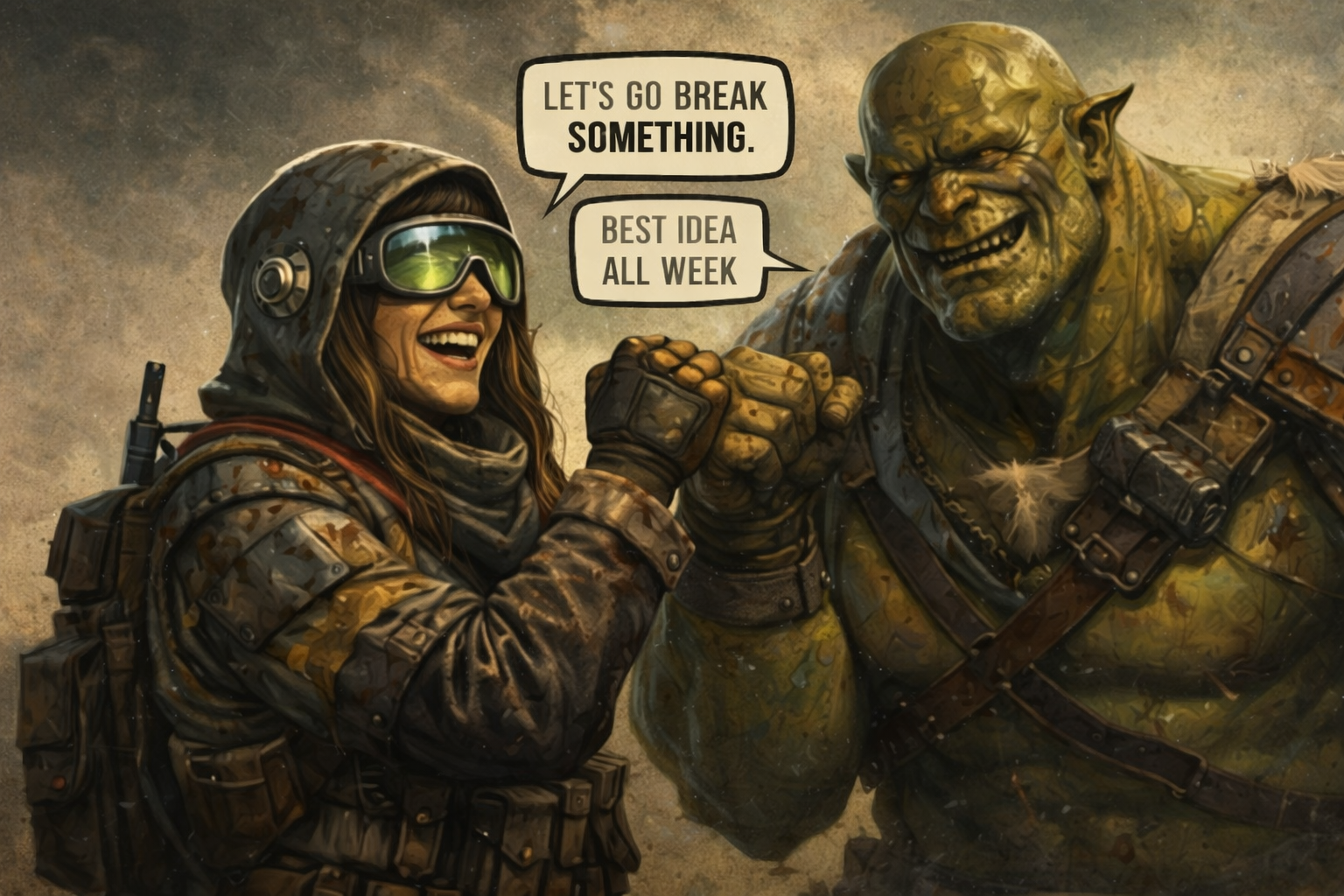
Graft moved. He didn’t charge like a beast, but fast and hard, like a bowling ball gliding toward the pins. He grabbed the nearest Gunner by the chest plate and lifted him one-handed. The man’s legs kicked, boots scraping air.
“GAH—” the Gunner choked.
Graft slammed him onto the floor hard enough to crack the armor. The man’s spine snapped with a sound like breaking wood, and he went limp.
The Gunner leader opened fire wildly.
Rook fired back. Her .38 wasn’t a hero’s caliber, but she was just trying to make space.
The two remaining Gunners ducked for cover, and Rook sprinted forward, shoving the CLEANSPRING manual bin into her bag with her free hand.
“Graft!” she shouted. “Modules!”
Graft had already grabbed the two sealed cartridge canisters under one arm and yanked the water-treatment unit free with his other hand, hoses whipping.
Rook stared at the soil scrubber tank. It was too big, too heavy. “We can’t take all of it,” she gasped.
Graft’s eyes flicked to the tank, then to her, and something like grim acceptance settled over his face.
“Take brain,” he rumbled, tapping the manual bin. “Take heart,” he said, hefting the cartridges. “Body… later.”
“There won’t be later.”
Graft looked past her, toward the facility’s deeper halls where the singing still warbled. “Maybe not,” he said. “But tomorrow, you live.”
The Gunner leader backed toward the corridor, bleeding from a shallow cut along his scalp where Rook’s bullet had grazed. His calm was gone now, replaced with cold calculation.
“You’re not leaving with that,” he said, voice flat. He tossed something toward them, a small device that clattered along the floor.
Rook’s eyes widened. “Grenade—!”
Graft didn’t hesitate. He shoved Rook back, then turned and hurled one of the dead Gunners’ bodies toward the beeping device.
The explosion was sharp, contained. The corpse took most of it, armor shredding, meat vaporizing in a wet mist that splattered the room like paint. It was ugly, sudden, and not remotely cinematic.
Graft staggered, shrapnel peppering his shoulder and neck. Dark blood ran down his arm, but he didn’t fall. He grabbed Rook’s sleeve and pushed her through the hole in the wall.
“Move!”
They ran.
The facility’s speaker system rose into full, cheerful hysteria. “Lockdown escalation. Assets must remain in place. Please—remain—calm—”
The singing resumed, louder, with a new layer: a child’s voice, prerecorded, reciting something like a pledge, warped into eerie nonsense by broken speakers.
Rook’s skin crawled.
They sprinted past murals and empty offices, past the intake room where skeletons sat in their patient circle. Behind them, the Gunner leader shouted orders, trying to round up the remainder of his men who had split off to explore the facility. He was still breathing, still hunting.
They reached the security door where Rook had first seen the sign. It was closing slowly, inexorably.
Rook’s eyes went wide. “No—!”
Graft shoved the modules through first, then Rook.
She stumbled out into the corridor beyond as the door kept sliding.
Graft was still inside.
For a heartbeat, Rook saw him framed by the narrowing gap: massive, bleeding, eyes bright with something fierce.
“Harlan!” she screamed, using his human name and grabbing the door edge with both hands. “Don’t you—”
Graft shoved the last canister through to her and shook his head once, then reached into his harness and pulled out the map, the liar’s map, and thrust it toward her. “Take,” he growled. “Fix it. Make true.”
Rook’s fingers closed around the map. “Come with me! You’ll die in there.”
Graft’s mouth twisted into an expression not quite a smile, not quite sorrow. “I can’t,” he said as the door narrowed. Graft’s gaze turned, toward the hallway where the Gunners’ silhouettes appeared, weapons raised. “Harlan died here,” he said. “I end it.”
Then he lifted his hand, palm out in a commanding gesture. “Go!”
The door sealed with a final, heavy THUNK.
Rook stumbled back, clutching the map and the cartridges. Her Geiger clicked in her ear like a nervous habit.
Inside, muffled by steel, she heard one last burst of gunfire, then a deeper sound, a grinding roar of collapsing machinery, like Graft was tearing the facility’s guts out by hand.
The singing cut off mid-note. Silence returned, heavy as the radioactive ash that blanketed the Glowing Sea.
Rook stood there for a long second, shaking. Then she did what the wasteland demanded.
She turned and ran.
* * *
The trip back wasn’t heroic. It was a slog through poison with a prize that felt heavier with every mile. She used RadAway when her vision began to blur at the edges. She rationed water until her throat was raw and lips cracked. She slept in shallow bursts, pipe pistol at the ready, waking at every slap of wind.
Twice she thought she saw movement behind her. Once she found boot prints that weren’t hers. Either the Gunners had someone else out here, or the Sea was playing tricks. She didn’t stop long enough to find out.
When she finally reached the settlement of Juniper Ridge, the guards almost shot her on sight. She must’ve looked like a ghost: ash-caked, eyes bloodshot, legs trembling under the weight of her backpack.
The settlement was a handful of shacks perched on the edge of livable land, buildings pieced together from whatever they could scavenge, and a few workbenches and trading stalls. Mamaw Della was waiting, wrapped in blankets, her cheeks hollow.
Rook held up CLEANSPRING like an offering.
Della stared. “What is that?”
“Hope,” Rook replied, voice cracking.
They installed CLEANSPRING in the old pump shed over three days, bolting the filter housings to a scavenged frame, rigged hoses with tape and prayer, wired the water-treatment unit to a jury-rigged generator that complained like an old man.
The first time clean water ran into a bucket, the whole settlement stood around it like a religious event. One of the children dipped a finger, tasted, and grinned wide enough to split his dirty face.
People laughed with relief. Someone cried. Someone clapped Rook on the shoulder hard enough to bruise. But she didn’t smile. Not yet.
That night, after the celebration dulled into exhausted sleep, Rook sat alone on the ridge with the map spread out on her lap.
She took a pen and traced the route again. At the “broken tooth,” she added a note in her own hand: TRUST THE LANDMARKS. At the end, near LANTERN, she wrote: SEALED. DO NOT OPEN. She double underlined the last remark.
The wind off the Glowing Sea was quiet tonight. The sky was clear enough to see a few stubborn stars. Rook folded the map carefully and tucked it away. Somewhere out in the ash, she imagined a heavy door, sealed and silent, and a super mutant with blood on his hands making sure it stayed that way. She didn’t know if Graft had lived, but Juniper Ridge drank clean water now.
It wasn’t salvation. It was enough.
Download all 4 parts of ‘Custodial Measures’ in Special Edition PDF…

 M.A. Kleen
What are your thoughts?