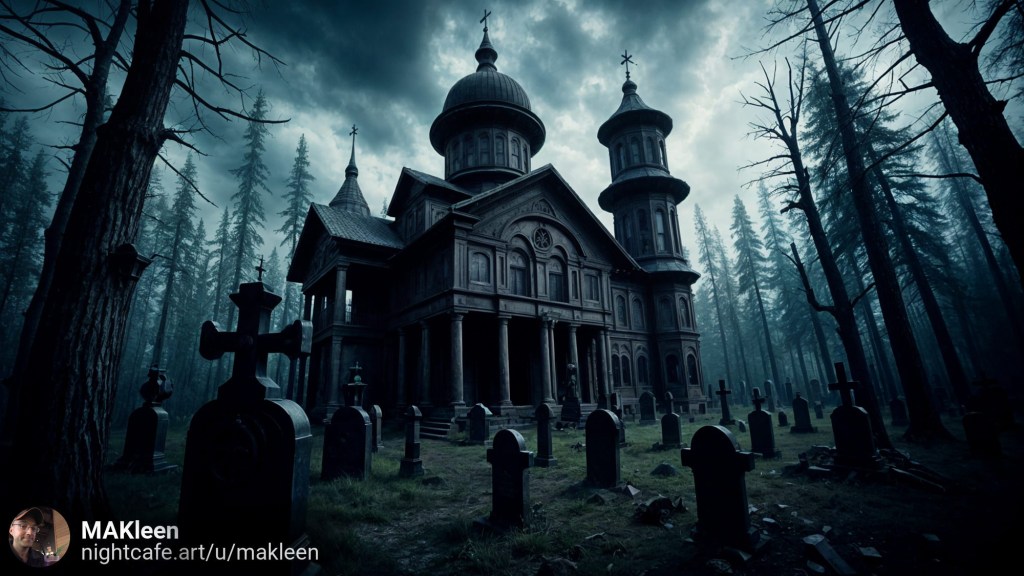
In the frozen isolation of a Siberian monastery, a cursed bell begins to toll without a hand to ring it, summoning the restless dead from their graves. As the snowbound night deepens, a young novice must choose between defiling a holy relic or letting the risen corpses breach the walls.
Please enjoy this horror short, part of a series experimenting with artificial intelligence. I fed a location, plot, characters, scenario, and mood into ChatGPT 5 and asked it to outline and craft a story, then used Stable Diffusion XL to create an illustration. How did it turn out? Well, you be the judge.
Winter had pressed its white palm over the monastery, smothering sound. The wooden cells hunched beneath drifts, their roofs bowed like monks at prayer; frost stitched lace along the windowpanes, and the onion domes wore caps of dull blue ice. Beyond the palisade, the taiga stood motionless, black trunks and wolf-shadow, as if the forest itself had paused to listen.
Father Andrei felt the listening, too. Newly arrived, he kept the rules, he said his prayers, but the silence threaded his thoughts and tightened them into knots. In the refectory, his breath made ghosts above his bowl. In the corridor, boards complained beneath his sandals with long, aching sighs. He tried to take comfort in routine, in the embroidery of ritual and smoke, but his hands shook lighting the candles.
Brother Mikhail moved like a slow bell, all habit and hinge. His fingers were thick with old frostbite, his beard stiff with hoarfrost. He tended the great bell as if it were a temperamental animal, feeding it oil, stroking its rope. “It remembers,” he once murmured to Andrei, eyes on the tower where wind moaned like a low psalm. “It was not born here.”
The storm arrived like a slow-breathing beast, shouldering against the walls until the timbers groaned. Father Andrei woke to a resonance he felt in his bones before he recognized the sound: one deep toll, round as a cavern, rolling through the rafters. Another followed—measured, ceremonial, impossible. No feast. No vigil. Midnight’s spine had already been crossed.
He drew on his coat and took his lantern. The corridor’s drafts plucked at the flame. Outside, snow came sideways, a glittering procession. Brother Mikhail stood at the base of the tower, face upturned, lips moving. The rope hung swaying, not from any hand but from some unwitnessed breath.
“Andrei,” Mikhail said without looking down, voice scraped thin. “Do not ask who calls. When it tolls without a hand, the earth will answer.”
A third strike went out into the white, and the monastery listened back.
Beyond the palisade, the graveyard sloped away, a scatter of tilted crosses and low mounds under frozen quilts. Lantern light braided with snow, and in that unsteady weave Andrei saw the drifts lift and settle—lift, settle—as if the ground were trying to remember how to breathe.
Faint, irregular tapping rose like beetles inside a wall. Then a crack: the sound of ice surrendering. A hand of yellow bone pressed up through crusted snow and groped the air with blind, slow patience.
“Inside,” Brother Mikhail said, steady, ushering him across the yard. “Bolt the doors. Bar the shutters.” The wind carried whispers in Church Slavonic, old as incense, sifting through the gate’s iron teeth. The syllables knew his name. A latch rattled; something tried its first steps in years. Andrei’s breath smoked prayers that did not warm his mouth.
By the fire’s reluctant tongue, Mikhail told the bell’s history. It came from a monastery far to the north that had been besieged without banners, so the story went. Its bronze was adulterated, icons scraped of silver leaf and melted, rings traded from the mouths of the dead for bread, all alloyed into one obedient throat.
“In that siege,” Mikhail said, “they rang it to waken their fathers. The dead rose and drove the enemy from the walls. But the fathers did not forgive being called.” He crossed himself. “Since then it tolls when it remembers us. Some say it is sanctified. Others say it is baptized in blasphemy. Either way, it hears.”
Destroying it was forbidden; it bore a saint’s name on its lip. Yet Mikhail’s eyes, reflecting embers, held a tired plea: the ringing had grown more frequent, as if impatience gathered like snow on a ledge.
The next night it tolled three times, each note heavier, edges roughened by frost. The walls replied in shudders. Frost clotted on the inside of the windows, curling fernwork across the panes. From beyond the gate came a sound like wet rope dragged over stone.
“They are nearer,” Mikhail whispered. He leaned against the door and coughed until red flecks marked his sleeve. Through a crack, Andrei glimpsed shapes like damp coats leaning on the palisade. Fingers, too many, too pale, felt along the wood, searching seams. Voices threaded through the storm, patient as monks intoning the hours. They called his name with terrible courtesy.
“Dawn will drive them back,” Mikhail said, but his voice had lost weight. He pressed a wooden cross into Andrei’s palm, his old fingers cold as ice. “Until dawn, we wait.” The bell’s rope stirred like a sleeper turning over.
By day, Brother Mikhail’s breath shortened and broke like a weak line in wind. He took to his bed in the chapel, the icons watching with flat, merciful eyes. “Stand watch until the end,” he told Andrei, and kissed the cross once before sleep took him.
Night rose, blue and bitter. The bell began again, no longer the spaced call of ceremony, but a laboring pulse, swollen and irregular. Each swing shook dust from beams. Snow sheeted from the roof. Andrei climbed to the clerestory and looked out. The graveyard was empty.
They were all gathered at the walls.
Faces blue as old bruises, eyes glazed like ice on a river, mouths slightly open as if to taste the ringing. They did not wail; they listened. The gate timbers creaked, small joints popping like knuckles. Andrei understood the choice as if it had been waiting in him for years.
He took the tower steps. They bent under him, complaining in old wood. The ringing thickened the air; it pressed on his chest like a slow hand. Inside the belfry, warm, damp air rose from the bell as from an animal’s flank. The metal’s skin gleamed slick, black-streaked, and it swung of its own accord, hitching as if remembering a limp.
Hands beat on the tower door below, polite at first, then in earnest. The rope swayed in its pulley like something breathing. Whispers crept through the slats, multiplying, offering bargains: absolution, knowledge, reunion with a mother he barely remembered, a garden without winter. The hammer lay in a corner where Mikhail kept it for tightening bolts. It was heavier than it looked.
“Forgive me,” Andrei said, to whom, he did not decide. He lifted the hammer. The first blow rang like daylight breaking ice. The bell stuttered. He struck again, and a crack opened like an eye down its belly.
Silence dropped, sudden and complete. The tower shivered as if relieved. Outside, the gathered dead folded as one into the snow, their coats and hair becoming drifts and tumbled shadows. The gate ceased its slow complaint.
Andrei staggered down. The air smelled of hot metal and something rank, like a cellar opened after a long absence. In the chapel, Mikhail lay with mouth slightly parted, as if about to argue, but peace had smoothed his brow.
He went to the door and listened for the wind. None. The world had been emptied of sound, except for a single thread of ringing within his skull—thin, constant, receding only when he whispered prayers. Beneath his feet the stone thrummed, answering some deeper bell below earth. He knelt and pressed his palms to the floorboards, and the monastery, patient as bedrock, listened back.

 M.A. Kleen
What are your thoughts?