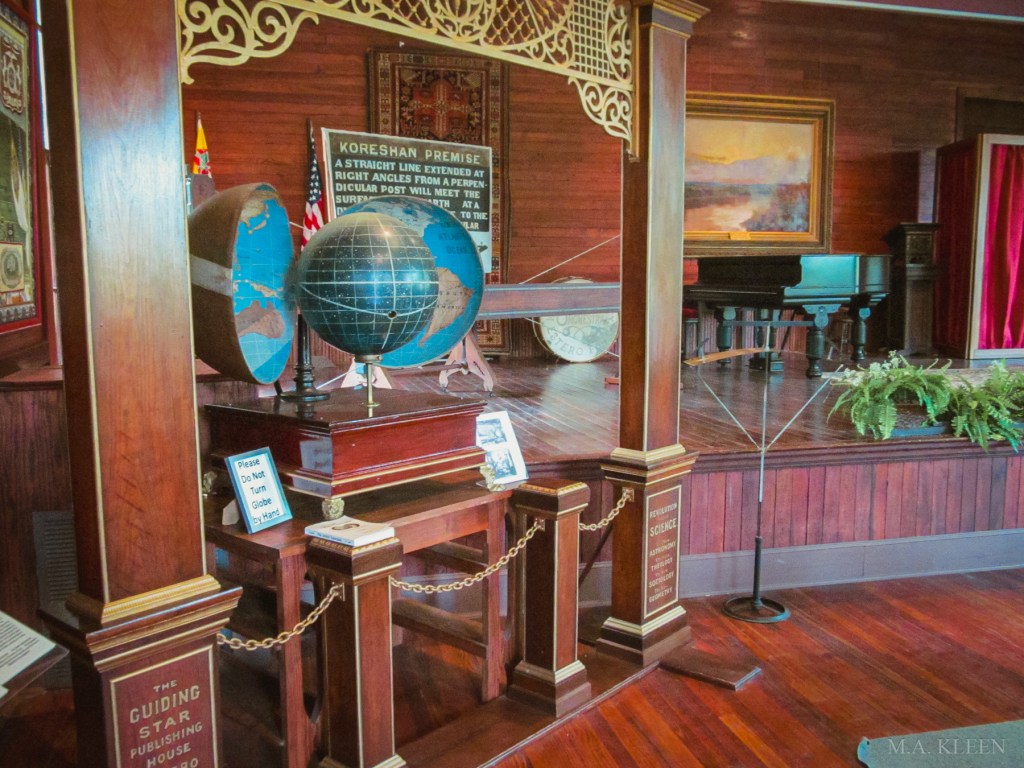
Step into the forgotten worlds of two utopian experiments—one grounded in a mystical hollow Earth theory, the other in radical communal marriage—as we explore the rise, fall, and enduring legacies of the Koreshan Unity and the Oneida Community. Their stories are as fascinating as they are strange, and their preserved sites offer a glimpse into dreams that dared to defy the ordinary.
America’s landscape is dotted with the remnants of ambitious utopian dreams, communities forged in the crucible of idealism, spiritual fervor, and sometimes, audacious innovation. Among these, two stand out for their unique ideologies, their dramatic stories of rise and fall, and their lasting legacies preserved as historic sites: the Koreshan Unity in Estero, Florida, and the Oneida Community in Oneida, New York. Though their philosophies and practices differ widely, both reflect humanity’s timeless desire to create paradise on Earth.
The Vision of the Koreshan Unity
Nestled in Florida’s pine flatwoods, the Koreshan Unity sought to build nothing less than a “New Jerusalem” on the Gulf Coast. This community, established by Dr. Cyrus Teed, grew out of his bold belief in a hollow Earth theory he called Cellular Cosmogony, which posited that the universe exists within a concave sphere. Teed’s vision extended beyond the scientific, intertwining gender equality, communal living, and spiritual enlightenment.
Teed, born in 1839 in New York, was a charismatic figure whose journey from small-town doctor to spiritual leader took a dramatic turn when he was electrocuted during an experiment. Claiming a divine revelation, he rechristened himself “Koresh” and began gathering followers. After facing hostility in Chicago, Teed and his group relocated to Estero, Florida, in 1894. The Koreshans thrived briefly, constructing residences, gardens, a bakery, and a cultural hub they called the Art Hall.
However, their dreams began to unravel after Teed’s death in 1908. His prophecy of resurrection went unfulfilled, eroding his followers’ faith. By the time the last Koreshan died in 1981, their ranks had dwindled to none. Today, the Koreshan State Historic Site preserves their once-thriving community, offering visitors a glimpse into this enigmatic chapter of Florida history. The grounds, meticulously maintained by the state, house historic buildings and echo with the stories of those who dared to envision a utopia.
Oneida Community: A Quest for Perfection

In stark contrast to the esoteric beliefs of the Koreshans, the Oneida Community in New York was grounded in a radical interpretation of Christianity. Its founder, John Humphrey Noyes, envisioned a society free from sin through what he called Christian perfectionism. Noyes’s ideas were as daring as his methods. Declaring himself sinless in 1834, he faced expulsion from Yale University and began attracting like-minded individuals.
By 1848, Noyes and his followers had relocated to Oneida, where they established a commune that embodied their belief in “Bible Communism.” This system rejected private property and introduced the controversial practice of complex marriage, in which all adult members were married to one another. Responsibilities for childcare and other communal tasks were shared.
The Oneida Community’s communal lifestyle endured for over three decades but eventually succumbed to internal tensions and external pressures. In 1881, the commune dissolved, but its legacy found an unexpected continuation: members formed Oneida Limited, a silverware company that still operates today. The original Mansion House, where the community once lived, is now a museum that offers visitors a fascinating window into 19th-century utopian life.
Shared Ideals, Divergent Paths
Despite their stark differences in belief systems—hollow Earth theories versus Christian perfectionism—the Koreshan Unity and the Oneida Community shared core ideals of communal living and social experimentation. Both sought to challenge societal norms, embracing equality and cooperation in ways that were revolutionary for their time.
Both communities aimed to redefine traditional gender roles. The Koreshans emphasized gender equality, even placing women on the governing council in their Planetary Chamber. Similarly, the Oneida Community encouraged shared responsibilities, including childcare, challenging the rigid patriarchy of the era.
At their core, these groups embraced the idea that communal living could foster a more harmonious society. By sharing resources, labor, and, in the case of Oneida, even personal relationships, they sought to transcend the limitations of individualism and create interconnected communities.
Legacy and Preservation
The ultimate fate of these communities—decline and dissolution—reflects the difficulty of sustaining utopian ideals in a practical world. Yet, their preservation as historic sites ensures their stories continue to inspire and educate.

The Koreshan State Historic Site in Estero, Florida, is a beautifully maintained park that allows visitors to wander the gardens, tour the historic buildings, and explore the Koreshans’ remarkable yet short-lived experiment. The site serves as a poignant reminder of their aspirations, quirks, and challenges. For history buffs and nature lovers alike, it’s a fascinating stop along Florida’s Gulf Coast.
The Oneida Community Mansion House in New York offers an equally compelling experience. With guided and self-guided tours, visitors can explore the 19th-century furnishings, learn about the ideology of Bible Communism, and marvel at the Curio Room, a collection of artifacts from around the world. The museum’s careful curation brings the Oneida story to life, offering insights into the complexities and contradictions of their utopian vision.
The stories of the Koreshan Unity and the Oneida Community highlight humanity’s enduring desire to create a better world. They remind us that while perfection may be elusive, the pursuit of it often leads to profound innovation and introspection. Walking through their preserved sites today, it’s hard not to feel a connection to these bold pioneers, who dared to envision something radically different.
Whether you’re drawn to the mysticism of the Koreshans or the pragmatism of the Oneida Community, these historic sites invite us to reflect on the beauty and fragility of dreams—and the enduring impact of those who dare to dream big.

 M.A. Kleen
What are your thoughts?