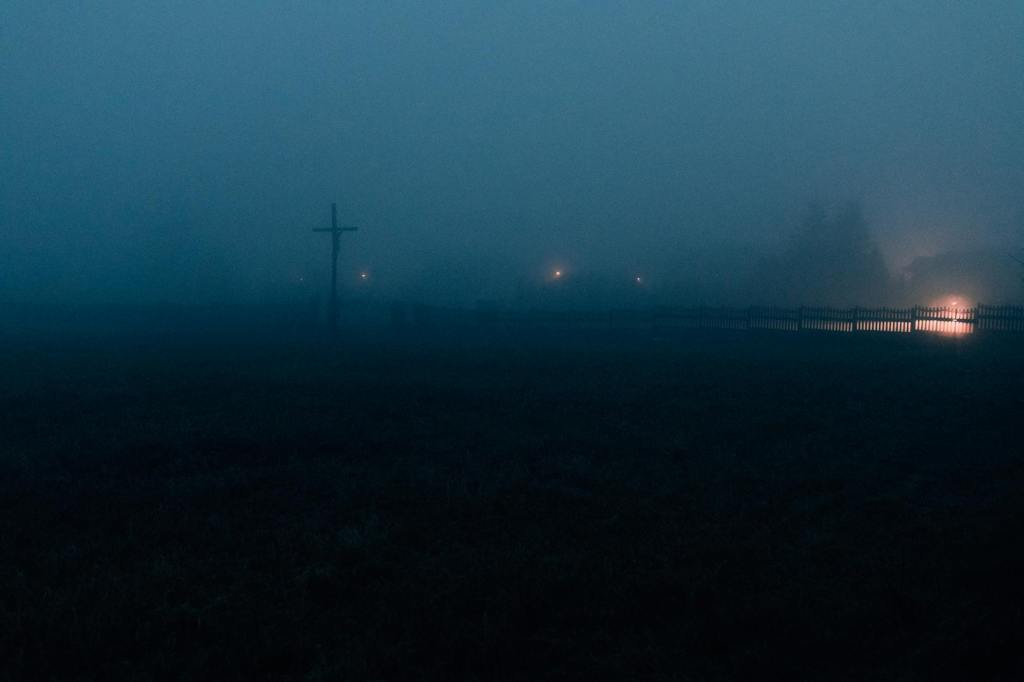
Missouri is full of places where the stories cling like river fog and refuse to burn off. From a hotel room with a death on the record to backwoods crossings that still echo with tragedy, these are the spots locals whisper about and brave visitors go looking for. Consider this your map to the Show-Me State’s most uneasy corners.
Bone Hill Cemetery – Levasy
Also known as Ebenezer Church Cemetery and Levasy Cemetery, “Bone Hill” takes its name from an old American Indian hunting method used to bring down buffalo. A tribe would find a sheer cliff or steep drop-off, then spook a herd into a stampede. Many animals plunged to their deaths and could be harvested with relative ease. One such “buffalo jump” was said to be near this cemetery, where early pioneers later found a large pile of buffalo bones.
According to legend, a pioneer family supposedly buried a cache of gold somewhere near a stone fence on the cemetery grounds. They intended to return in seven years—but never did. Ever since, visitors have reported a blue light hovering over the stone wall, said to be the family’s spirits still standing watch over what they left behind.
Landers Theatre – Springfield
Built in 1909, the Landers Theatre is a handsome, four-story brick landmark on East Walnut Street in Springfield, Missouri. Listed on the National Register of Historic Places, it has remained in operation since it first opened its doors. Like many old theaters, it carries a reputation for being haunted. On December 17, 1920, a fire broke out and nearly burned the place to the ground. A janitor died in the blaze, and his ghost is said to linger in the balcony. Another grim tale involves an infant accidentally dropped from the balcony—witnesses claim they’ve heard a baby crying, or even the sickening “thud” of the fall playing out again. Over the years, people have reported a “green orb” and an inky black vortex in different parts of the theater, and passersby have sometimes glimpsed a blonde woman in Elizabethan costume framed in a fourth-floor window.
Satan’s Tunnel – Hawk Point
Ghostly figures are said to haunt the dark recesses of this old underpass—or so many locals believe. The railroad tracks that once crossed over the tunnel are long gone, and the old rail bed has been swallowed back up by nature. The entrance is slick with moss and scrawled over with graffiti.
According to one legend, back when trains still ran here, a man walking the tracks was struck and plunged to his death. Another claims a man was lynched from a tree near the entrance. A third tells of a hobo who made the tunnel his home and was later found dead, a look of terror frozen on his face. The ghosts of all three unfortunate men are believed to linger beneath the roadway. And as if that weren’t enough, locals say the place has drawn Devil worshipers who come to perform rituals in the shadows. Any one of these stories is reason to steer clear; taken together, they make Satan’s Tunnel a genuinely unsettling place to visit.
Black Tram Bridge – Blackwell
Formerly spanning the Big River along Upper Blackwell Road, the area around this bridge has long been described as “ominous” and “creepy.” Visitors say it gives off an evil vibe that seemed to suit the old, creaky steel bridge known as the “Black Tram.” Legend claims a judge named Blackwell once used the bridge as a gallows, hanging people from its frame.
If you can find the spot at all—locals like to say the road signs appear and disappear—you might be chased off by a ghost car. Park on the bridge and flash your headlights three times, and the ghost car is supposed to show itself. Others report seeing a young couple walking down the road; they vanish as you draw near and are said to have died in an accident in the 1950s. The area is also rumored to attract Satanists, drawn by all that “negative energy.” In recent years, the original steel suspension bridge was torn down and replaced with a concrete one.
Northwest Missouri State University – Maryville
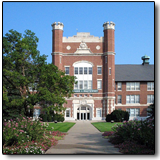
Northwest Missouri State University was founded in 1905 as a teachers college, originally known as the Fifth District Normal School. Its Administration Building has weathered more than its share of calamity: a tornado struck it in 1919, and a fire in 1979 destroyed much of the west wing, central wing, and auditorium. But it was a different accident that gave rise to the school’s most enduring legend.
On April 28, 1951, a gas tank exploded outside Roberta Hall (then, unimaginatively, called Residence Hall). The fireball blew out windows and injured several students. Roberta Steel suffered third-degree burns over most of her body and lingered for months before dying. According to A. S. Mott in Haunted Schools: Ghost Stories & Strange Tales, students later began hearing sad piano music drifting from an empty room in the basement. Roberta has also been said to manifest in more visible ways, appearing as a shadow, or as a figure in a window, and in one account, she even disturbed two coeds as they slept. Roberta Hall now bears her name in her honor.
Savoy Hotel and Grill – Kansas City
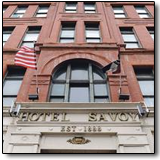
Built in 1888 by the owners of the Arbuckle Coffee Company, the Savoy Hotel is said to be the oldest continuously operating hotel west of the Mississippi River in the United States. Its restaurant, the Savoy Grill, is Kansas City’s oldest. Inside, the Grill still shows off stained-glass windows, old lanterns, and a massive carved oak bar. The Savoy has hosted plenty of famous guests over the years—but some of its more ethereal visitors are less welcome.
Legend holds that in the 1800s, a woman named Betsy Ward stayed in Room 505. One day she was found dead in the bathtub. Some say it was suicide; others insist it was murder. Either way, her spirit is blamed for the strange occurrences that still center on that room. Another ghost, a man named Fred Lightner, is said to haunt a different room, and guests have reported seeing a young girl in a Victorian dress wandering the fourth floor.
Devil’s Promenade – Near Joplin
Since the 1860s, an old road near the Oklahoma border has been the setting for one of America’s most famous spook lights. The Hornet Spook Light appears in an area known as the Devil’s Promenade. It comes rushing down the road, bobbing and weaving, and is often described as bright, hot, and about the size of a basketball. In the 1950s, one reporter who saw it called it a diffused orange glow.
Hundreds of people have reported witnessing the light. It has been photographed and even studied by scientists, yet no one has been able to pin down exactly what it is. Legend supplies its own answers. Some say it’s the lantern of an old miner whose children were kidnapped by Indians in the early 1800s. He went searching into the Devil’s Promenade and never came back. Others claim it’s the spirit of an Osage chief. The Hornet Spook Light became so well known that a small museum was once dedicated to it.
Zombie Road – Wildwood
Once called Old Fawler Road, this claustrophobic strip of pavement, now known as the Al Foster Trail (and, in some places, the Rock Hollow Trail), follows the Meramec River but has been closed to vehicle traffic for years. Over time it has built quite a reputation, one that’s traveled well beyond the St. Louis area. Most of the stories cluster around an old railroad crossing at the trail’s western end.
According to one legend, laborers who died while building the railroad rise from their graves at night—hence the name, Zombie Road. Others claim it comes from an inmate nicknamed “Zombie” who escaped a mental institution and was later found dead on the road. In the 1970s, two teenagers were struck and killed by a train near the crossing, and people also point to suicides and murders that allegedly occurred here. Strange lights, unexplained sounds, and unsettling sightings have convinced many that Zombie Road is thrilling to visit—but a bad place to linger.
Pythian Castle – Springfield
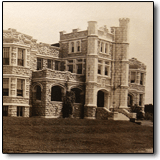
In 1913, the Knights of Pythias, an American fraternal organization and secret society, built this imposing structure from Carthage stone quarried in the Ozarks. Originally called the Pythian Home of Missouri, it served as an orphanage and retirement home for the children and widows of members. Legend has it that children staying here were forced to crawl through a steam tunnel to deliver laundry to an adjacent building.
During World War II, the U.S. government commandeered the castle as a recovery home for wounded soldiers. Some of those soldiers later reported hearing screams and seeing the ghosts of children. One veteran even claimed he heard a conversation on the second floor—despite being completely alone. In recent years, a private owner purchased the Pythian Castle and opened it for tours. Since then, it has been featured on TV shows such as Ghost Lab and Haunted Collector, as well as the documentary Children of the Grave.
Lemp Mansion – St. Louis
This historic mansion in St. Louis’s Benton Park neighborhood was once home to the Lemp family, who made their fortune brewing beer before Prohibition. The house was built in 1868, and in 1876 William J. Lemp and his wife, Julia, purchased the property. It remained in the family until 1949, when Charles Lemp—William’s son—took his own life. In all, three members of the Lemp family committed suicide in the house, fueling rumors that their tormented spirits still roam its halls.
In 1980, Life magazine named the Lemp Mansion one of America’s nine most haunted houses. For years, another story has clung to the place as stubbornly as the family name: that William J. Lemp, Jr. fathered a child with a mistress and kept the boy hidden away in the attic. Supposedly deformed, he’s remembered in local lore as the “Monkey Face Boy.” Later tenants reported a grab bag of disturbances—apparitions, disembodied voices, objects that seemed to move on their own, and that unmistakable feeling of being watched. Today, the mansion operates as a restaurant and inn.
Donate
Enjoy what you read? Please consider making a one-time donation to support my research.
Enjoy what you read? Please consider making a monthly donation to support my research.
Enjoy what you read? Please consider making a yearly donation to support my research.
Choose an amount
Or enter a custom amount
Your contribution is appreciated.
Your contribution is appreciated.
Your contribution is appreciated.
DonateDonate monthlyDonate yearlySources
Livingston-Martin, Lisa. Haunted Joplin. Charleston: Haunted America, 2012.
Mott, A. S. Haunted Schools: Ghost Stories & Strange Tales. Edmonton: Ghost House Books, 2003.
Ogden, Tom. Haunted Colleges and Universities: Creepy Campuses, Scary Scholars, and Deadly Dorms. Guilford: Globe Pequot Press, 2014.
Scott, Beth and Michael Norman. Haunted Heartland: True Ghost Stories from the American Midwest. New York: Barnes & Noble Books, 1985.
Southall, Richard. Haunted Route 66: Ghosts of America’s Legendary Highway. Woodbury: Llewellyn Worldwide, 2013.
Straight, James. Weird Missouri: Your Travel Guide to Missouri’s Local Legends and Best Kept Secrets. New York: Sterling, 2008.


 M.A. Kleen
What are your thoughts?