I’ve logged over 3,100 hours in Hearts of Iron IV, the World War II grand strategy game, and have been a fan of the series since the original launched in 2002. Over the years, I’ve gained extensive experience defeating the game’s AI. With hundreds of modifiers and overlapping mechanics, Hearts of Iron IV can be overwhelming even for veteran players. To simplify ground combat, I developed the “S.T.A.L.I.” method: a five-pillar framework that helps me focus on what really matters. When applied properly, it all but guarantees success against the A.I. (at least in the current version of the game).
S.T.A.L.I.
The 5 Pillars of Victory in Hearts of Iron IV
- S — Stats (Division templates, generals, soft/hard attack, etc.)
- T — Terrain (Combat width; Using hills, rivers, forests to your advantage)
- A — Air Support (Fighter superiority, CAS, tactical bombing)
- L — Logistics / Supply (Fuel, infrastructure, trucks, supply hubs)
- I — Intelligence (Spy agency, recon, decryption bonuses)
Stats
Decipher the data, dominate the battlefield.
Unit statistics, such as soft attack, hard attack, defense, and organization, form the foundation of ground combat in Hearts of Iron IV. Even with every other advantage, a poorly designed division with low organization will almost always lose. When it comes to defeating the AI, the most important stats to focus on are soft attack and organization.
Without getting too far into the weeds, soft attack targets enemy infantry and lightly equipped units, while hard attack is used against armored and heavily mechanized divisions. Most divisions (especially those produced by the AI) have more soft than hard targets, so maximizing soft attack is usually more effective.
Organization represents a unit’s ability to stay in the fight. Once it drops to zero, the unit is forced to retreat regardless of its strength. High organization allows divisions to sustain combat longer, making it one of the most critical stats. A best practice is to make sure your division’s organization is at or above 30.
In HOI4, divisions are typically organized into armies led by generals, and multiple armies can be grouped into army groups commanded by field marshals. Both generals and field marshals have an overall skill level, along with four specialized attributes (Attack, Defense, Logistics, and Planning) that provide bonuses based on their ratings. They also possess traits that apply various modifiers depending on the terrain or the types of units under their command.
Using generals with high skill levels is an obvious advantage, but it’s equally important to match their traits to the types of units they command. For example, assigning a general with the Infantry Officer trait to an armored division wastes that general’s strengths. While they may eventually develop the Panzer Leader trait through experience, it’s more effective to assign generals who already have that trait (or the Armor Officer trait) to lead armored divisions from the start.
The planning bonus is one more statistic you need to pay attention to. The planning bonus is a temporary attack multiplier that builds up while divisions are on an offensive front and remain idle or assigned to a battle plan. Once you attack or manually move the divisions, the bonus begins to decay, faster if you micro‑manage them, which means you need to time your assault to make full use of the boosted stats. It can mean the difference between victory and defeat.
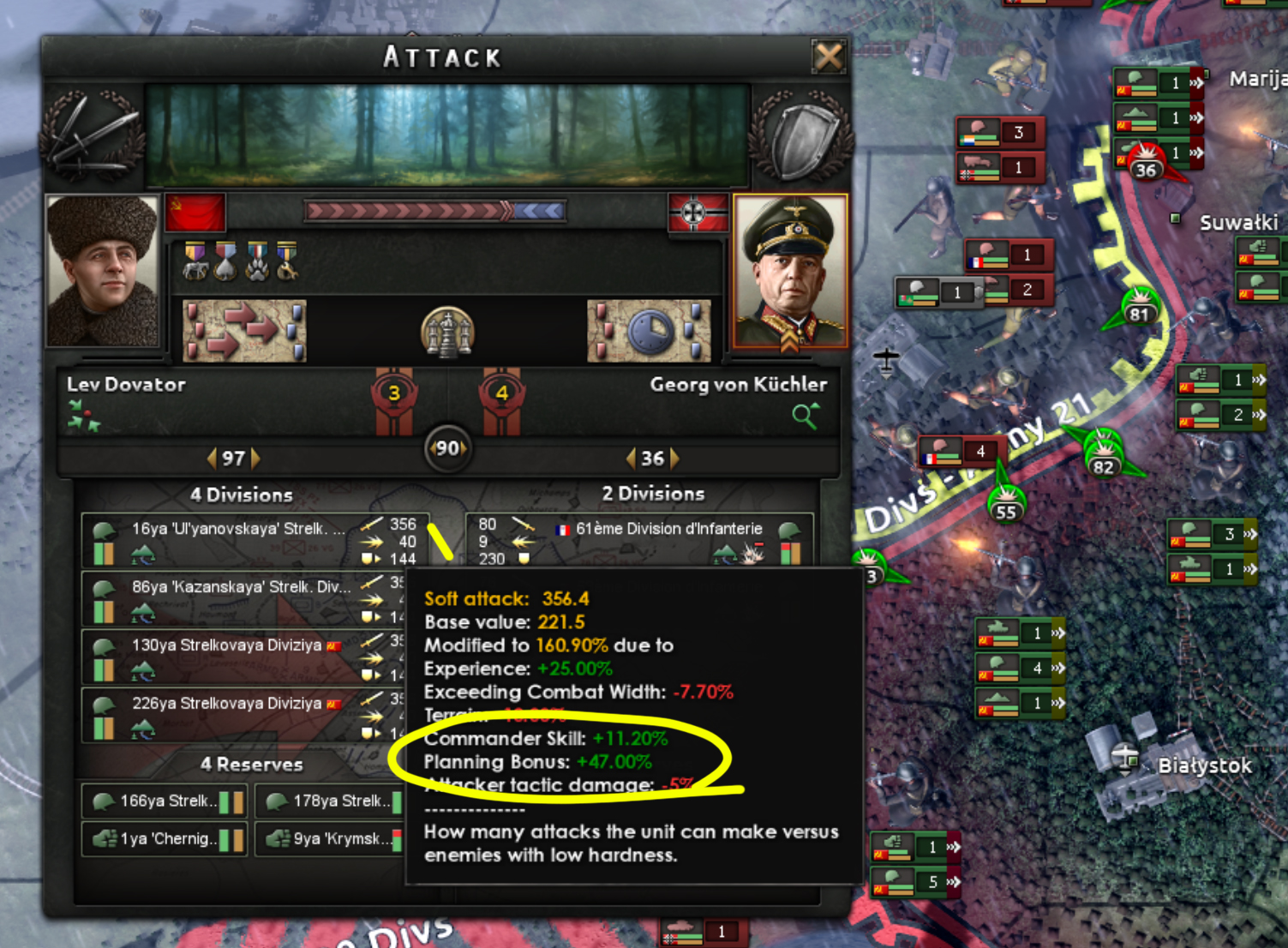
In short, ensuring your divisions have high soft attack and organization, and are led by skilled generals using offensive lines to build a planning bonus, will go a long way toward securing victory against the AI.
Terrain
Choose ground that favors you, not the enemy.
Unsurprisingly, terrain plays a prominent role in ground combat in HOI4. There are eight relevant terrain types in the game: Plains, Desert, Hills, Mountain, Forest, Jungle, Marsh, and Urban. Rivers also have terrain modifiers when moving and battling between tiles. Each terrain type has a Combat Width.
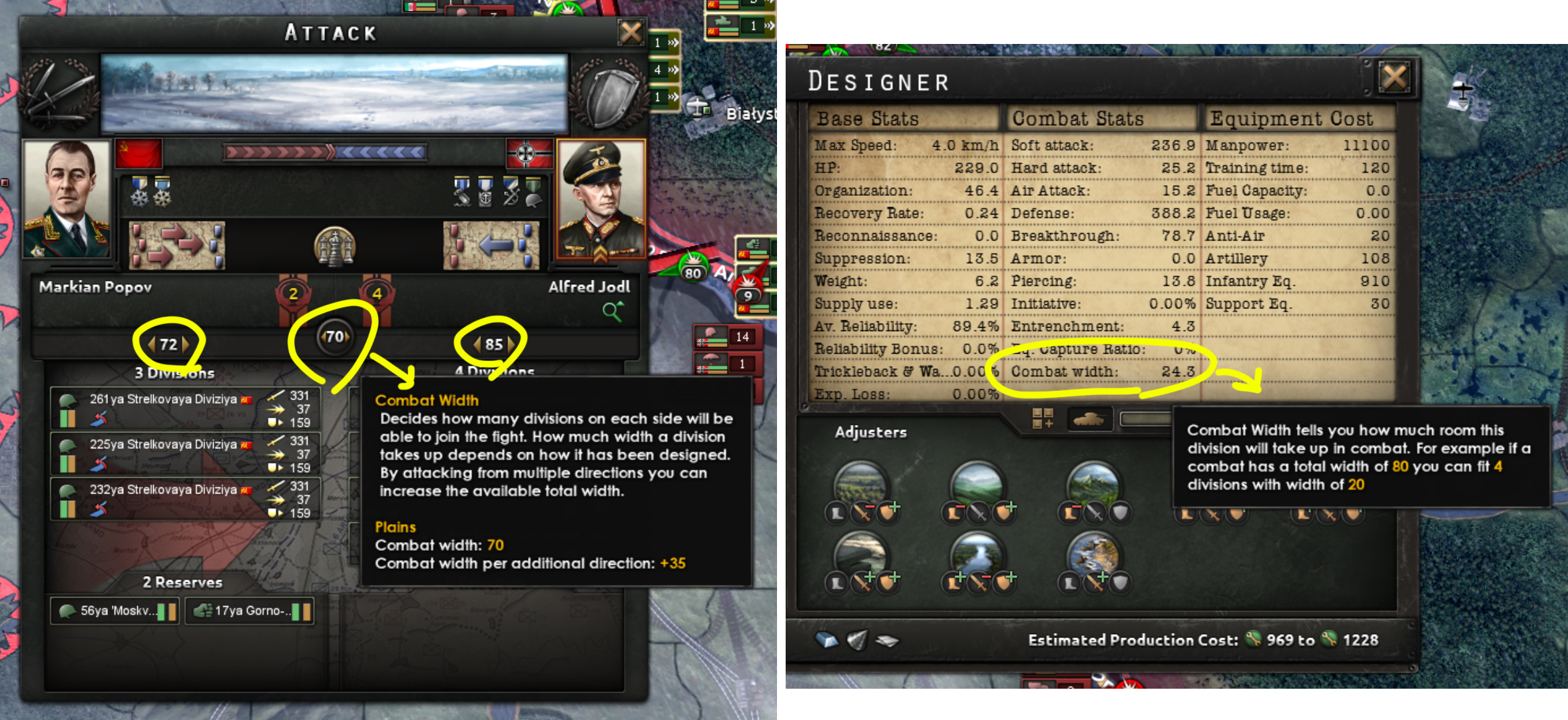
Combat Width determines how many divisions (based on their number and types of battalions) can actively engage in a battle at once. Each terrain tile has a base battle width that sets the maximum combat space; exceeding that width imposes penalties. When you exceed the battle’s available width, divisions beyond the limit either must wait in reserve or fight with a combat width penalty.
People much smarter than me have calculated the most efficient combat widths for various terrain types. It’s essential to design your division templates with combat width in mind. For example, if you’re planning to fight primarily in mountainous regions, such as Italy or Switzerland, you should aim for a combat width between 25 and 28. In jungle terrain, an optimal width falls between 30 and 33.
In my experience, a combat width between 18 and 25 performs well against the A.I. in all but the most specialized conditions.
Each terrain type also applies modifiers to movement, attack, and defense, with plains serving as the baseline (no penalties). Mountains, marshes, and jungles impose the most severe penalties across all categories.
It’s possible to overwhelm enemy divisions in any terrain, if you don’t care about casualties, attrition, or equipment loss. But smart players match terrain with the appropriate division types to minimize penalties and preserve strength. Sending armored divisions into mountains against entrenched infantry is a quick way to bleed them dry.
Special forces and support companies like Engineers and Recon help mitigate the negative effects of terrain. Mountaineers receive bonuses to movement, attack, and defense in hills and mountains. Marines gain attack bonuses in marshes, during river crossings, and when conducting amphibious assaults.
The chart below shows how various divisions are affected by combat in marshy terrain. Marshes reduce unit attack to 60%, and while Motorized divisions can still achieve victory there, they suffer an additional 10% attack penalty. Standard Infantry performs adequately, but Marines gain a 30% attack bonus in marshes, nearly offsetting the terrain penalty entirely. A Marine division equipped with an Engineer support company enjoys a significant advantage over most other units when fighting in marshy conditions.
| Motorized | Infantry | Infantry w/Eng. | Marines | Marines w/Eng. | |
|---|---|---|---|---|---|
| Movement | -30% | 0 | +20% | 0 | +20% |
| Attack | -10% | 0 | 0 | +30% | +30% |
| Defense | 0 | 0 | +25% | 0 | +25% |
Mastering terrain comes down to designing and deploying the right divisions for the right conditions. It is often the difference between victory and disaster. Understanding combat width, terrain penalties, and unit specialization is a key pillar of winning battles in HOI4.
Air Support
Command the skies, dominate the land.
Air support is another critical pillar of ground combat and should never be overlooked. Even if your air force isn’t strong enough to secure full air superiority, it can still neutralize the enemy’s advantage and disrupt their Close Air Support (CAS). Securing “green air” in a combat zone is often the deciding factor between a breakthrough and a bloodbath.
Air superiority is achieved by small and medium fighter planes flying Air Superiority missions. Maintaining air superiority (aka “green air”) in regions with ground combat gives significant bonuses on offense and defense, especially when paired with Close Air Support (CAS). CAS is provided by Tactical Bombers and CAS air frames flying Close Air Support missions.
Unfortunately, Paradox is clear as mud when it comes to the air modifiers applied to ground combat. There are three relevant modifiers, which can be viewed in your Officer Corps tab:
- Air Superiority [army_bonus_air_superiority_factor] = Modifies the bonus to land combat from air superiority. “Friendly Air Superiority effect on enemy divisions.”
- Air Support Mission Efficiency [air_cas_efficiency] = Modifies efficiency of Close Air Support. “Improved tactics for planes doing close air support resulting in increased abilities in dogfights.”
- Ground Support [air_cas_present_factor] = Modifies impact of close-air-support in land combat. “Having well-coordinated planes helping out in combat lets your troops fight better.”
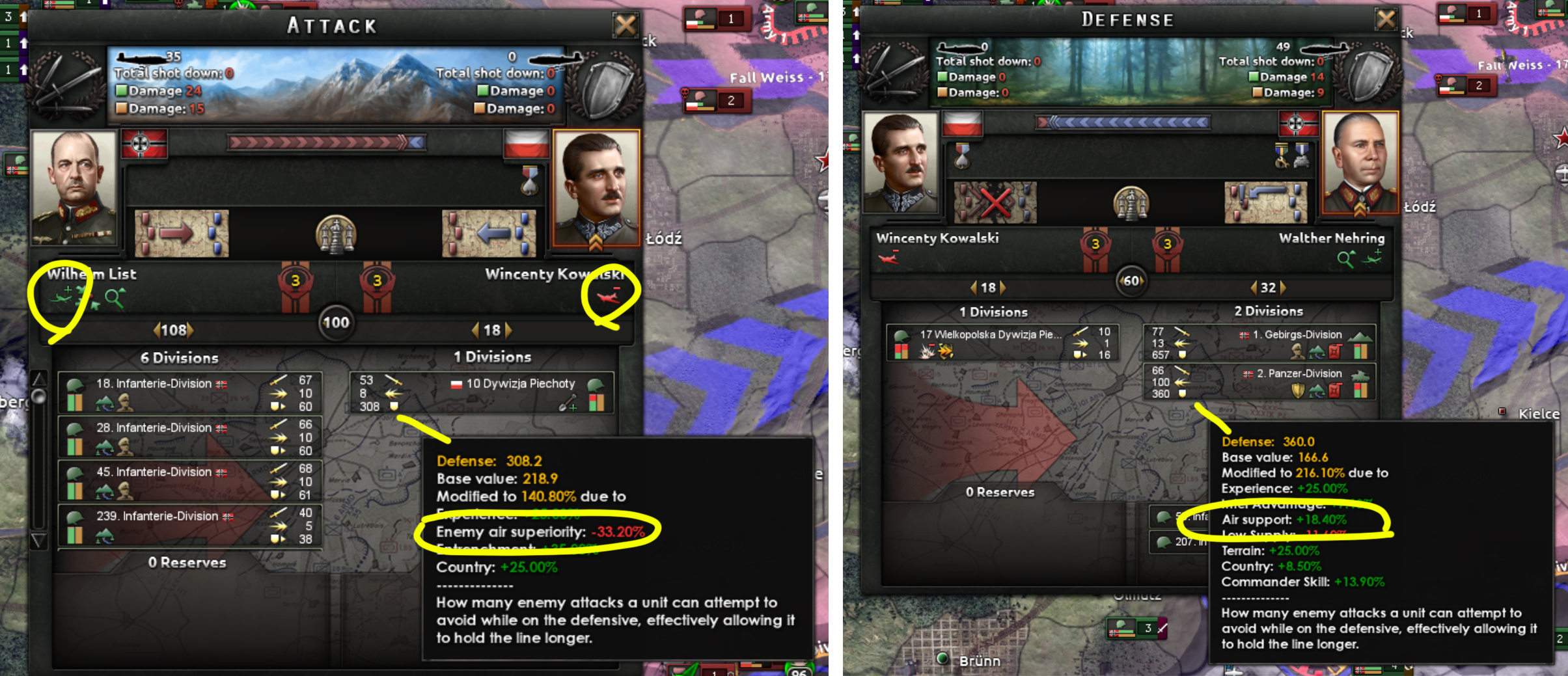
This Air Superiority value (found under Army Command in the Officer Corps tab) should not be confused with “Air Superiority Mission Efficiency”, which applies to air combat only. Air Superiority adds a penalty to enemy defense in ground combat when your planes have achieved “green air” in an air region.
Besides inflicting direct damage on enemy units, CAS applies positive modifiers to your attack and breakthrough in offensive battles and defense in defensive battles, depending on your Air Support Mission Efficiency and Ground Support percentages.
Additionally, having air superiority makes it less likely your CAS or bombers will be disrupted or shot down.
Conducting logistic strikes and strategic bombing of railroads and supply hubs destroys enemy trains and trucks, reducing their unit movement speed and inflicting a large out of supply penalty during combat.
Logistics / Supply
Out of supply means out of the fight.
Logistics encompasses the guns, ammunition, support equipment, food, and fuel that keep your armies operational and combat-ready. The expansion No Step Back (2021) introduced a more sophisticated supply system built around trucks, trains, and supply hubs. Each hub’s effective range is influenced by weather, terrain, infrastructure, railway level, and motorization.
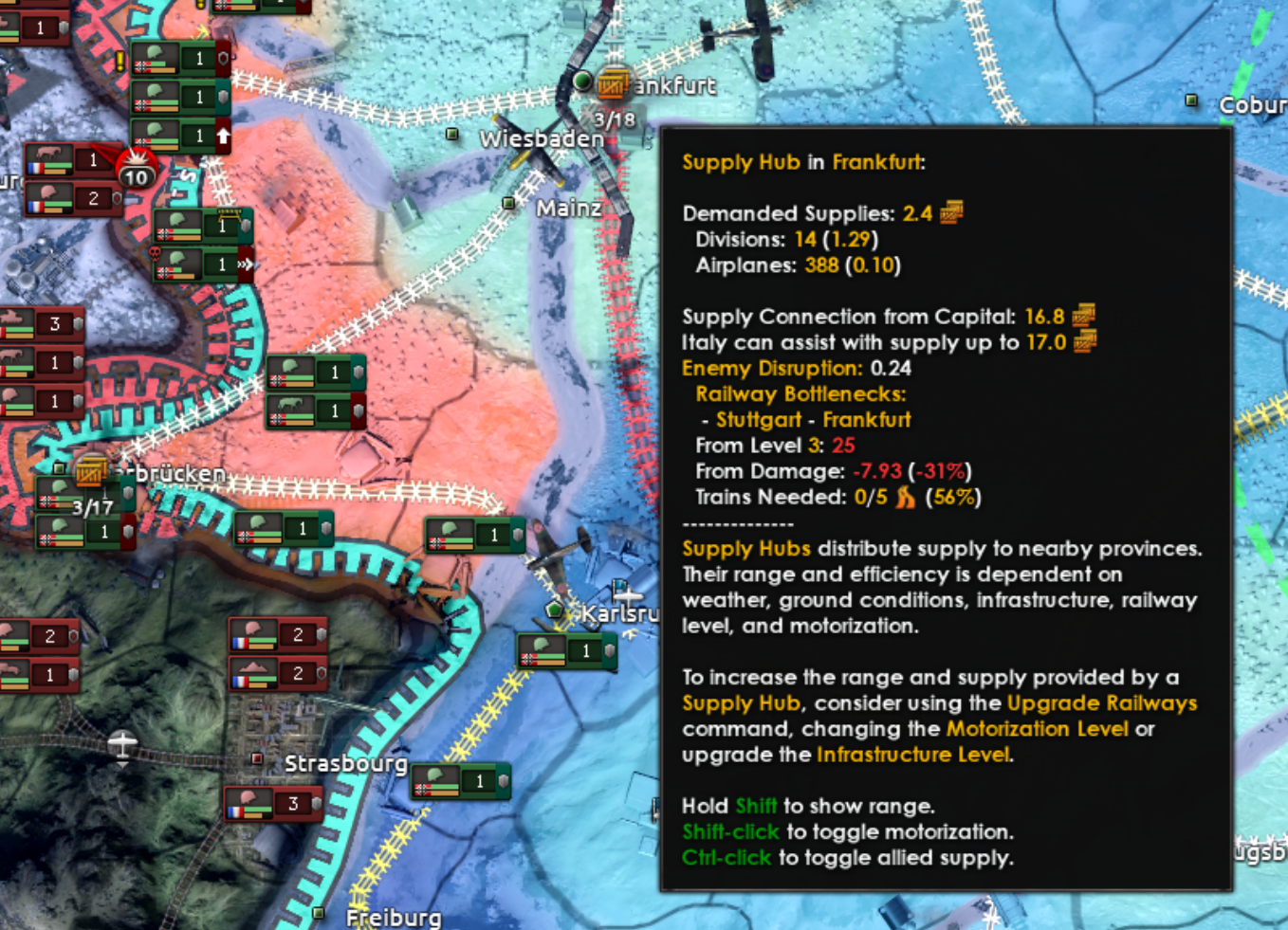
Divisions that require more supply than nearby hubs can deliver suffer severe penalties to movement speed and combat effectiveness, along with increased attrition. Motorized, mechanized, and armored units without fuel are essentially immobilized and unable to fight effectively.
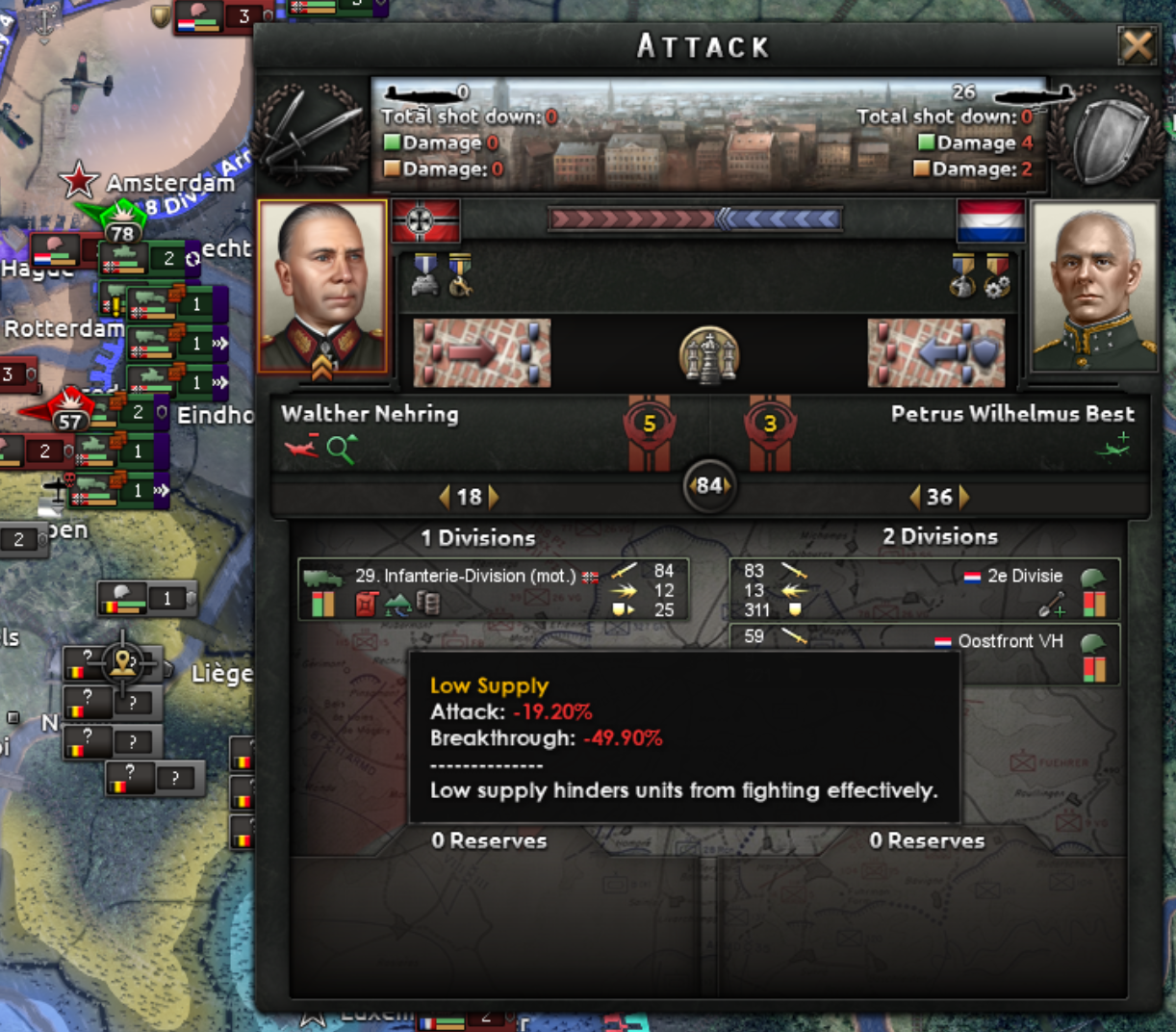
In addition to keeping your divisions in supply, it is absolutely critical to deliver enough Infantry Equipment, Support Equipment, Artillery, and other types of equipment to keep division strength at 100 percent.
Unit strength affects combat by scaling a unit’s damage output and determining how much equipment and manpower are lost during battle. A unit’s strength is a percentage based on its manpower and equipment ratio, with a lower strength unit dealing less damage and being more susceptible to being destroyed more quickly by taking higher proportional losses to its remaining strength and HP.
A general’s Logistics skill, field marshal traits like Logistics Wizard, and the Logistics Company can all help reduce a unit’s supply consumption. Additionally, Transport wings flying Air Supply missions can relieve divisions in low supply areas.
In short, while it’s possible to win without air superiority, intelligence advantages, or favorable terrain, victory is impossible without effective logistics. Ensuring your factories produce enough trucks and trains to keep supplies flowing, and that your divisions remain in supply and at full strength, is essential to winning battles in Hearts of Iron IV.
Intelligence
Decrypt, disrupt, exploit.
Intelligence, introduced in the La Résistance expansion (2020), is often overlooked, but when used effectively, it can provide advantages on the battlefield. Intel networks established in foreign countries grant bonuses to friendly invasion defense and planning speed, while reducing enemy max planning and entrenchment. Divisions with an intelligence advantage gain increased attack and defense in combat. Active decryption bonuses can temporarily lower invasion penalties and further enhance planning speed and defensive capabilities.
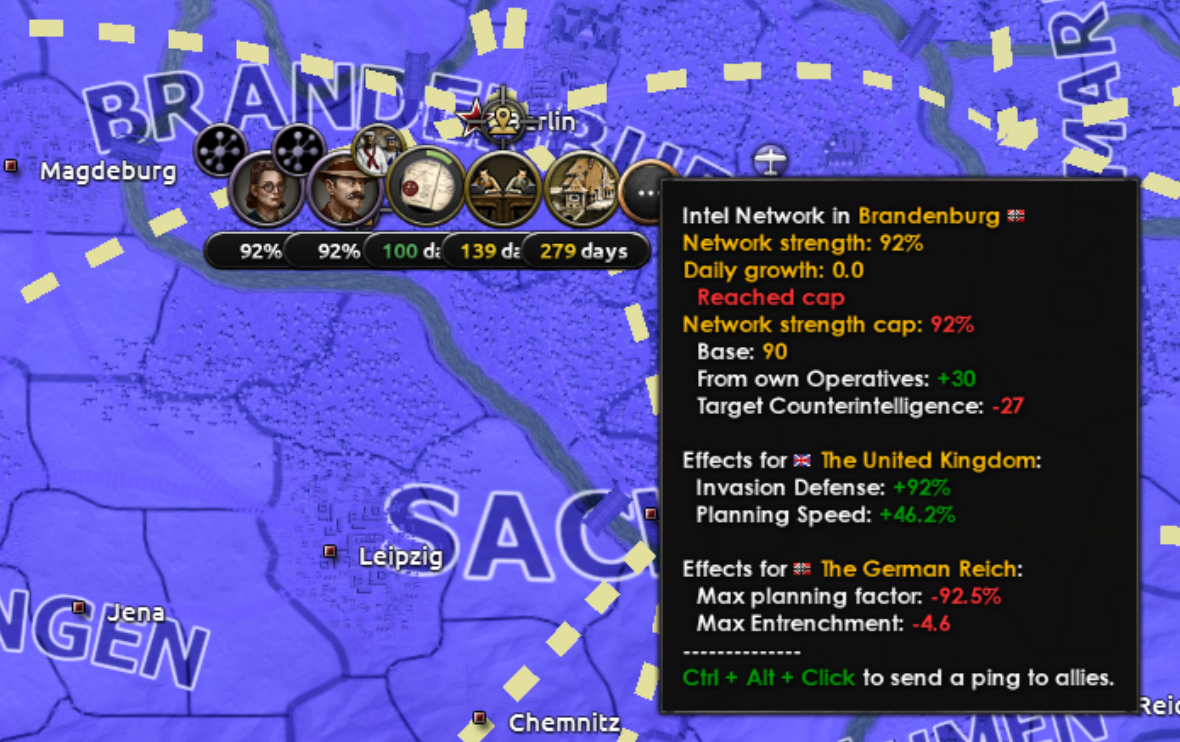
The “Invasion Defense” bonus is poorly named, since it essentially reduces the Naval Invasion Penalty inflicted on your units conducting a naval invasion (but not by the amount shown).
As stated earlier, the planning bonus is a temporary attack multiplier that builds up while divisions are on an offensive front. When fighting defensively against the AI, like the Soviet Union in 1941, for example, intelligence networks can neutralize your opponent’s planning bonus, denying them a significant boost.
When on the offensive, your intelligence network reduces the enemy’s Max Entrenchment factor, making it much easier to break through their defensive line.
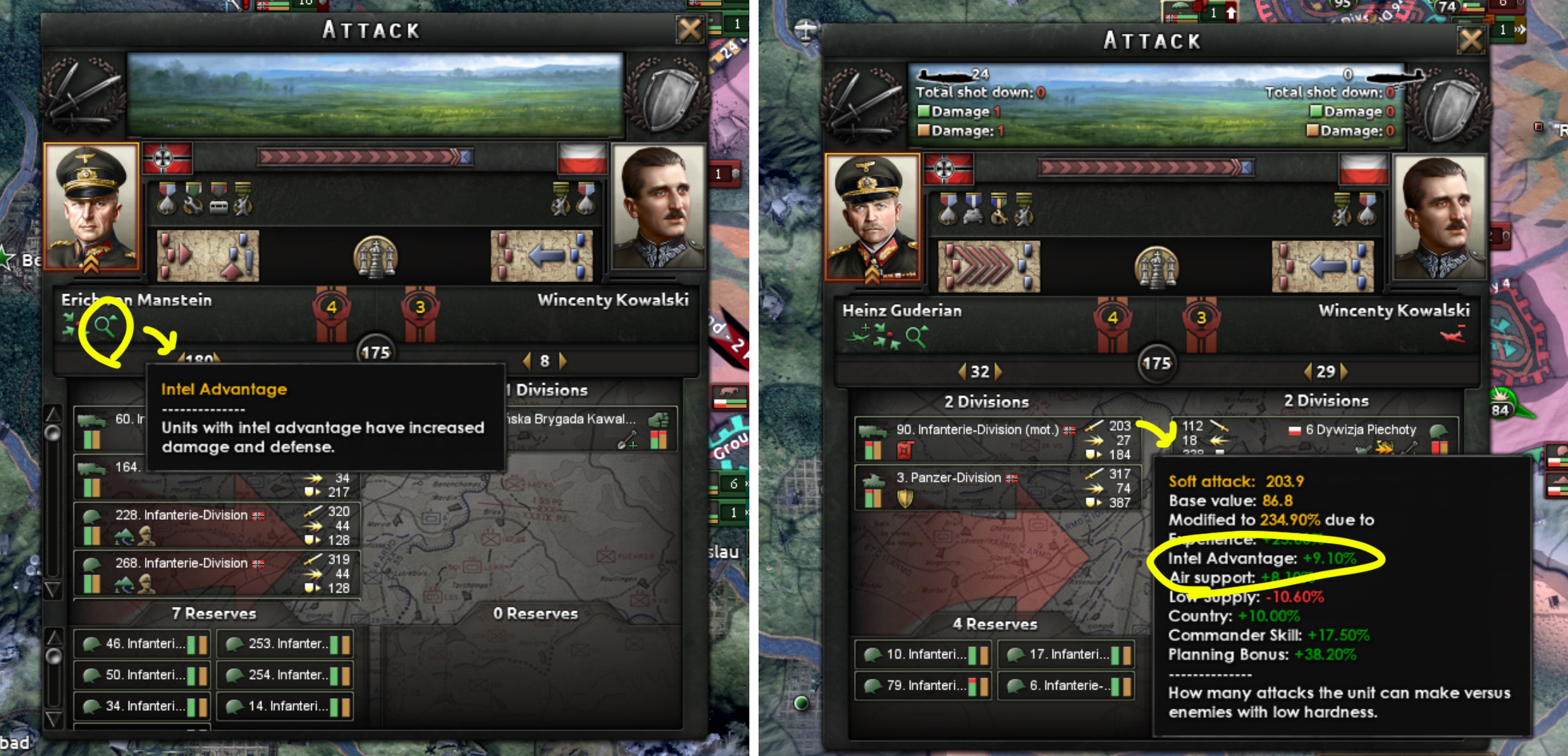
Finally, there’s a little-known modifier called Intel Advantage that affects your divisions’ attack and defense in battle. The side with the higher total Army Intel (visible in the target country’s Intel Ledger) receives this bonus, which can reach up to 15%, depending on the difference between each side’s Army Intel levels.
Your level of Army Intel on another country depends on a combination of factors, including friendly intel networks, army infiltration, active spy planes over the target nation, radar coverage, captured operatives, and more. Raising this intel level as high as possible is essential for gaining the intel advantage in combat.
To simplify it even further:
S — Pair high-skilled generals with balanced units with high soft attack and organization at or above 30.
T — Keep division combat width between 18-22. Match terrain with appropriate unit type.
A — Keep skies “green” and use CAS and logistic strikes.
L — Always make sure your units are in supply and you are producing enough equipment, trains, trucks, etc. to replace losses.
I — Use intelligence networks and make sure your Total Army Intel on enemy countries is as high as possible.
Mastering Hearts of Iron IV isn’t about memorizing every modifier—it’s about focusing on what truly wins battles. With the S.T.A.L.I. method, you can cut through the complexity, outmaneuver the AI, and take advantage of every opportunity. Whether you’re grinding through marshes, bombing supply lines, or timing the perfect breakthrough with a planning bonus at your back, victory goes to the player who controls more than just divisions … They control the stats, the skies, the supply lines, and the shadows.


 M.A. Kleen
What are your thoughts?