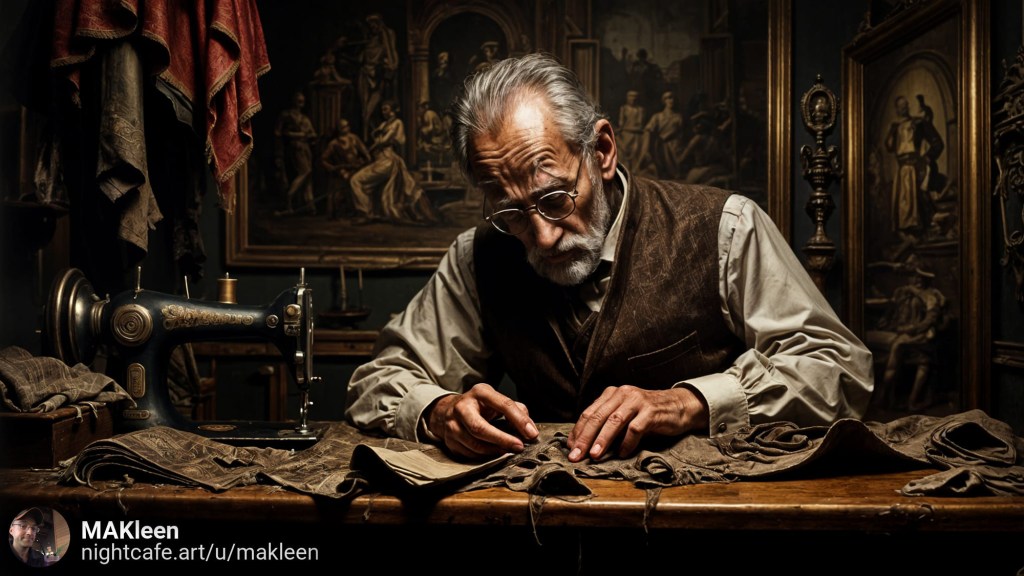
In 1920s New Orleans, gifted tailor Antoine stitches garments that grant his clients their deepest desires—thread by stolen thread from the souls of the dead. But when he weaves a wedding dress for the woman he loves, the cost comes due in blood and whispers.
Please enjoy this horror short, part of a series experimenting with artificial intelligence. I fed a location, plot, characters, scenario, and mood into ChatGPT 5 and asked it to outline and craft a story, then used Stable Diffusion XL to create an illustration. How did it turn out? Well, you be the judge.
New Orleans keeps its heat in the bones. In Antoine’s shop on Dauphine, the air tastes of steam, chalk, and machine oil. Jazz floats from a basement club across the alley; the horn lines thread the shutters, tangle in pins. The window mannequins wear linen that drinks the light. Inside, a treadle foot hums, and scissors click like metronomes.
Antoine is forty-something, narrow-shouldered, precise. He stains his fingers with blue tailor’s chalk and pricks them without flinching. Measurements live in his head, neck to nape, wrist to thumb, numbers that arrive before the tape unrolls. Customers trust his eye more than their mirrors: dockhands who want Sunday suits, matrons who want new skin.
At night he locks the front and draws the curtain on the workroom. There stands the narrow armoire no apprentice is allowed to touch. Its key warms when it finds his palm. He opens it only after the street has fallen silent. The shelves are stacked with bolts the color of rain, but deeper in, in a hidden drawer, lie skeins that give off a breath of light, twined like cobwebs spun from moonwater—and they sing when he listens.
The boy comes after closing, trumpet case tucked under his arm like a promise. “Lucien,” he says, and smiles with chapped lips. He wants a suit that looks like luck. The bandleader at the Blue Comet is auditioning again on Friday, and the doorman won’t even look his way unless he shines.
Antoine measures him, shoulder seam, chest rise, inseam, and feels the thrum in the air like a muted horn. He ought to choose the charcoal with honest drape. Instead, when the locks are shot and shutters drawn, the key warms his palm. The hidden drawer slides, and a filament of gold breathes against his fingers, humming in a note somewhere between yearning and applause.
The suit is finished by dawn. Lucien pays in coins and gratitude. On Saturday, a customer mentions a boy whose music caught like fire, hired on the spot, the room in rapture. A week later: another mention, a dropped word, a whisper at the counter. He collapsed mid-song, a sudden stroke, no warning.
Antoine stands very still, spool paused in his hand. “Coincidence,” he tells the empty shop. The gold thread in the waste-bin glints like a wink.
The widow arrives in late February, veiled and fragrant with lilac water. Madame Broussard’s eyes are sharp as garnet. She wants a gown “to turn a man’s head—one in particular.” Her voice is all champagne bubbles and command.
Antoine sketches something daring for Mardi Gras, a bodice cut to scandal. For days he fingers bolts of silk, yet each seems dull, deaf to her hunger. On the fourth night, the chest draws him again. The crimson thread there feels warm, warmer than it should, and smells faintly of roses long dead. When his needle drinks it in, the stitch runs like blood in water.
At the ball, she is the comet and all others the dust. Two days later her younger suitor proposes; the gossip sails in with the morning paper. But a month on, her carriage no longer waits outside his door. Word comes instead from a hatmaker: Madame Broussard has taken to her bed, voice a rasp, cheeks hollowed. Within weeks she is gone.
The weight in Antoine’s chest shifts, an old echo rising. He remembers his mentor’s hushed warning: “Life threads, stolen at the last breath. They give what the soul most craves, but the bill comes swift.” The chest had been left to him “only for need.” He had opened it when customers thinned after the war.
Now he understands why the threads sing.
Word spreads in ways Antoine doesn’t intend. A banker’s wife swears her coat brought a promotion for her husband. A cabaret dancer whispers that her beaded shawl drew the richest man in the audience to her table. Soon, clients arrive not for cut or cloth, but for the quiet miracles they’ve heard rumored.
Antoine refuses some, at first. He tells himself he will choose only the harmless, the humble wishes. But debts press in—suppliers unpaid, rent overdue. And there is the thrill: each stitch with a life thread moves differently beneath his hands, more alive, the garment breathing as he works.
The threads themselves are not silent. Some hum like a muted trumpet, others whisper in French tinged with the bayou. When he sleeps, their voices spill into dreams, calling him by name, pleading or laughing in strange, dry tones. He wakes with the taste of cloth in his mouth and finds his fingers aching to touch the chest again.
Céleste arrives on a bright spring morning, hair pinned with violets, a roll of white satin under her arm. She has sewn for him on and off for years, her hands quick, her laugh like rain on glass. Now she stands in his doorway, smiling in a way that hurts. “A wedding dress,” she says. “For June. I want it to promise a happy life.”
Antoine measures her, though he knows her every curve from memory. He tells himself he’ll use only her satin, nothing from the chest. But the thought gnaws: when she leaves, she will belong wholly to someone else. That night, the key is in his palm before he knows he’s reached for it.
In the drawer lies the rarest silver thread, finer than breath, almost too bright to look at. It sings in long, aching notes as he works, weaving blessing and curse into the hem.
On the day she wears it, her fiancé cannot take his eyes from her. The ceremony is a painting come to life, joy blooming in every face. But within a fortnight, Antoine sees her pallor, the tremor in her hands when she visits, the way her voice fades like cloth left too long in the sun.
She comes to him in a storm, rain soaking her coat, eyes fever-bright. The dress is bundled in her arms, silver hem trailing like a snared moonbeam.
“You cursed me,” Céleste says, slamming it onto his counter. Her voice is hoarse. “I found this.” From her pocket, she draws a brittle notebook, the pages crackling with his mentor’s hand. It speaks of life threads, stolen at the instant of death, binding the wearer to that soul’s end.
Antoine reaches for the gown. “I can undo it,” he insists, though his hands tremble. He tries scissors first, then a knife, but the stitches resist, the silver fusing tighter the more he pulls. Fire blackens the silk but leaves the thread bright and cold.
Her knees buckle. He catches her, but she is already sliding away, her breath shallow, pulse faltering. Outside, the bells of St. Louis toll the hour, each strike echoing like a needle through cloth.
When she stills, the shop feels smaller, the air pressed thin. The silver thread gleams unbroken.
Antoine works alone for days, the shop locked, windows shrouded in muslin. The gown lies folded in the corner like a shroud. He cannot bring himself to burn it.
At last, he returns the silver thread to the chest, shoving it deep beneath the others. The voices do not fade; they have moved inside him. At night, they murmur at the base of his skull, Céleste among them now, each voice tugging at some hidden seam.
He boards the windows, nails the door shut. The city’s music drifts faint through the walls, muffled like fabric under a needle. In the dim light, he sits at his worktable, the key warm in his hand. The drawer slides open. From its heart, he draws a single black thread, so fine it nearly vanishes against his skin.
He threads his needle, the voices falling silent for the first time. Then he bends over his lap, and begins to sew.

 M.A. Kleen
What are your thoughts?