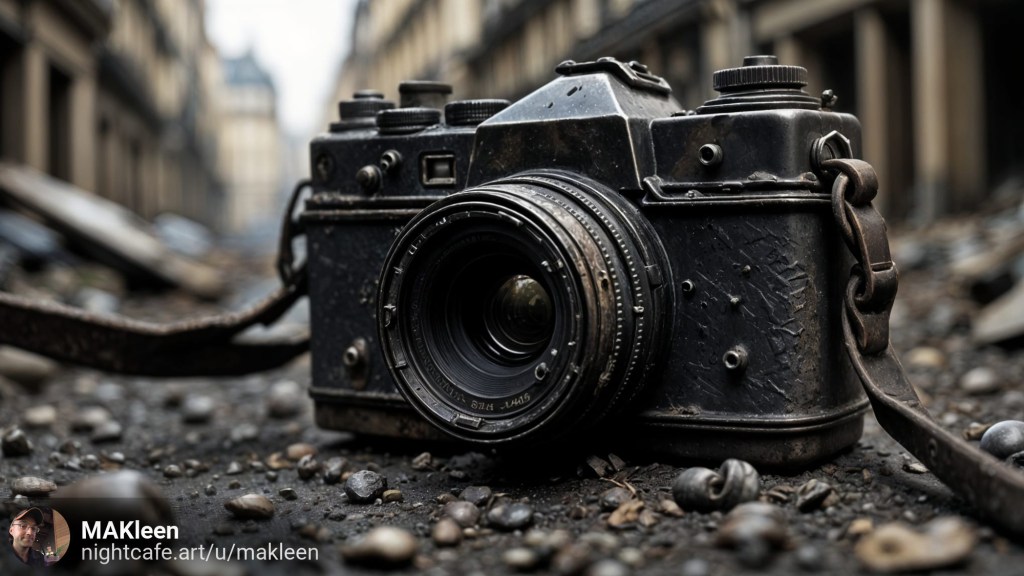
In post-war Paris, a young photographer captures haunting images of the city’s ruins, only to find a shadowy figure drawing closer in every frame. As the lens brings it nearer, she learns too late that some subjects step out of photographs to claim their own.
Please enjoy this horror short, part of a series experimenting with artificial intelligence. I fed a location, plot, characters, scenario, and mood into ChatGPT 5 and asked it to outline and craft a story, then used Stable Diffusion XL to create an illustration. How did it turn out? Well, you be the judge.
Paris, 1946—scaffolds clung to facades like splints, and whole blocks gaped where buildings had been. Claire walked with her camera high on her shoulder. Soot collected in her shoes. The river carried the smell of wet metal.
She told herself she was chasing truth, not ruin. Her eye was good; she framed a bombed apartment block, its front peeled away like a tin lid. Bedsprings glinted, a child’s mural stopped at jagged plaster. She imagined her spring exhibit—La Ville Réapprend—and rehearsed her pitch to curators who had many artists and few frames to spare.
The shutter clicked. She caught the light off a twisted fire escape, then packed up and returned to her apartment over a bookbinder’s shop.
In her makeshift darkroom, blackout cloth over the window, string for clips, she measured developer and fix. The air bit with chemical tang. Negatives first, then contact sheets, images rising like faces from deep water.
The first frames showed the ruin as she’d seen it. On the third, far down the street—something darker than shadow, too solid for blur. A featureless silhouette, unnaturally straight.
“Someone wandered into the frame,” she murmured, setting it aside.
Days later, she photographed a roofless church whose steps drew pilgrims: women in scarves, a boy with candles, a man drinking from a dented flask. She imagined the caption: The Faithful Return.
Under red light that night, the image bloomed: steps, faces, and the same dark figure, closer now, three steps below the doors, head tilted.
She laid this beside the first. Not a flaw. It had moved. She frowned and brought the prints downstairs.
Monsieur Dupré, the paper merchant, tapped the figure’s margin. “Les spectres du passé. This city is more crowded than it looks.”
“Someone on the steps,” she said lightly.
He shrugged.
To disprove herself, she went to a Right Bank market—cabbages, bright jars, children shouting. She photographed a flower stall, relishing the normal bustle.
In the darkroom, petals appeared, hands reaching for blooms, and beyond the crowd, the figure, more defined: a coat’s hint, a blank tilt of the head.
Claire began waking at night, sure she heard footsteps behind her. She varied her route home. Once, turning a corner, she thought a step matched hers, then fell away.
“You’re inventing it,” she told herself.
In another photographer’s studio, she found a 1942 print of a bridge under barbed wire. Behind the crowd: the same dark smudge.
“Michel shot that,” the owner said. “Died weeks later. Gas leak.”
That night, Claire set her tripod on her balcony, framing her street. She took the shot.
The developed print revealed the figure between buildings, directly aligned with her door. No tilt. Waiting.
She locked both locks, shoved a chair under the knob, and slept on the couch. Before dawn, she woke to the smell of damp stone. The apartment felt slightly bigger, as if stretched.
She refused to go out, photographing interiors instead: light across her rug, the bookbinder mending a spine.
In those prints, the figure appeared again—shoulder visible in a mirror’s corner; looming behind the bookbinder in the doorway, too tall for the frame.
The darkroom bulb flickered. She thought she saw a dense patch by the tub. Light banished it, and she laughed until her stomach hurt.
She went to the archives, to lose herself in someone else’s order. A librarian slid a folder toward her with the absent tenderness of a nurse. Legends of the Occupation, collected after the Liberation.
A page described an old story darkened by war: after great tragedies, a figure sometimes appeared in photos of ruins—a soul-taker marking those who stared too long at death. It drew closer with each photograph, until it reached the camera. Then it no longer needed the lens.
She left as snow began to fall.
In the morning, she returned to the apartment ruin where she’d first seen it. Snow dusted the skeletal frame; the courtyard was hushed. She set her tripod, hands stiff in gloves.
The sensation of being watched came like a draft. She turned—only a blank wall, a single lit window, curtain puffing inward.
Facing the ruin, she whispered, “Enough,” and pressed the shutter.
Back home, she performed the darkroom ritual with care.
The print emerged: the ruin’s scarred plaster, fractured mirror, and in the mirror, the back of her own head, braid a dark line. Inches behind her stood the figure, looming. Its form suggested a man pressed under cloth: hollows where eyes should be, an elongated hand hovering over her shoulder. Where its face belonged, the emulsion had fixed an open mouth, whispering or swallowing.
The print trembled in her tongs.
Then—a footstep behind her. Wrong for the room, close to her shoulder. The bulb flickered. Her mouth went dry.
“Non,” she said. Not a prayer, just refusal.
The camera tipped from the table, clacking on tile. In the spotted mirror, something moved that was not her.
The print slipped from her grasp, floating face down. The room smelled of damp earth.
Another step. A breath, cold on her neck.
She thought of the woman at the church steps, the boy with candles, the bridge crowd. The bookbinder humming below, Dupré’s dusted fingers, the plant on her sill leaning toward weak light. She imagined her name on an exhibit label, strangers stepping close to look.
“Enough,” she whispered.
The bulb steadied. Pipes fell silent.
A touch landed on her shoulder, light, but definite. She didn’t turn. The sentence that had been writing itself across days was complete. She reached for something—print, towel, switch—but her hand froze in the air beside another that wasn’t hers.
Neighbors later claimed they’d heard something. The bookbinder’s wife told police she’d smelled “cellar air, but colder” through the vents. Dupré closed early without knowing why.
Two days later, they opened her darkroom door. The trays’ water was scummed grey, the clipped prints curled. One lay face down in the developer, corner torn. The camera on the floor bore a fresh crack; the film was still inside.
They searched the way Parisians had learned to search: hospitals, lists, the places where luck failed.
The last photograph was the only clue. Someone held it at the edges while another made notes. No one looked at it for long.
The city breathed in and out, calling it proof of life. New glass rose in storefronts. A boy shifted his basket on church steps. On a bridge, a river of people thinned into something else.
Claire’s camera waited on a shelf, each scuff a fact, each scratch a refusal to explain. The print dried, curling toward itself, as if paper knew to make a smaller surface for the eye.

 M.A. Kleen
What are your thoughts?