In a salt-stained villa on the Italian coast, a forbidden chest of drawers opens each morning to reveal a half-painted portrait—its subject doomed to die when the painting is complete. When the latest face belongs to her, young Sofia must find a way to stop the final stroke.
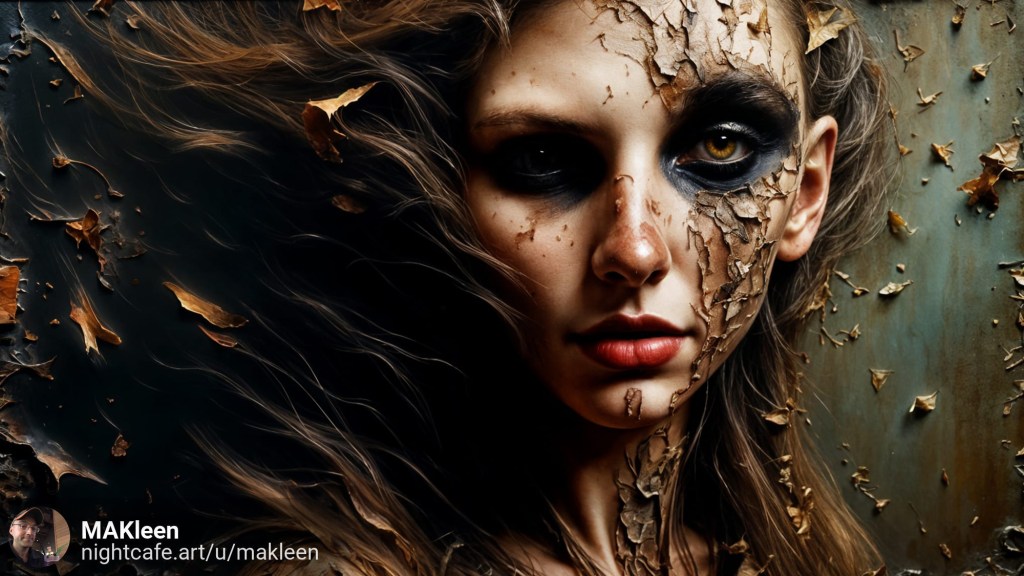
Please enjoy this horror short, part of a series experimenting with artificial intelligence. I fed a location, plot, characters, scenario, and mood into ChatGPT 5 and asked it to outline and craft a story, then used Stable Diffusion XL to create an illustration. How did it turn out? Well, you be the judge.
The sea keeps the villa honest. Salt whitens the shutters, eats the nails, and curls the lavender hung to dry from the rafters. Even the marble saint by the garden stairs has a rind of brine. From the upper gallery, the water lies like a silver blade at the horizon.
Isabella wears widow’s black the way sailors wear tattoos—inked too deep to shrug off. She moves like a measured prayer through rooms of cool tile and dim mirrors, her hair braided tight, her mouth composed. The villa was her husband’s, and then his absence’s.
Sofia arrives from Florence with a valise and eyes that refuse to be dimmed by mourning. Seventeen, all quick hands and quicker curiosity, she kisses her aunt’s cheek and looks past her into the hall where oil portraits hang like windows onto other weather. The sea breathes in the open arches; turpentine laces the air.
“There is a room you must never enter,” Isabella says that first night, when the lamps scumble the plaster into gold. “It is not a place for the living.”
After midnight, wood slides somewhere above, slow as a held breath: a drawer opening.
On the third afternoon, when the sun lay heavy on the water and Isabella walked the gardens with her parasol, Sofia climbed the narrow stairs to the top floor.
The forbidden studio’s door was warped from salt air, the keyhole crusted green. She pushed, and it yielded with a sigh.
Light came grudgingly through curtains yellowed with age. The room smelled of turpentine and something older—oil gone rancid, wood that had drunk in too many winters. Canvases leaned against the walls like dozing giants. Dust lay over everything except the far corner, where a great chest of drawers stood.
It was wide, waist-high, the wood dark as old wine, its front carved with ivy that curled into the open mouths of serpents. Each drawer had a brass pull, dulled by touch.
Sofia slid one open. Inside, on a stretched canvas, was the half-finished portrait of a man she recognized from the village. It was a baker’s father, his face rising from shadow, the eyes sketched in charcoal.
Another drawer revealed a young woman, her skin tones half-blended, the hair only suggested in ochre strokes.
The newest drawer gaped slightly. On its canvas, faint lines hinted at the curve of a cheek, the ghost of a brow, so pale it seemed a trick of light.
By the week’s end, news came that the baker’s father had taken ill. The bells in the village tolled for him three days later, their echo carried up the cliffs to the villa.
Sofia mentioned it to the housemaid while taking tea in the courtyard. The woman crossed herself and glanced toward the upper windows.
“It’s always the same,” she whispered. “A face begins in that chest, and the person dies when the painting is done. Your aunt’s husband painted them once. Now it paints itself.”
That evening, unable to let the words rest, Sofia crept again into the studio. The air was close, almost damp. She opened the drawer with the young woman’s face. The hair now curled more fully, and a smear of rose touched the lips.
A cold draft stirred the curtains behind her.
“Close it,” Isabella’s voice commanded, sharp as a slap. She was in the doorway, her gloved hands trembling.
“I have tried to keep you safe from this,” she said, pushing the drawer shut with finality.
That night Sofia dreamed she lay inside one of the drawers, her skin smelling faintly of turpentine, her face only half-painted.
A week later, passing the studio, Sofia caught the unmistakable scent of fresh oil paint. The door, usually locked, hung ajar.
Inside, the curtains had been drawn wide, letting in a pale morning light. One drawer sat open. The faint image she had seen before was now unmistakable—the tilt of the head, the curve of the cheek, the arch of an eyebrow.
Her own face.
Her breath came short. She backed away and found Isabella waiting in the hall, lips pressed thin.
“It has chosen you,” Isabella said. “The chest belonged to my husband. He believed his best portraits captured the soul itself. When he died, the chest began opening drawers on its own. Each face belonged to someone still living. The painting would finish itself, sometimes over days, sometimes weeks, and then the person would die.”
Sofia’s voice cracked. “Then lock it away!”
“I’ve tried. I’ve burned the portraits, even nailed the drawers shut. It doesn’t matter. It chooses who it paints.”
Outside, the sea was a shining, merciless mirror. Inside, the canvas in the open drawer seemed to breathe with her own reflection.
Sofia returned to the studio that night with a palette knife gripped so tightly her knuckles ached. She pulled her portrait from the drawer and slashed at it. The blade scraped, but the paint seemed to resist—wet one moment, dry the next. Each gash sealed itself as if the surface were living skin.
She hauled at the heavy chest, dragging it inch by inch toward the balcony. The sea below roared in the moonlight, but as she reached the doors, the thing grew impossibly heavy, its carved feet gripping the floor like roots. She let go, and the chest seemed to sigh in relief.
By morning, her portrait had advanced. The lips now blushed faintly, the eyes beginning to catch light.
Fever found her that afternoon. Her skin burned; her limbs felt waterlogged. Isabella sat at her bedside, cool cloths pressed to her forehead, whispering reassurances that felt rehearsed. Yet Isabella’s own face looked drawn, her eyes ringed as though she hadn’t slept in days.
In the corner of the room, Sofia thought she saw the chest, though the studio door remained closed upstairs.
Storms rose from the horizon like bruises, rolling in with thunder that rattled the shutters. Waves struck the cliffs so violently they flung spray against the upper windows of the villa.
Sofia woke in the night to the sound of wood sliding. Fever or no, she followed it upstairs.
In the studio, lamplight pooled on the open drawer. Isabella stood over it, brush in hand. Her black dress clung to her in the humid air, hair loose around her shoulders.
“If I complete you,” she murmured, “perhaps it will take me instead.”
Her brush moved with a surety that was almost tender, painting the last shadow under the jaw, the precise gleam in the eyes. With each stroke, Sofia felt something inside her loosen, like a knot being undone. Her breathing eased; the fever’s grip broke.
The final stroke gleamed wetly under the lamplight. Isabella’s hand stilled. She looked at Sofia once, and smiled faintly. Then she collapsed to the floor, the brush rolling away.
In the drawer, the portrait no longer bore Sofia’s face. It was Isabella’s, eyes closed, serene, already dry.
The villa grew quieter in the weeks after Isabella’s burial. Sofia kept the studio locked, the key on a chain around her neck. She told herself she would never again touch the serpent-carved chest.
But one pale morning, the smell of wet oil woke her. She climbed the stairs, the key trembling in her fingers.
Inside, a single drawer yawned open. On the canvas, a face was half-formed. It was an unfamiliar man, his eyes smudges of shadow.
Outside, the sea was calm, glass-bright under the sun. Inside, the air tasted of salt and linseed, as if the chest had been breathing all along.

 M.A. Kleen
What are your thoughts?