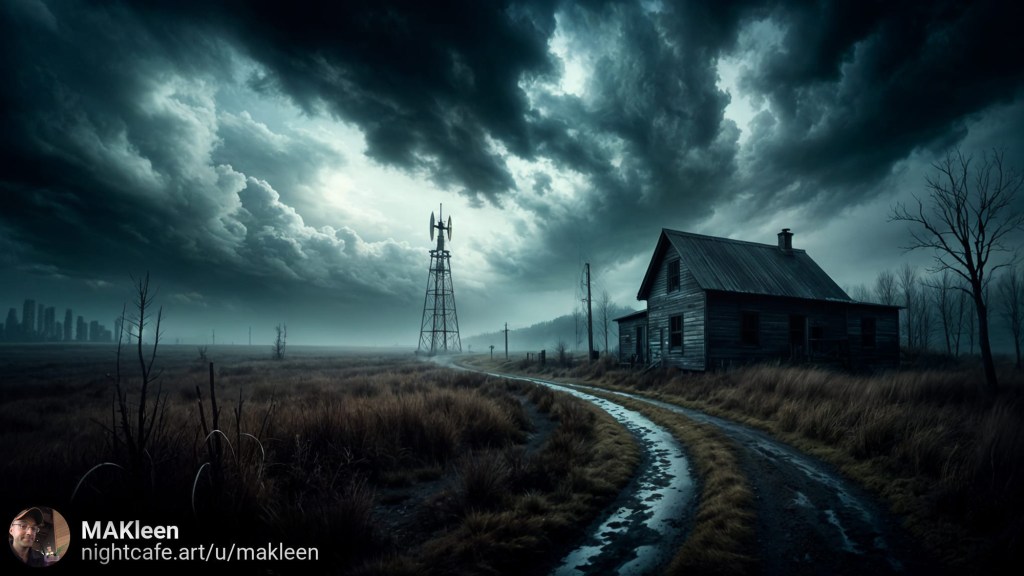
In Dust Bowl-era Kansas, a lonely radio operator discovers a hidden frequency that calls him by name, and seems to speak through the townsfolk around him. As the broadcasts grow clearer, the voice beneath the static draws him toward a gathering no one remembers attending.
Please enjoy this horror short, part of a series experimenting with artificial intelligence. I fed a location, plot, characters, scenario, and mood into ChatGPT 5 and asked it to outline and craft a story, then used Stable Diffusion XL to create an illustration. How did it turn out? Well, you be the judge.
The wind carried the land’s emptiness into the shack, gritting through cracks in the clapboard walls, rattling the single window, and moaning along the wire to the mast. Henry used to think it sounded like the prairie singing. Lately, it had the same pitch as static.
Under lamplight, sleeves rolled, he tuned the set with slow precision. The tubes glowed orange. Outside, the grain silo loomed over the dark. The Depression had emptied the town; laughter was rare, the dogs quiet, the chickens fewer.
He cupped the headphones, the wire taut across his lap. Beyond the hiss came Morse chatter, ship signals, sermons—and then, a sudden clear seam, like ice breaking. He fine-tuned.
A woman’s voice rose from the noise, soft, muffled, layered with faint breaths.
“—Henry—”
The name was wrong in shape but still his. Then: “Lo-ssen. Bel-oh. Ke-thel. Listen. Below.” Behind it, a wet clicking, too regular for an animal, too organic for a machine. Once, a distant cry. He wrote the syllables with a trembling hand and listened until dawn, stepping outside to the metallic taste of static on his tongue.
The next night, after drifting the bands, his hand returned to the unmarked frequency. The voice was weaker but spoke the same strange words. At two, Hiram in Nebraska broke in: “Don’t stay on 29.83 after dark.” Then his voice cut out, replaced by a rush of whispers.
That night Henry dreamed of wheat bent into spirals, towering headless shapes at their centers.
By day, the world seemed ordinary—until Mrs. Kellerman at the post office hummed the tune he’d heard, and a farmhand at the feed store muttered the same syllables. Uneasy, he told himself to avoid the signal. Yet after midnight, he tuned in. The voice grew clearer, repeating his name, telling him to listen, to look below. It read out a string of numbers.
Each number matched the date of a local event: a missing child found with bleeding ears, livestock dead with ears torn raggedly. Neighbors whispered on porches and crossed themselves.
He began hearing the cadence in hinges, water pumps. Symbols, circles within circles, appeared scratched into his shack door. His notebook filled with transcriptions and sketches.
One night, he found Clara standing at her window, lips moving in silence. Startled awake, she said she’d been dreaming a tune. Henry’s stomach clenched when she hummed it.
Determined to find the source, he set up antennas to triangulate the signal. The strongest point was not far away—it was directly beneath the town.
When the broadcast came, the voice greeted him by name. “Below,” it said, then a call-and-response of many voices. He took off the headphones; the sound stayed.
At the edge of town, the wheat tickled his legs as he stepped into the field. Shapes resolved into neighbors standing in rows, heads tilted toward the sky, mouths slack. Mrs. Kellerman. The Straubs. The sheriff, hat in hand. Clara among them.
A hundred cloudy eyes turned to him in unison. The air pressed thin around him; he thought, We are instruments. Clara’s gaze flickered with recognition.
Henry fled.
He burst into the shack and switched on the set. “Join,” the voices said, a thousand mouths making a single chord. “Join the circle.”
“Where are you?”
“Below, and above, and through.”
Pressure built in his skull, teeth aching. The symbols on the door swam in his vision—shadows cast by something present and not present. Without deciding, he stepped outside.
The field stretched to the horizon, townsfolk fixed in place, eyes on a star-crowded sky. The constellations were wrong, arranged to match his notes. Vast, skeletal figures moved between ground and sky.
The static became a question without words. Henry answered: “Listen. Below,” and spoke an unearthly address. Relief washed through him. He stepped forward to join, until Clara’s head turned slightly, a human movement that broke the spell. He stepped back.
The shack shuddered. Heat rolled over the field; the wheat bowed in perfect ripples. The signal cut.
The crowd exhaled. Faces shifted to confusion. A child cried. Clara swayed; Henry caught her. “I was dreaming,” she said. “We were at a dance, or some kind of a meeting.”
By noon, life resumed as if nothing had happened. No one mentioned the field. In the shack, the door was charred with the same symbols, the radio tubes blackened. The dial found only hiss, but within it, Henry still heard a faint whisper of his name.
For three days, he avoided the field. On the fourth, he saw Clara idly trace circles in dust. He wiped them away, laughing sharply.
That evening, he tuned to the hiss again. The penny-taste of fear filled his mouth. The wind tugged the wire. A whisper came close—not in his ear, but in the place where a prayer lives.
He walked into the wheat. The ditch was wider than he remembered. The first star lit. At the spiral’s center, the wheat bent in memory.
The headphones hung around his neck, cups cold on his collarbones. Clara’s distant voice called his name, but the wind translated it to something else.
The wheat bowed. The stars rearranged themselves. Henry stepped forward, accepted into the order of things that leaned toward sound. The static rose. He opened his mouth. He didn’t have to speak.
Behind him, the shack’s lamp flickered, as if deciding which world to light.


What are your thoughts?