What if the neighbor you trust is hiding a dark secret—or worse, you’re the only one who sees it? From Rear Window to Disturbia, explore how the paranoid neighbor trope has evolved from city apartments to suburban cul-de-sacs, turning everyday spaces into chilling grounds for suspicion and fear.
Suburban neighborhoods, with their cul-de-sacs and trimmed hedges, were designed to embody safety and community. Yet, within the realm of Suburban Gothic horror, these idyllic settings become fraught with suspicion and dread. Nowhere is this tension more palpable than in the “paranoid neighbor” trope, a theme that has evolved from the bustling cityscape of Alfred Hitchcock’s Rear Window (1954) to the eerie quiet of suburban cul-de-sacs in films like Fright Night (1985), Arlington Road (1999), and Disturbia (2007).
This archetype—the watchful observer who suspects their neighbor of terrible deeds—channels universal fears: the unknown hiding in plain sight, the limits of trust, and the consequences of being right when no one believes you. Over decades, as societal anxieties shifted from urban crime to suburban isolation, the paranoid neighbor trope adapted, finding fertile ground in the suburbs. Let’s peer through the windows of these films to see how this theme has evolved and what it reveals about Suburban Gothic horror.
Urban Suspicion: Hitchcock’s Rear Window
The roots of the paranoid neighbor trope can be traced back to Alfred Hitchcock’s Rear Window. Set in a bustling city, the film follows L.B. “Jeff” Jeffries (James Stewart), a photographer confined to his apartment by a broken leg. Bored and frustrated, Jeff becomes a voyeur, obsessively watching his neighbors through their open windows. His idle curiosity turns to fear when he begins to suspect one of them, Lars Thorwald (Raymond Burr), of murdering his wife.
Rear Window lays the foundation for the trope with its themes of surveillance, voyeurism, and suspicion. Jeff’s initial doubts are dismissed by those around him, including his girlfriend Lisa (Grace Kelly). His fixation becomes a source of tension, reflecting the dangers of isolation and the fine line between curiosity and obsession.
What makes Rear Window enduring is its moral ambiguity. While Jeff ultimately proves Thorwald’s guilt, his intrusive behavior raises questions about privacy and the ethics of watching. This dynamic—blurring the line between hero and intruder—became a hallmark of the paranoid neighbor trope as it transitioned from urban apartments to the quiet streets of suburbia.
From Cities to Suburbs: Fright Night and the Supernatural Neighbor
By the 1980s, the paranoid neighbor trope had migrated to suburbia, a setting ripe for horror. In Fright Night (1985), Charley Brewster (William Ragsdale), a suburban teenager, begins to suspect that his new neighbor, Jerry Dandridge (Chris Sarandon), is a vampire. Charley’s obsession grows as he observes Jerry’s suspicious activities—such as moving a coffin into his house and preying on young women.
Unlike the urban chaos of Rear Window, suburbia in Fright Night offers a false sense of security. Jerry’s charming demeanor allows him to blend seamlessly into the neighborhood, exploiting its culture of polite disengagement. Charley’s struggle to convince his friends and family of Jerry’s true nature echoes Jeff’s dilemma in Rear Window: the frustration of seeing something sinister when others refuse to believe.
What sets Fright Night apart is its supernatural element. Jerry is not just a villain but a literal monster, representing fears that suburban tranquility masks something far darker. The film’s blend of horror and comedy underscores the absurdity of suburbia’s obsession with appearances, as Charley’s desperate attempts to expose Jerry clash with the neighborhood’s unwillingness to disrupt its idyllic facade.
Paranoia Meets Terrorism: Arlington Road
The paranoid neighbor trope took a darker, more political turn in the 1990s with Arlington Road (1999). The film follows Michael Faraday (Jeff Bridges), a widowed college professor who becomes suspicious of his new neighbors, Oliver and Cheryl Lang (Tim Robbins and Joan Cusack). Michael’s growing unease turns to terror as he discovers the Langs are domestic terrorists plotting a catastrophic attack.
Unlike Rear Window or Fright Night, Arlington Road shifts the focus from voyeurism to personal stakes. Michael’s paranoia is fueled by his own trauma—his wife, an FBI agent, died in a botched standoff. This personal history amplifies his suspicions, making him both an unreliable narrator and a tragic figure.
Arlington Road uses the suburban setting to heighten its tension. The Langs are the picture-perfect neighbors, their friendly demeanor and wholesome family life camouflaging their violent intentions. This duality reflects the fears of the late 20th century, a time when terrorism and domestic unrest were beginning to infiltrate the American consciousness. The film’s chilling conclusion, where Michael is framed for the Langs’ crimes, underscores the paranoia of the era: the idea that even righteous vigilance can lead to catastrophic misunderstanding.
Modern Paranoia: Disturbia
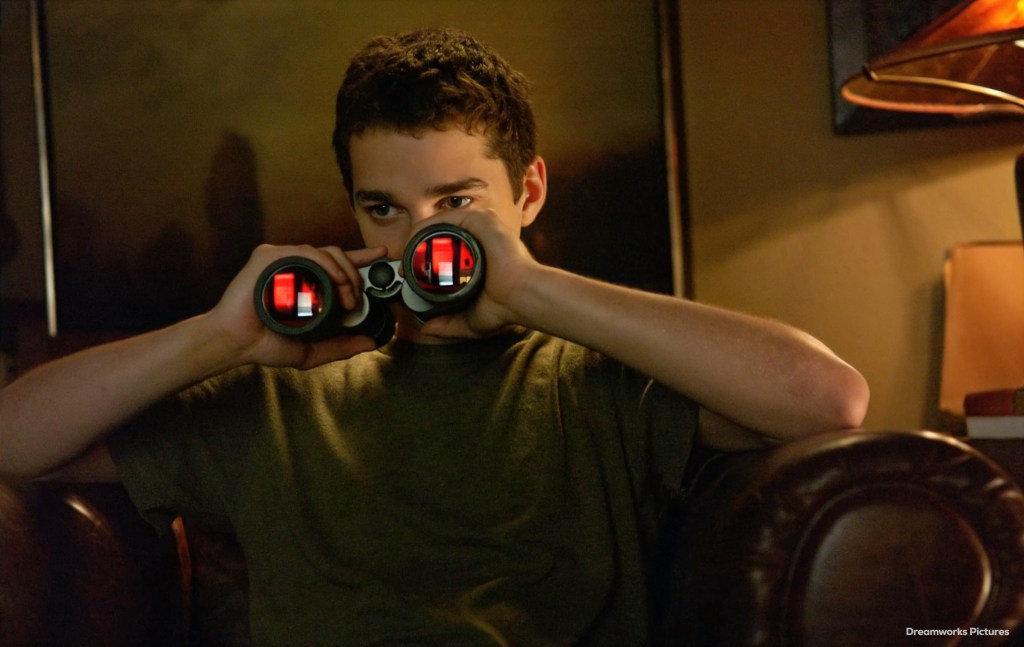
The paranoid neighbor trope reached a new generation with Disturbia (2007), a loose reimagining of Rear Window set in a modern suburban neighborhood. Shia LaBeouf stars as Kale Brecht, a troubled teenager under house arrest who becomes obsessed with watching his neighbors. His boredom turns to fear when he suspects one of them, Robert Turner (David Morse), of being a serial killer.
Disturbia updates the trope for the digital age, with Kale using technology like binoculars, cameras, and a phone to spy on Turner. The film plays with suburban Gothic themes, using the monotony of Kale’s confinement to reflect the broader isolation of suburban life. Unlike the crowded city of Rear Window, Kale’s suburban neighborhood feels eerily empty, emphasizing the isolation that makes Turner’s crimes possible.
What sets Disturbia apart is its exploration of grief and guilt. Kale’s fixation on Turner is partly fueled by his unresolved trauma over his father’s death, giving his paranoia a deeply personal edge. This emotional depth aligns with the film’s critique of suburban apathy: Kale’s neighbors remain oblivious to Turner’s activities, highlighting the dangers of disengagement in a setting designed to foster community.
Across these films, several recurring themes emerge, revealing the universal fears that drive the paranoid neighbor trope:
Isolation and Surveillance: From Jeff in Rear Window to Kale in Disturbia, these characters are often isolated, physically or emotionally, making them hyper-focused on their surroundings. This isolation mirrors the disconnection of urban and suburban life, where proximity doesn’t always mean connection.
The Frustration of Being Unbelieved: Whether it’s Charley in Fright Night or Michael in Arlington Road, the paranoid neighbor struggles to convince others of the danger they see. This theme reflects a fear of powerlessness and the social cost of challenging the status quo.
The Duality of Neighbors: Each of these films highlights the unsettling idea that neighbors—those we’re supposed to trust—can harbor dark secrets. The Langs’ friendly facade in Arlington Road and Jerry’s charm in Fright Night underscore this tension, turning the ordinary into the menacing.
Cultural Anxieties: These films reflect the fears of their times: urban crime in Rear Window, supernatural threats in Fright Night, domestic terrorism in Arlington Road, and suburban disengagement in Disturbia. The settings evolve, but the paranoia remains rooted in societal anxieties.
The paranoid neighbor trope is a cornerstone of Suburban Gothic horror, a genre that critiques the veneer of suburban perfection. By placing suspicion and danger in familiar spaces, these films challenge the idea that safety can be engineered. Suburbia, with its fences and cul-de-sacs, becomes a stage for human vulnerability, where the ordinary conceals the extraordinary.
Rear Window established the voyeuristic foundation, while Fright Night brought the trope into suburbia with a supernatural twist. Arlington Road added a political dimension, and Disturbia modernized the theme for a digitally connected but emotionally distant age. Together, these films show how the paranoid neighbor archetype has evolved, reflecting shifting fears while staying rooted in the unsettling idea that danger often lies just next door.
The paranoid neighbor trope taps into a primal fear: the unknown hiding within the familiar. From the crowded city apartments of Rear Window to the eerie quiet of suburban streets in Fright Night, Arlington Road, and Disturbia, this theme has adapted to reflect changing cultural anxieties. Yet, its core remains unchanged: the tension between trust and suspicion, community and isolation.
These films remind us that even in the most idyllic settings, paranoia can take root. After all, in Suburban Gothic horror, it’s not what’s lurking in the shadows—it’s who’s lurking behind the curtains.

 M.A. Kleen
What are your thoughts?