Hollywood’s attempts to depict the U.S. War in Afghanistan have ranged from action-packed spectacles to biting satires and thought-provoking dramas, each grappling with the war’s complexity but falling short in capturing its contradictions. Its films reveal as much about the challenges of storytelling as they do about the conflict itself.
The U.S. War in Afghanistan, a twenty-year conflict spanning 2001 to 2021, was a complex and polarizing chapter in modern history. Its depiction in cinema reflects the challenge of translating such a long and multifaceted war into compelling narratives. Four films—12 Strong, War Machine, Lions for Lambs, and Whiskey Tango Foxtrot—offer distinct perspectives on the war, each striving to convey a different aspect of the experience but ultimately falling short of fully capturing its intricacies.
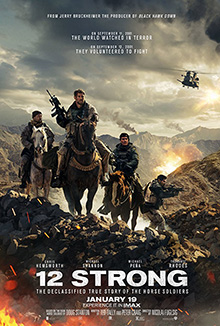
12 Strong (2018), directed by Nicolai Fuglsig, recounts the story of the first U.S. Special Forces team deployed to Afghanistan in the immediate aftermath of the September 11 attacks. Featuring Chris Hemsworth as Captain Mitch Nelson, the film dramatizes the soldiers’ collaboration with Afghan warlord General Dostum to take on the Taliban. While the film’s high-octane battle scenes and moments of camaraderie highlight extraordinary bravery, its reliance on Hollywood embellishment detracts from the story’s authenticity.
The climactic horseback charge against Taliban rocket launchers, a thrilling visual spectacle, never actually occurred, with real-life events being far more grounded and strategic. This creative liberty, while entertaining, reduces the film’s ability to grapple with the complexities of trust-building and the tenuous alliances that defined the war. Ultimately, 12 Strong comes across as formulaic, delivering action at the expense of substance and missing an opportunity to offer a nuanced reflection on the soldiers’ experiences.
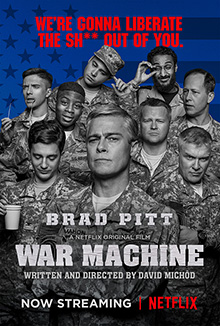
In stark contrast, War Machine (2017), directed by David Michôd and starring Brad Pitt, takes a satirical approach, parodying U.S. military leadership during the conflict. Based on Michael Hastings’ The Operators, the film critiques the hubris of figures like General Glen McMahon, a thinly veiled representation of General Stanley McChrystal. Pitt’s portrayal of McMahon humorously captures the absurdity of attempting to “win” a war where the objectives are ill-defined and strategies often backfire.
Moments of biting dialogue, such as Ben Kingsley’s depiction of former Afghan President Hamid Karzai lamenting the performative nature of his role, underline the futility of American efforts to impose stability on Afghanistan. However, the film’s tone sometimes veers into caricature, leaving viewers uncertain whether they are meant to laugh or reflect critically. Its satire is sharp but uneven, and like 12 Strong, it falls short of truly engaging with Afghan perspectives or the lives of ordinary people caught in the conflict.
Lions for Lambs (2007), directed by Robert Redford, offers a more philosophical lens, weaving together the stories of two soldiers in Afghanistan, a professor challenging his students’ apathy, and a journalist navigating political spin in Washington. The film aspires to provoke deep reflection on the moral and political dimensions of the war, questioning the decisions of leaders while highlighting the courage of those who serve. Meryl Streep and Tom Cruise deliver boilerplate performances as a journalist and senator locked in a debate about the war’s justification and the role of the media in shaping public perception.
However, the film’s fragmented narrative and heavy-handed delivery dilute its impact. Its intellectual ambition is commendable, but its tendency to lecture rather than immerse audiences in its characters’ dilemmas limits its emotional impact. The story of the two soldiers, while poignant, is overshadowed by the film’s broader commentary on political cynicism and media complicity, leaving viewers with ideas to ponder but little to feel.
A more personal take on the war emerges in Whiskey Tango Foxtrot (2016), a dramedy based on journalist Kim Barker’s memoir of her time in Afghanistan. Starring Tina Fey as Kim, the film explores the chaotic world of war reporting and the personal toll it exacts. Through a mix of humor and drama, it captures the absurdities of life in Kabul, from the cultural barriers faced by journalists to the moral ambiguities of their work.
Kim’s journey from a greenhorn to a seasoned reporter, while engaging, sometimes overshadows the broader context of the war. The film emphasizes her personal growth and professional challenges, but in doing so, it skirts deeper questions about the media’s role in shaping perceptions of the conflict. While it offers glimpses into the lives of Afghan civilians and the impact of war on local communities, these moments are often secondary to Kim’s story.
Together, these films reflect the difficulty of encapsulating the U.S. War in Afghanistan in a single narrative. 12 Strong seeks to celebrate heroism but simplifies the realities of warfare. War Machine exposes the absurdity of military leadership but occasionally loses focus in its satire. Lions for Lambs aims to provoke intellectual debate but falters in its execution, while Whiskey Tango Foxtrot humanizes the war’s impact on individuals without fully engaging with its systemic complexities. Each film offers a perspective on the conflict, but all fall short of portraying the full scope of its contradictions and consequences.
The Afghanistan War itself was a protracted and complicated endeavor. Launched in response to the September 11 attacks, its initial objectives of dismantling Al-Qaeda and overthrowing the Taliban expanded into a nation-building mission. Over two decades, shifting strategies, inconsistent political will, and mounting costs eroded public support. The war’s end in 2021, with the Taliban swiftly regaining control, underscored the challenges of imposing external solutions on a deeply fragmented nation.
These realities are difficult to convey in film, and the shortcomings of these four works highlight the challenge of translating such a sprawling and ambiguous conflict into coherent, compelling storytelling. Each attempts to grapple with aspects of the war, but none fully captures its contradictions, leaving the true story of Afghanistan’s impact—and its lessons—still waiting to be told.

 M.A. Kleen
What are your thoughts?