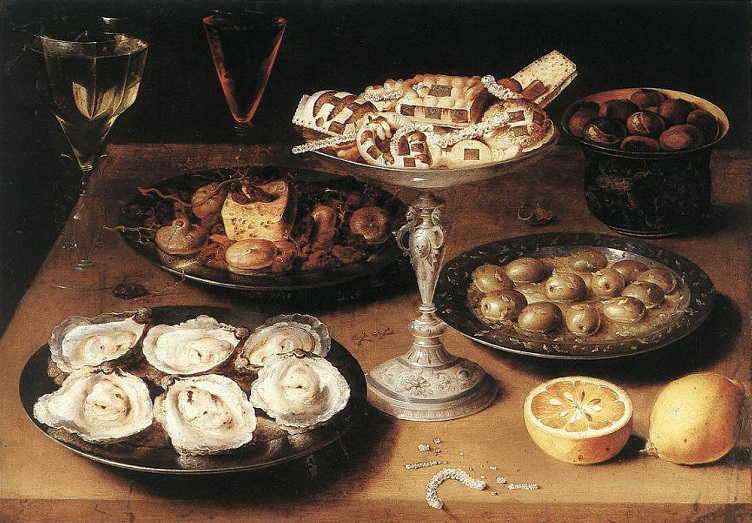
Food has long been more than just sustenance in American culture—it’s a symbol of community, faith, and even rebellion. From the Pilgrims’ feast with the Wampanoags to the Boston Tea Party and Southern traditions rooted in African heritage, explore how food has shaped America’s history, identity, and enduring traditions.
Food and religion have always been deeply intertwined in American culture. So much so that every November, we come together as a nation to celebrate abundance with Thanksgiving. The imagery of colonists and American Indians sharing a bountiful harvest, reminiscent of Jesus’ Last Supper, serves as a powerful metaphor for food’s role as a unifying force in society.
Land of Plenty: Early Colonial Abundance
When the first colonists arrived, they encountered a land teeming with natural resources. At Plymouth Colony in 1621, for instance, a storm left the beach covered in piles of lobsters stacked two feet high. Lobsters were so plentiful and easy to gather that they were considered food only fit for the poor. In Eating in America, Waverley Root and Richard de Rochemont noted this abundance, adding that the storm also left pools of crabs along Virginia’s shores.
At Jamestown, Captain John Smith marveled at the abundance of fish, writing that they “took more in one hour than we could eat in a day.” Colonists were awestruck by the size of the salmon, strawberries, and lobsters in the New World. But even this abundance had its limits: the Pilgrims, overwhelmed by clams and mussels, fed them to their hogs rather than eat them themselves.
Breaking Bread: A Religious and Cultural Tradition
The act of sharing food has roots in the Judeo-Christian tradition, where breaking bread with others is a sacred act of community and gratitude. It’s no surprise, then, that the Pilgrims chose to share a feast with the Wampanoags after surviving their first harsh winter in New England. This meal would eventually inspire Thanksgiving, a national holiday centered around gratitude and the communal joy of sharing food.
Even in his early experiences in the New World, John Smith observed the joy of dining together. Celebrating his first Christmas with the Powhatans, he noted, “We were never more merry nor fed on more plenty of good oysters, fish, flesh, wildfowl, and good bread, nor ever had better fires in England.”
Food, Protest, and Revolution
A century later, food and drink were central to colonial grievances against Britain. The Tea Act of 1773 led to the famous Boston Tea Party, where fifty colonists, disguised as Native Americans, dumped 90,000 pounds of tea into Boston Harbor. Tea had become more than a drink; it was a symbol of British oppression under mercantilist policies. The British also taxed other staples, such as Madeira wine, exacerbating tensions with colonial merchants like John Hancock.
Root and de Rochemont noted that “foodstuffs have to be counted among the causes of the American Revolution.” Even as the Continental Army struggled to acquire weapons and clothing, they ensured supplies of sugar, ginger, rum, and molasses—essential provisions for morale and sustenance during the war.
Food in the American South: A Cultural Anchor
Food also played a central role in the lives of enslaved Africans and their descendants. In the South, food wasn’t just sustenance; it was a cornerstone of social interaction and cultural preservation. Pamela Kittler and Kathryn Sucher, in Food and Culture in America, observed that “food is lovingly prepared for family and friends. The sharing of food is considered an important factor in the cohesiveness of southern Black society.”
This reverence for food wasn’t confined to the enslaved. Antebellum Southern masters also prized lavish meals. A visitor to Montgomery, Alabama, in the 1830s described a breakfast table overflowing with cornbread, buckwheat cakes, fish, chicken, beefsteak, hominy, bacon, and eggs—a testament to the South’s emphasis on abundance.
Jualynne Dodson and Cheryl Gilkes, scholars of religion and sociology, highlighted the communal significance of food in Afro-Christian traditions. They noted that the act of sitting at the “welcome table” to share food was deeply rooted in African traditions and played a key role in fostering community.
Food as a Unifying Force in American Culture
From the abundance of the New World to the symbolic significance of bread and wine in Christianity, food has always been more than just nourishment in American life. It has been a source of connection, a catalyst for protest, and a symbol of abundance.
Christianity, which ties “breaking bread, drinking wine, and praising God” into one unified practice, has made these rituals accessible to people from all walks of life. The abundance of farmland and livestock in America only amplified this unifying effect. As a result, food remains a central thread in the fabric of American culture—one that we celebrate together every Thanksgiving.
In America, food tells a story. It speaks of survival, community, and the shared joy of abundance, reminding us why it is so central to our identity as a nation.
Dodson, Jualynne and Cheryl Gilkes. “’There’s Nothing Like Church Food’: Food and the U.S. Afro-Christian Tradition: Re-Membering Community and Feeding the Embodied S/spirit(s).” Journal of the American Academy of Religion 63 (Autumn 1995): 519-538.
Kittler, Pamela Goyan and Kathryn Sucher, Food and Culture in America: A Nutrition Handbook. New York: Van Nostrand Reinhold, 1989.
Root, Waverley and Richard de Rochemont, Eating in America: A History. New York: William Morrow and Company, Inc., 1976.

 M.A. Kleen
What are your thoughts?