Veteran pollster Ann Selzer, once celebrated for her accuracy, is facing the fallout from a catastrophic polling error in the 2024 presidential election. Her abrupt retirement raises questions about the impact of partisan bias on professional credibility and the lasting consequences of allowing politics to overshadow objectivity.
Every 2 to 4 years, celebrities and professionals from all walks of life put everything on the line, hoping their voice will be the one to persuade you to support their preferred candidate. Everyone is human, after all, and it’s natural to want to use one’s position of influence to promote ideas and candidates they support. However, being human also means that even the best and brightest among us are not immune to the grip of partisan fervor.
Case in point: veteran pollster J. Ann Selzer, who recently announced her retirement following a significant misstep in predicting the 2024 presidential election, with her final poll missing the mark by a 16-point margin. Just days before the election, her firm, Selzer & Co., in partnership with The Des Moines Register, released a poll showing Kamala Harris (D) leading Donald Trump (R) 47% to 44% in Iowa, a historically conservative state. In reality, Trump won Iowa decisively, securing 56% to Harris’s 42.7%.
Sixty-eight-year-old J. Ann Selzer, who holds a Ph.D. in Communication Theory and Research from the University of Iowa, has had a storied career in polling. She spent decades working for The Des Moines Register and founded Selzer & Co. in 1996. Selzer earned widespread acclaim for her precision, most notably as the only pollster to accurately predict Barack Obama’s victory in the 2008 Iowa Democratic caucuses. Polling aggregator FiveThirtyEight gave her an A+ rating.
So, when The Des Moines Register published her poll on November 2nd, two days before the election, it created quite a sensation. Democratic pundits took this as evidence that Kamala Harris was poised to win in a landslide, that women angry over the Dobbs v. Jackson decision were rising up to dump Donald Trump into the political waste bin once and for all. There was only one problem: every other poll showed Trump leading Harris in Iowa by a significant margin.
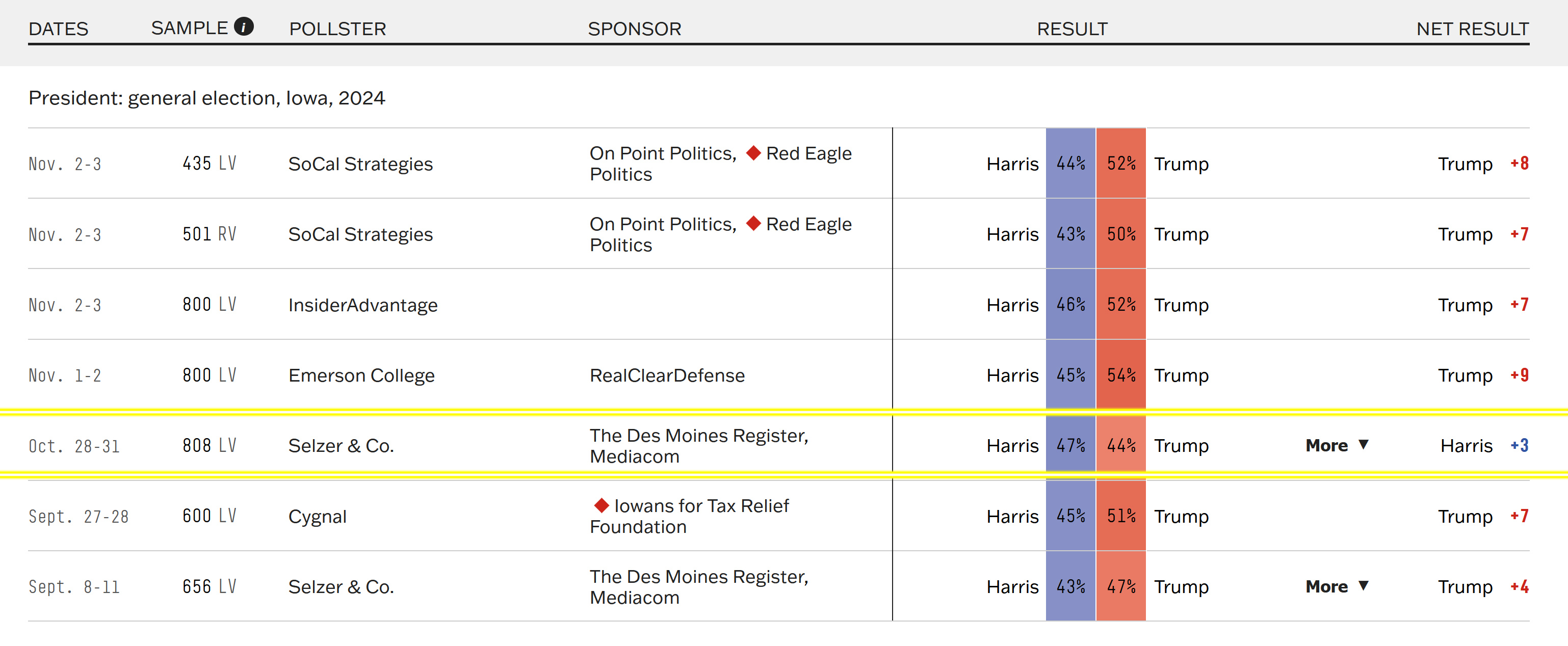
Even Selzer & Co. published a September Iowa poll showing Trump with a 4-point lead. So what happened? Well, if you look at the polling aggregates, Harris maintained a 2.5 to 3% average lead over Trump nationally until late October, when she started to slip. Despite spending over a billion dollars on advertisements and celebrity endorsements, a series of embarrassing interviews began to cut into Harris’ lead. She needed something to regain momentum, or at least the appearance of it.
Then Ann Selzer entered the spotlight with her outlier poll showing Harris ahead in one of the least likely battlegrounds, giving Democrats a critical morale boost. Selzer hardly contained her joy during her media appearances, attributing Harris’ supposed lead to women breaking for her by historic margins, driven largely by the abortion issue. However, the results were way off the mark. Nationally, Harris received 2% less support from women compared to Biden in 2020, while Trump gained 3% more support from women than he had in the previous election.
In Iowa, exit polls revealed that only 12% of voters identified abortion as the most important issue facing the country in the 2024 election. In contrast, 42% highlighted the economy as their primary concern, followed by immigration at 20%.
Not only did Donald Trump ultimately win Iowa, he won the electoral college, every swing state, and the popular vote.
Ann Selzer announced her retirement from polling on November 17th, stating that she had decided to step back from her “life’s work” a year earlier. Curiously, she had never mentioned any plans to retire in her numerous pre-election interviews. While it’s true that election outcomes are inherently difficult to predict and even the best pollsters frequently miss the mark, it’s unusual for a seasoned professional to step away due to a mere misstep. One off-target prediction typically isn’t enough to prompt such a sudden exit.
It’s more likely that Selzer, herself a Harris supporter, allowed wishful thinking and political bias to seep into her polling methodology and data interpretation. At a time when Democrats were desperate for anything to shift the narrative and generate election-day momentum, Selzer seemed more than willing to step into that role. By doing so, she not only damaged her once-stellar reputation but also effectively discarded a lifetime of professional achievements. Her decision to retire now only cements this colossal error as the defining moment of her career.
In fields like polling and data analysis, objectivity is everything. While biases may inevitably creep in, the goal is to minimize their influence and earn trust across the spectrum. Ideally, anyone—regardless of their affiliation—should be able to rely on your data and analysis. Your professional reputation hinges entirely on the trust and confidence others place in your work.
Selzer is far from the only public professional to sacrifice everything on the altar of partisan politics, and she won’t be the last. But her experience should be a lesson to those in positions of influence: credibility is hard-earned and easily lost. Allowing personal biases to overshadow professional standards not only undermines trust but can also destroy a lifelong reputation in an instant. In a world increasingly divided by partisan fervor, maintaining objectivity and integrity isn’t just important—it’s essential for preserving the public’s faith in experts and institutions.


 M.A. Kleen
What are your thoughts?