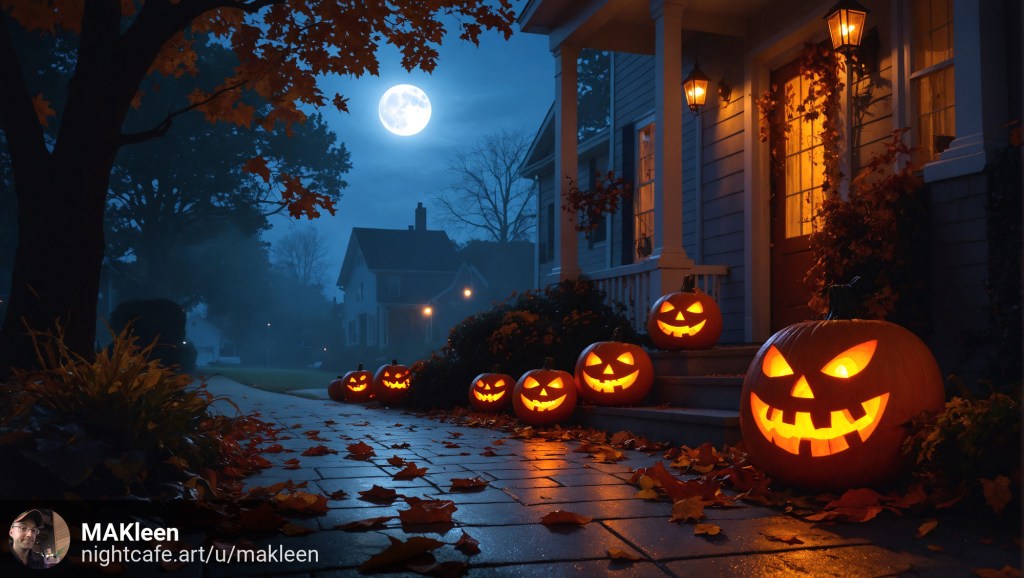
Is Halloween truly a dark, pagan celebration, or has it been misunderstood and misrepresented over time? Explore how Halloween’s roots in community and Christian tradition have been overshadowed by modern myths—and why it is time to reclaim the holiday’s joyful, unifying spirit.
Is Halloween an evil holiday? Is it secretly pagan? Is Halloween too dangerous for children to celebrate? These are questions that, unfortunately, many parents find themselves asking each year. Reflecting back to my childhood in the 1980s, I vividly remember trick-or-treating with my older sister when I was young, and later on, going out with a group of friends. We’d start as dusk fell or even after dark, and afterward, we’d join our parents for a Halloween party at a neighbor’s house. Nearly every home was decorated.
Years later, during my college days, I visited my then-girlfriend’s family for Halloween in a small town in central Illinois. The experience was a shock. Parents in this town drove their children from house to house, accompanying them to each door—though few even came to the doors. The goal seemed to be to “hurry up and get away” from neighbors as quickly as possible. As we drove through town, I noticed how few homes were decorated. Where was the sense of community I remembered from my childhood?
In recent years, Halloween seems to have evolved into just another excuse for twenty-somethings to wear “sexy” costumes and get drunk, often without the festive, child-centered spirit of the past. What happened to the Halloween I knew?
In the early 2000s (since re-published elsewhere), Scott P. Richert, former editor of Chronicles Magazine and now the publisher of Our Sunday Visitor, wrote several insightful articles addressing the intersection of Catholicism and Halloween, why Christians should celebrate it, and where many Halloween misconceptions stem from. These articles should resonate with secular readers, too, as they explore Halloween’s cultural and social significance.
In his article “Halloween, Jack Chick, and Anti-Catholicism,” Richert examined the roots of modern misunderstandings about Halloween. He recounted Halloween traditions of the 1970s, which resonated with me as they closely mirrored my own experiences a decade later. Richert explained that in 1980, a fundamentalist named Jack Chick began publishing anti-Catholic tracts, which targeted Halloween as well. I remember seeing some of those comics as a child.
In 1986, Chick released a pamphlet explicitly condemning Halloween (All Hallows Eve) and All Saints Day, claiming the holiday derived from pagan Druid practices. However, Druidism had effectively ceased over 400 years before the creation of All Hallows Eve and All Saints Day. Chick also argued that Halloween marked “Satan’s birthday,” a belief that still lingers in certain circles. Richert concluded that Chick’s pamphlets contributed significantly to Halloween’s tarnished reputation, leading some parents to avoid celebrating it with their children.
In another article, “Why the Devil Hates Halloween,” Richert presented a compelling case against the idea that Halloween is a “Devil’s holiday.” Instead, he suggested that Halloween can be a holiday that unites communities and fosters values like generosity, gratitude, and neighborly love. Richert argued that the holiday gives people an opportunity to express these virtues and resist the negative aspects of modern life.
He noted, “The Devil hates that we celebrate the vigil of All Saints Day by living out some of the virtues of those saints, here and now, among family and friends.” He concluded that Halloween can be a meaningful occasion, one that brings people together for joy and community, elements he argued the Devil would oppose.
In his article “Should Catholics Celebrate Halloween?” Richert answered with a resounding “Yes!” Halloween, a contraction of “All Hallows Eve,” serves as the vigil for All Saints Day, a time when Catholics honor the saints and the souls in Heaven. Like other Christian holidays, Halloween integrated some folk traditions over time. Richert explained that Puritans in England first condemned Halloween, along with other holidays they considered “too Catholic,” as pagan.
Ironically, one of the most popular “Christian alternatives” to Halloween today is the “Harvest Festival,” which, Richert argued, actually shares more similarities with the Celtic Samhain than with the Christian All Saints Day. While celebrating a harvest is valuable in its own right, Richert suggested there’s no need to strip Halloween of its connections to the Christian liturgical calendar.
These articles provide invaluable context and history for parents interested in countering the fear-mongering and misinformation that often surround Halloween. Rather than an “evil” holiday, Halloween can be a vibrant celebration that fosters community and respect for the past. Halloween deserves to be celebrated by both the young and the old, connecting us with those who have passed on and with the community in which we live.


 M.A. Kleen
What are your thoughts?