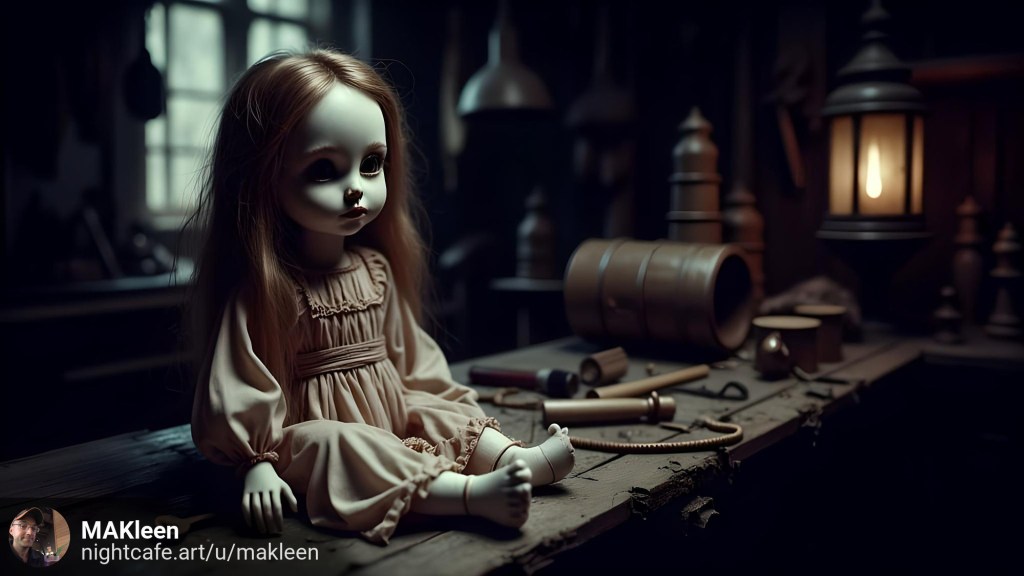
Please enjoy this horror short, part of a series experimenting with artificial intelligence. I fed a location, plot, characters, scenario, and mood into ChatGPT and asked it to craft a story, then used Stable Diffusion XL to create an illustration. How did it turn out? Well, you be the judge.
When antique dealer Lydia Winters visits a reclusive dollmaker’s eerie workshop, she discovers his dark secret: the souls of the living are trapped inside his lifelike dolls. As the trapped souls whisper for help, Lydia must uncover the truth before she becomes the next victim in his twisted collection.
Lydia Winters had always been drawn to the peculiar. As an antique dealer specializing in rare, one-of-a-kind artifacts, she had seen her fair share of oddities: clocks that chimed at strange hours, mirrors that seemed to distort more than just reflections, and paintings with eyes that followed you across the room. But nothing intrigued her quite like the dolls—antique, hand-painted, porcelain dolls. There was something unnervingly lifelike about them, as if they harbored secrets within their glassy eyes and delicate frames.
So when she received a cryptic letter from a reclusive dollmaker in a distant village, offering her the chance to acquire his “final collection,” she couldn’t resist. The letter had been brief but compelling:
Dear Ms. Winters,
I hear you are a connoisseur of the unique. I invite you to my workshop to see my life’s work—the last of my creations. You may find them… unlike any you have ever seen.
Sincerely,
Gregor Faust, The Dollmaker
Lydia drove for hours through dense woods, winding her way through the misty, forgotten countryside until she arrived at a small, decrepit village where the Dollmaker’s workshop stood. The building was ancient, weathered by time and overgrown with vines, its windows obscured by layers of dust. As she approached the door, a strange unease settled over her, but she dismissed it. She had come too far to turn back now.
The bell above the door jingled softly as she stepped inside.
The workshop was unlike any place Lydia had ever been. Shelves lined the walls, each crowded with dolls of all shapes and sizes. The air was thick with the smell of varnish and old wood, mingled with a faint sweetness, like decaying flowers. Sunlight filtered weakly through the grime-covered windows, casting long shadows across the room. Every surface was cluttered—tools for carving, paints, brushes, and fabrics were strewn about haphazardly. But it wasn’t the disarray that unnerved Lydia.
It was the dolls.
They stared down at her from their perches, their painted faces frozen in serene, lifeless expressions. Yet, as she moved through the room, she couldn’t shake the feeling that they were watching her, that their unblinking eyes followed her every step.
“Ms. Winters,” a voice rasped from the shadows.
Lydia jumped and spun around. From behind a heavy curtain at the back of the room, a tall, thin man emerged. He was gaunt, with sunken eyes and a sharp, angular face, his skin pale as parchment. His clothes were old-fashioned, a bit tattered, and he walked with a slight limp, but his hands—his hands were immaculate, long and slender, the hands of an artist.
“Mr. Faust?” Lydia asked, composing herself.
He nodded slowly, his eyes never leaving her. “You’ve come for the dolls?”
Lydia swallowed the lump in her throat and nodded. “Yes. You said you had a collection for sale?”
Faust’s lips curled into a faint smile. “Oh, indeed. They are my finest work. My life’s work. But they are not for just anyone. They are… special.”
He gestured for her to follow him deeper into the workshop, past rows of eerily lifelike dolls. Lydia’s heart pounded as they walked. The dolls were too perfect, their skin too smooth, their eyes too bright, too real.
“How did you make them so… lifelike?” Lydia asked, her voice tinged with curiosity and fear.
Faust paused, his smile fading. “A doll, Ms. Winters, is more than just porcelain and paint. To create something truly lifelike, one must capture more than appearance. One must capture the essence of life.”
Lydia frowned. “Essence?”
Faust nodded again, this time more solemnly. “Souls.”
Lydia laughed nervously, waiting for Faust to say he was joking, but his expression remained dead serious. The air in the room seemed to grow colder, and she suddenly became aware of the low murmuring sounds—like distant whispers—coming from the shelves of dolls.
“You’re not serious,” she said, forcing a smile. “That’s impossible.”
Faust moved to a nearby table, where a half-finished doll lay, its porcelain face blank, its glass eyes yet to be set. “What you see before you, Ms. Winters, is merely a vessel. A doll is hollow until it is filled with something more… enduring. Something immortal. I have perfected the art of soul transference.”
Lydia felt her stomach drop. “H… How?” she squeaked.
Faust didn’t answer immediately. Instead, he picked up a small, ornate mirror from the table and handed it to her. It was an antique, the silver frame tarnished but beautiful, its surface smooth and reflective.
“This is the key,” he said softly, his voice barely more than a whisper. “Through this mirror, I can capture a soul’s reflection. The essence of life that resides within each person—their very spirit—becomes trapped. From there, I transfer it into my dolls, where they remain forever.”
Lydia’s hand trembled as she held the mirror. She glanced at the reflection and saw her own wide, fearful eyes staring back at her.
“This is madness,” she muttered, backing away. “You’re telling me you’ve imprisoned people inside these dolls? That’s… that’s—”
“Murder?” Faust finished for her, his voice calm, almost kind. “No, Ms. Winters. These people are not dead. They live on, preserved for eternity, free from the decay of flesh. Isn’t that what everyone desires? To escape death?”
Lydia looked around the workshop in horror. The whispers were louder now, more urgent. She could hear faint voices, pleading, calling out from the shelves.
“They’re still… aware?”
Faust tilted his head slightly, considering her question. “Yes. They are aware. But they grow quieter over time, as they accept their new reality. Some, however…” His eyes flicked toward a particularly large, ornately dressed doll in the corner. “Some resist.”
Lydia dropped the mirror, her heart racing. “This is insane. You’re insane! I’m leaving.”
She turned to run, but Faust moved with surprising speed, blocking her path.
“I cannot let you leave, Ms. Winters,” he said softly. “You’ve seen too much.”
Lydia’s mind raced as she tried to find a way out. Her eyes darted to the door, then back to Faust, who stood calmly before her. His calmness unnerved her even more.
“Why?” she demanded. “Why are you doing this? What could possibly drive you to such madness?”
Faust’s expression darkened, his eyes clouded with a deep, ancient sorrow. “I was once like you,” he began, his voice low. “A man of the world, fascinated by beauty, by art, by the fleeting nature of life. But then, I lost the one thing that mattered most to me—my wife, Elara. She was… everything.”
His hands trembled as he spoke her name, the pain of the memory evident in his hollow gaze.
“When she died, I could not accept it. I sought a way to bring her back, to preserve her beauty, her essence. And I found it. The mirror,” he said, nodding toward the ornate object on the table. “It holds power beyond understanding. I captured her soul—trapped it in one of my dolls.”
Lydia’s breath caught in her throat as she followed his gaze to the large, regal doll in the corner. Its dress was elaborate, its face more perfect, more detailed than the others. Elara.
“But it wasn’t enough,” Faust continued, his voice barely a whisper. “The soul… it needs others to survive. I had to keep feeding it, keep capturing more souls to sustain her. She demanded it.”
Lydia’s eyes widened in horror. “She demanded it?”
Faust nodded, his face twisted with grief. “She spoke to me. She said she was lonely, that she needed companions, that she needed more souls to stay… alive.”
He stepped toward her, his eyes filled with desperation. “Don’t you see? I had no choice. It was the only way to keep her with me.”
Lydia shook her head, tears brimming in her eyes. “You’ve been murdering people for centuries.”
“No,” Faust said, his voice rising. “I’ve been saving them! Preserving them! Would you rather let life slip through your fingers, to let beauty decay and wither away? This is immortality, Ms. Winters. This is salvation.”
The whispers grew louder now, filling the room with a cacophony of voices—pleading, crying, whispering in languages long dead. Lydia could hear them clearly, their anguish unmistakable.
“They want to escape,” she whispered, looking around at the shelves of dolls. “They don’t want to be trapped in those bodies.”
Faust’s face twisted with anger. “They don’t understand. They don’t appreciate what I’ve given them.”
Before Lydia could respond, she felt something cold brush against her hand. She gasped and looked down—one of the dolls had moved. Its tiny porcelain fingers clutched at her sleeve, its painted eyes wide with terror.
“Help us,” the doll whispered, its voice barely audible but filled with unmistakable desperation. “Free us.”
Lydia stumbled back, horrified. The dolls could move. They were alive—trapped, aware, and suffering.
The workshop seemed to shift around her, the air thickening as the energy in the room intensified. More dolls began to move, their heads turning, their tiny hands reaching out.
“Free us,” they whispered in unison.
Faust’s expression darkened. “They are confused,” he said, stepping closer to Lydia. “They don’t understand that this is for their own good.”
Lydia’s heart pounded in her chest as she realized what she had to do. The mirror—the key to everything—was still on the table. If she could break it, maybe—just maybe—she could free the souls trapped inside the dolls.
She lunged toward the table, but Faust was faster. He grabbed her arm and pulled her back with surprising strength.
“You don’t know what you’re doing!” he hissed. “If you break the mirror, you’ll destroy them all!”
Lydia struggled against him, her mind racing. Could she trust him? Would breaking the mirror really destroy the souls? Or would it set them free?
The dolls continued to whisper, their voices growing louder, more frantic. “Free us.”
With a burst of adrenaline, Lydia broke free of Faust’s grip and grabbed the mirror. Without hesitation, she slammed it against the floor.
The mirror shattered, and for a moment, there was silence—complete, terrifying silence.
Then the room exploded with light.
The dolls screamed, their voices rising in a deafening chorus as the shards of the mirror reflected a blinding, otherworldly light. Faust cried out, his face contorted in agony as the energy from the broken mirror surged through the workshop.
Lydia shielded her eyes, backing away as the dolls began to collapse, their porcelain faces cracking, their glass eyes shattering. The souls—twisted, ghostly forms—rose from the broken dolls, swirling around the room like a violent storm.
“No!” Faust screamed, reaching out to the dissipating souls. “Elara! Come back!”
But it was too late. The souls, freed from their porcelain prisons, vanished into the ether, leaving the workshop in ruins. The walls began to tremble, and the shelves collapsed, sending broken doll parts crashing to the floor.
Lydia ran, stumbling over debris as the workshop began to collapse around her. She barely made it out the door before the entire building caved in, burying Faust and his twisted creations beneath the rubble.
Lydia stood outside the ruins, her heart pounding in her chest. The sun had begun to rise, casting a faint golden light over the wreckage. The air was still now, the whispers finally silenced.
She stared at the collapsed workshop, unsure of what to feel. The dolls were gone. The souls were free. But the weight of what she had witnessed lingered, heavy and suffocating.
As she turned to leave, a cold breeze brushed against her skin, and she thought she heard, just for a moment, the faintest whisper.
“Thank you.” And then, there was only silence.

 M.A. Kleen
What are your thoughts?