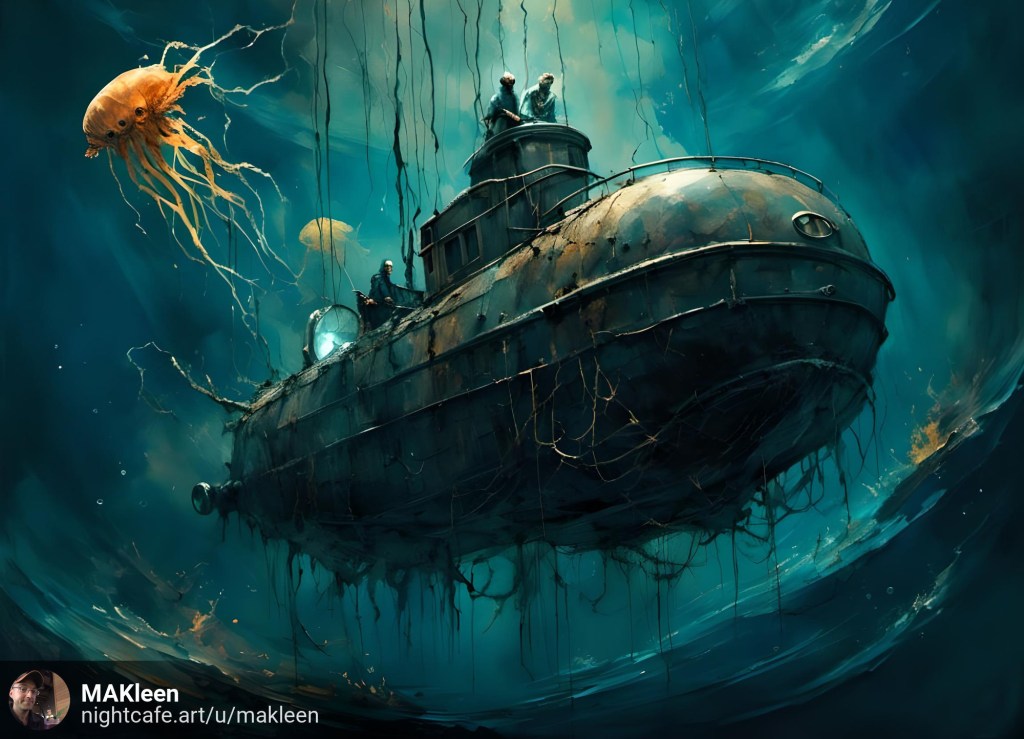
Please enjoy this horror short, part of a series experimenting with artificial intelligence. I fed a location, plot, characters, scenario, and mood into ChatGPT and asked it to craft a story, then used Stable Diffusion XL to create an illustration. How did it turn out? Well, you be the judge.
In the heart of the Atlantic, where the sea is a vast and hungry void, the crew of the Melancholia encounters a monstrous, ancient force lurking in the depths—its haunting song promising madness and death. As they descend into the abyss, the line between reality and nightmare begins to blur.
The sea was a void. No horizon, no land, just an endless stretch of water darker than the night sky above it. Elias Reed leaned against the deck rail of the Melancholia, a bulky research submersible, staring into that unfathomable blackness. The cold wind bit at his face, carrying with it a scent that made his stomach twist. It wasn’t the familiar tang of saltwater. No, this smell was far worse—fetid, metallic.
“How long since we lost sight of the coast?” he asked, his voice barely audible over the wind.
Captain Alistair Thorne stood beside him, his gnarled hands gripping the railing. He didn’t answer at first. His eyes, sharp but hollow, scanned the distance as if waiting for something to rise from the depths.
“Three days,” the captain finally said, his voice hoarse. “Three days since we entered the Devil’s Throat.”
Elias shivered at the name. The Devil’s Throat—a vast, uncharted trench in the heart of the Atlantic, a place spoken of in whispers by the old sailors. No maps dared mark its exact coordinates, and no ship that ventured there ever returned to tell its tale. The sea itself, they said, was alive in that region, as if the ocean had a mind, a will, and a hunger.
“We should turn back,” Elias muttered. He hated how small his voice sounded, how cowardly. But the dread gnawing at his bones had been growing ever since they crossed that invisible line into the abyssal region.
“And go where?” Thorne grunted, glancing over his shoulder at the skeleton crew huddled on deck. “We’re out of provisions. Storms took most of ‘em. We’re off course and God knows how far from any port.”
Elias swallowed hard, his throat dry. He had been hired on as a marine biologist, tasked with studying strange oceanic lifeforms that had been reported in this part of the Atlantic. Yet he had never anticipated the terror that came with the sheer isolation of the sea—how small and fragile a man felt upon its surface, as if one wrong move would send him plummeting into the yawning abyss below.
A low creak from the Melancholia’s hull made both men tense. The ship had been groaning more frequently over the past day, as if protesting their journey. The captain had said it was the deep pressure—there were whispers of the trench pulling on the ship, dragging them ever closer to its heart.
“Best get some rest,” Thorne said, breaking the silence. “We make no progress tonight.”
Elias nodded, though he doubted he would find sleep. His mind was too full—of that endless black water, of the strange, haunting dreams that had plagued him ever since they crossed into this forsaken territory.
As he turned to leave, the sea moaned—a deep, guttural sound that reverberated through the submersible’s hull. Elias froze, his heart racing. It was not the wind, nor the creak of the ship. This was something else. Something alive.
Thorne’s eyes met his, wide and alarmed. “Get below deck,” the captain growled.
The command was barely out of his mouth when the ship lurched violently. Elias was thrown to the ground, sliding across the wet metal hull plates. A scream pierced the air—one of the crew, swallowed by the sudden chaos.
And then, rising from the depths, came the song.
Elias struggled to his feet, heart pounding. The sound—high-pitched, melodic, and yet alien—was seeping into his bones. The ship rocked violently again, nearly capsizing. Around him, the crew scrambled, shouting incoherently.
“Get the nets!” someone yelled. “Something’s tangled in the rigging!”
Elias staggered toward the sound, eyes squinting against the wind and salt spray. He reached the starboard side where several men were gathered, staring at the churning water below. Their faces were pale, eyes wide with fear.
“What is it?” Elias demanded, grabbing the arm of a sailor.
The man’s lips moved, but no sound came out. He pointed a shaking finger toward the waves, and Elias followed his gaze.
At first, he saw nothing but the roiling sea, its surface broken by whitecaps. But then—something moved. A glint of silver beneath the surface, writhing, enormous.
“Dear God…” Elias whispered.
The thing that had tangled itself in the nets was no ordinary creature. Its body, long and serpentine, glistened like polished stone. Tendrils—dozens of them—unfurled from its sides, wriggling grotesquely as if searching for purchase on the ship. Its head, vaguely humanoid but twisted and monstrous, rose above the water. Large, hollow eyes stared up at them, unblinking.
The song was louder now, emanating from the creature itself, reverberating through the air like the toll of a distant bell. Elias clapped his hands over his ears, but it did nothing to muffle the sound.
“It’s the siren…” Thorne’s voice was barely a whisper, but Elias heard him clear as day. The captain had joined them, staring at the creature with a mixture of horror and resignation.
“We need to cut it loose!” Elias shouted, but his words were drowned out by the rising cacophony. The other men—what few remained—seemed transfixed, their eyes glazed as if in a trance. They weren’t moving. They weren’t even blinking.
With growing dread, Elias realized they were no longer in control of themselves. The song had them.
Desperate, he lunged for the emergency axe, raising it to the ropes that held the net. But before he could swing, something cold and slimy wrapped around his leg.
He looked down, horrified, to see one of the creature’s tendrils coiling around his ankle. It was pulling him, slowly but surely, toward the edge of the ship.
“Help!” Elias screamed, but none of the crew moved. They stood like statues, their eyes locked on the creature, the song coursing through their veins like poison.
Elias clawed at the deck, trying to break free, but the tendril tightened, dragging him closer to the rail. His nails scraped against the metal, leaving bloodied trails. The cold, wet sensation of the creature’s grip made bile rise in his throat.
Just as he was about to be pulled overboard, a shot rang out. The tendril recoiled, releasing him, and Elias collapsed to the deck, gasping for air.
Captain Thorne stood above him, revolver in hand, smoke curling from the barrel.
“Get below deck, now!” the captain barked. His voice cut through the fog in Elias’s mind, and he scrambled to his feet, stumbling toward the hatch.
The last thing he saw before descending was the creature retreating into the depths, its haunting song fading as the waves closed over it.
But the terror was far from over.
The ship was eerily silent. The wind had died down, and the sea, though black as ever, was still. Elias sat in the dimly lit galley, his mind racing. The other crew members sat around him, faces pale and eyes hollow. None of them spoke. The only sound was the faint creaking of the ship and the distant lap of water against the hull.
Thorne stood at the head of the table, his face a mask of grim determination. “We’ve lost half the crew,” he said. “The sea’s taken them. And it’ll take the rest of us if we don’t act.”
“What was that thing?” Elias asked, his voice trembling. “That song… it—”
“It’s the abyss,” Thorne interrupted. “The sea’s alive out here. Things down there… they don’t belong to our world.”
Elias felt a chill run down his spine. “Then we turn back.”
Thorne shook his head. “Too late for that. We’re caught in it now. There’s no going back.”
“What do you mean, no going back?” one of the remaining crewmen demanded, his voice shaking. “You brought us here! You—”
“The Throat doesn’t let go,” Thorne said, his voice low. “Once it has you, it pulls you in.”
Elias’s heart pounded in his chest. “So what do we do?”
For a moment, no one spoke. Then, Thorne’s gaze shifted to a map spread out on the table. “There’s a way,” he said slowly. “But it’s dangerous. The trench has a heart—a place where it’s deepest. If we can reach it, maybe we can find what’s drawing us in and end this.”
Elias stared at him, incredulous. “You want to go deeper?”
“We have no choice.”
The Melancholia descended into the depths. The ocean, once merely black, had turned to an oppressive void. Elias stood by the observation window, staring into the abyss as the ship’s equipment creaked and groaned under the pressure. Outside, there was nothing. No fish, no light—just endless water, darker than any night.
The crew was silent, each man lost in his own thoughts. The farther they descended, the more the oppressive weight of the sea pressed down on them, not just physically, but mentally. It was as if the very presence of the abyss was creeping into their minds.
Then, out of the darkness, something moved.
Elias’s breath caught in his throat. At first, it was just a shadow, barely visible against the blackness. But as it drew closer, he realized it was not just one thing—it was many.
Shapes—large, serpentine—swam just beyond the reach of the ship’s lights. Their forms were indistinct, almost dreamlike, but their sheer size was unmistakable. They glided silently through the water, surrounding the ship.
“They’re here,” Elias whispered.
As if in response, the song began again, faint at first but growing louder with each passing second. The same eerie, otherworldly melody that had nearly driven them mad before.
“We’re close,” Thorne said, his voice tight. “Prepare yourselves.”
The ship descended further, and the shadows grew bolder, circling closer, their massive bodies brushing against the hull. The song was deafening now, filling the ship, filling their minds.
And then, below them, something vast appeared. The sea floor opened up into a massive chasm—an abyss within the abyss. At its center, pulsating with a sickly, greenish light, was a structure.
“It’s not natural,” Elias breathed. “It’s… alive.”
The ship hovered over the chasm, and the crew stood frozen, staring at the impossible structure below. It pulsed like a heartbeat, and with each pulse, the song grew louder, more insistent.
“We have to stop it,” Thorne said, his voice barely audible over the cacophony. “It’s what’s drawing us in.”
“But how?” Elias asked, fear gripping him.
Thorne turned to him, eyes dark. “We go down.”
The descent into the chasm was like entering another world. The air in the ship grew thick, oppressive, as if the abyss itself was closing in on them. Elias gripped the railing, his heart pounding in his chest.
The structure below them loomed larger with each passing second, its surface slick and pulsating, like the skin of some immense, ancient creature. Tendrils of bioluminescent light reached out from it, snaking through the water, brushing against the ship.
“This is madness,” Elias muttered. “We’re going to die down here.”
“Maybe,” Thorne said, his eyes fixed on the structure. “But we die either way.”
The ship touched down on the edge of the chasm, and the crew prepared to disembark. Elias’s hands trembled as he donned his diving suit, his mind racing with images of the things that lurked in the water outside.
As they descended into the depths of the structure, the song reached a fever pitch, vibrating through the walls, through their bones. It was no longer just a melody—it was a voice. A voice calling to them, beckoning them closer.
They reached the heart of the structure, a vast chamber lit by the sickly green glow. In its center was a mass—an enormous, pulsating organ, like the heart of some monstrous sea god.
Thorne stepped forward, eyes wide with awe and terror. “This is it,” he whispered. “This is what calls to the deep.”
Before Elias could stop him, the captain reached out and touched the mass. Instantly, the song stopped.
And then, the ocean screamed.
* * *
Elias didn’t remember how they escaped. The ship was on the surface now, the sun rising over a calm sea. The crew was gone—taken by the abyss, or perhaps consumed by the very thing they sought to stop.
He stood at the rail, staring out at the endless ocean. The fear, the horror—it was all still there, lurking just beneath the surface.
Because the sea remembers. And the abyss never forgets.
As the sun dipped below the horizon, Elias felt it again—the pull of the deep.
And in the silence that followed, he heard the song once more. The abyss was waiting.

 M.A. Kleen
What are your thoughts?