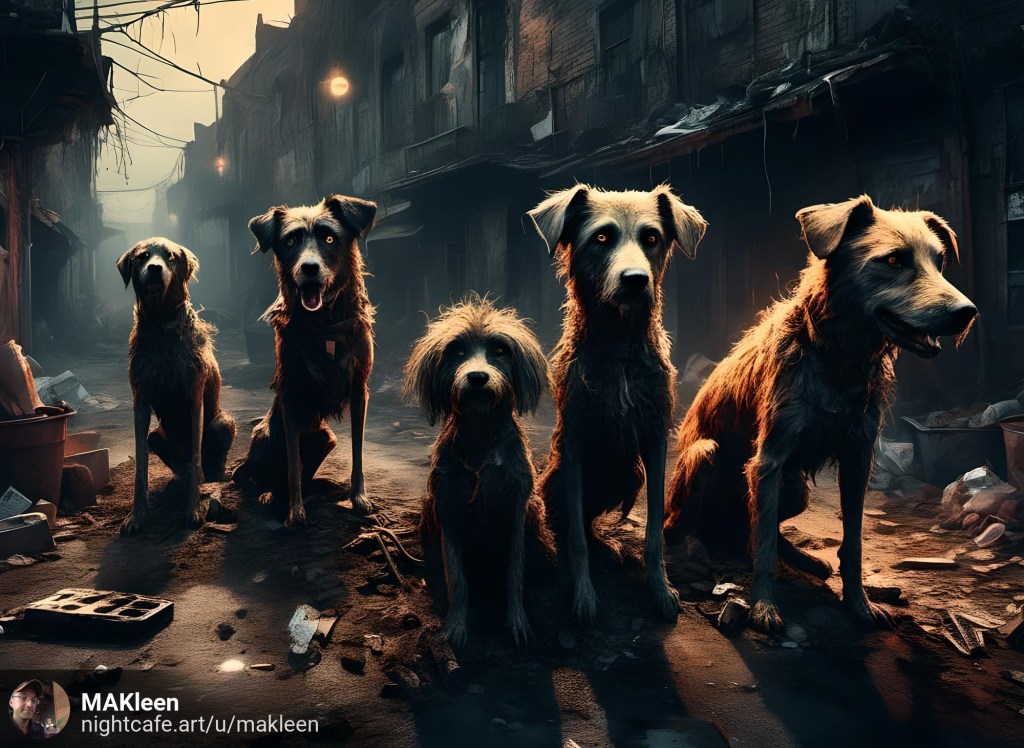
Please enjoy this horror short, part of a series experimenting with artificial intelligence. I fed a location, plot, characters, scenario, and mood into ChatGPT and asked it to craft a story, then used Stable Diffusion XL to create an illustration. How did it turn out? Well, you be the judge.
In the heart of a decaying city slum, a lone stray dog fights to survive as a mysterious illness known as “the mange” turns his fellow dogs into soulless, zombie-like creatures—and he knows he’s next.
I was born in an alley. My first memories are of cold metal and sharp stones beneath my paws, of my mother’s warmth as she nursed me, and the stench of garbage in the air. But that was long ago, and now I am alone.
I’ve been alone for weeks.
The city has a way of grinding you down. It’s loud, it smells bad, and food is scarce unless you’re good at scavenging. You learn to find food where you can: in the trash bins behind the restaurants, or in the market when a kind human tosses a scrap your way. But for dogs like me, the ones without homes, without collars, it’s every day’s battle to survive.
I am no stranger to death—there is always another dog lying dead in the gutter or missing when morning comes—but now it is different. Now something much worse has come.
It started with whispers.
I first heard the rumors from Snarl, an old mutt with a scar running down his face like a river of raised fur. We met near the docks one evening while scavenging. He growled at me as usual, trying to keep me away from his fish bones, but something was wrong. His eyes darted around nervously, more than usual.
“Stay away from the mangy ones,” he grumbled, pawing at his side.
I didn’t understand at first. Mange? Mange was nothing new in the slums. Dogs had been scratching themselves raw for as long as I could remember, myself included. It wasn’t pleasant, but you dealt with it. But the way Snarl said it, with fear in his voice, made my fur prickle.
“What do you mean?” I asked, my head low, trying not to show any aggression.
He growled softly, his gaze fixing on the distant street where dark figures limped in and out of the shadows. “It’s not the same. Not anymore. It’s spreading. It… it takes them.”
“Takes them?” I echoed. Snarl’s teeth flashed as he snapped at a rat scurrying too close.
“They ain’t the same once it gets ‘em. They ain’t… dogs no more.” He sniffed the air as if smelling something foul. “They’re… wrong. Stay away from the packs, kid. Trust me.”
I didn’t stay to ask more questions. Snarl had been getting twitchy for weeks, and I wasn’t about to waste time listening to the ramblings of an old dog. But after that night, I started noticing things.
The first was a change in the air.
The city was always rank with the smell of rotting food, stagnant water, and the exhaust of the human’s machines. But beneath it, something else was growing—a sickly sweet stench that clung to your fur, sticking in your nostrils no matter how hard you shook your head.
Then came the dogs. Dogs I had known for months—some, even years—began to vanish. Others, when they reappeared, were… different. Their eyes glassy, their movements stiff, like they were being dragged around by an invisible leash. At first, I thought they were just sick. Mange, yes, but mange had never done this. Mange made you itchy, made you weak, not… hollow.
It was late one night, huddled under an abandoned cart, when I saw it happen to a friend of mine. His name was Bristle. He was a tough dog, the leader of a small pack that roamed the outskirts of the market. Bristle was strong, smart. I looked up to him. We weren’t close, but we had a silent agreement not to mess with each other’s turf.
That night, Bristle was alone.
I could smell him before I saw him—a sharp, rancid odor that burned my throat. I slunk out from under the cart, staying low to the ground, my tail between my legs. I found him near the edge of the market, stumbling between stalls, knocking over crates of old fruit. His coat, once thick and brown, was patchy, tufts of fur hanging off his sides like dead grass. His ribs jutted out under his skin, and his eyes… his eyes were wrong.
They were empty.
I approached cautiously, sniffing the air. “Bristle?” I called out, ears flat.
He didn’t respond. He didn’t even turn to look at me. He just kept walking, staggering, his paws dragging across the pavement, leaving a trail of blood behind him. His skin was raw and red, his mouth hanging open, drool pooling at the corners. I watched in horror as he collapsed, his body shivering, convulsing, like something inside him was trying to tear its way out.
I froze. Every instinct told me to run, but I couldn’t move. I couldn’t look away.
Then he stopped shaking.
Bristle lay still for a moment, his chest barely rising and falling. I edged closer, my heart pounding in my chest. Was he dead? I whined softly, taking another step toward him.
And then, with a sound that made my skin crawl, Bristle lifted his head.
His neck twisted at an unnatural angle, his bones cracking as he slowly turned to face me. His eyes—those empty, glazed eyes—locked onto mine, and I felt a chill race down my spine. This was not Bristle. Not anymore.
A low growl rumbled from his throat, deep and guttural, a sound I had never heard from him before. His lips peeled back, revealing blackened gums and teeth that looked far too long, far too sharp.
I bolted.
I ran faster than I ever had before, my paws pounding against the pavement as I darted between alleys and streets, not stopping until I was sure I was far, far away from the market. My lungs burned, and my legs ached, but I didn’t stop. Not until I found a pile of old newspapers to hide under. I curled up tight, my body trembling, trying to make sense of what I had just seen.
Bristle wasn’t Bristle anymore.
The next few days passed in a blur. I avoided the usual places, keeping my distance from other dogs, from any sign of movement. Every time I caught that sickly sweet scent on the wind, I turned and ran in the opposite direction. I didn’t want to know who else had fallen to the mange. I didn’t want to see their eyes.
But the city was closing in around me.
Dogs were disappearing faster now, entire packs vanishing overnight. The streets were quieter than I had ever known them to be. The few dogs I did see were too far gone, their bodies twisted and decayed, their minds lost to whatever horror had taken them. They wandered the streets like ghosts, their jaws snapping at nothing, their eyes dull and lifeless.
And the smell. That horrible smell was everywhere now, thick in the air, clinging to my fur like oil. I couldn’t escape it. I couldn’t escape them.
One night, I returned to the alley where I had been born. I hadn’t been back in months, but I needed somewhere familiar, somewhere safe. But when I got there, it was empty. No signs of the old pack. No signs of life. Just silence.
I curled up in the corner, my body exhausted, my mind racing. I couldn’t stay here much longer. The mange was spreading, and I had no doubt it would find me eventually. I had to leave the city. I had to find somewhere far away from the packs, from the stench, from the sickness.
But as I lay there, the cold concrete against my side, I realized something terrifying. Something that made my heart stop in my chest.
I had been scratching.
Not much at first, just a little. A paw behind my ear here and there, nothing unusual. But now… now I could feel it spreading. The itch. The heat beneath my skin. I tried to ignore it, tried to pretend it wasn’t happening, but deep down, I knew.
I was already infected.
It was only a matter of time.
I didn’t want to go like Bristle. I didn’t want to lose myself, to become one of those empty shells wandering the streets, searching for something they couldn’t remember. But what choice did I have? There was no cure, no escape. The mange was relentless, unstoppable.
As the days passed, I felt myself slipping. The itch grew worse, spreading down my legs, across my belly. My fur fell out in clumps, and the sores began to open, weeping and raw. I could smell myself now, that same sickly-sweet odor that had clung to the others. The smell of death.
I didn’t want to become like them, but I knew I couldn’t stop it. My body was failing, my mind unraveling. I found myself wandering the streets, not knowing where I was going, not caring. The city blurred around me, a maze of shadows and sounds that no longer made sense.
And then, one night, as I limped through a darkened alley, I saw him. Bristle.
He was waiting for me, his body hunched and broken, his eyes glowing faintly in the dark. Behind him, more shapes emerged from the shadows—dogs I had known, dogs I had once called friends. They were all there, waiting.
Waiting for me.
I stopped, my legs trembling, my heart pounding in my chest. I knew what they wanted. They wanted me to join them, to become one of them. I could feel the mange crawling beneath my skin, whispering in my ears, telling me to give in.
But I wasn’t ready. Not yet.
With a final burst of strength, I turned and ran, the sound of their growls echoing behind me. I didn’t know where I was going. I didn’t care. All I knew was that I couldn’t stop, not until my body gave out, not until the mange finally took me.
I ran until the world faded, until there was nothing left but darkness and the sound of my own labored breathing.
And then, at last, I was alone.
For now.


What are your thoughts?