Note: This article requires a basic knowledge of the game Hearts of Iron IV, its interface and mechanics. Watch some tutorials here or here.
The Hearts of Iron IV expansion Arms Against Tyranny, released in October 2023, was probably the largest rework of this popular WW2 grand strategy game to date. Among other things, it added special forces doctrines that greatly increased the specialization of mountaineers, marines, and paratroopers. At most, you can only unlock two of the three branches (with a special event at war after 1940), forcing you to decide which special forces most complement your strategy and play style.
The purpose of each branch should be obvious, but to summarize: Mountaineers are designed for fighting in hills and mountains, and to a lesser extent, winter weather. Marines are designed to conduct naval invasions and river crossings and negate the sharp penalty afforded to other units for doing so. Paratroopers are the only unit type that can be paradropped from transport planes.
But in a head-to-head fight, which leg infantry is the best? I wanted to find out.
The following chart compares a single battalion of infantry, mountaineers, marines, and paratroopers in 1936 without any additional technology or unlocked doctrines. All things are considered, they’re pretty evenly matched, although basic infantry has a higher HP, which means they can take more damage. They also have significantly lower training time.
| Battalion Attributes | Infantry | Mountain | Marine | Paratroopers |
|---|---|---|---|---|
| HP | 25.0 | 20.0 | 20.0 | 22.0 |
| Org | 60.0 | 70.0 | 70.0 | 70.0 |
| Recovery Rate | 0.30 | 0.40 | 0.40 | 0.40 |
| Weight | 0.5 | 0.5 | 0.5 | 0.5 |
| Supply Use | 0.06 | 0.05 | 0.05 | 0.05 |
| Soft Attack | 6.0 | 6.0 | 6.0 | 6.0 |
| Hard Attack | 1.0 | 1.0 | 1.0 | 1.0 |
| Defense | 22.0 | 22.0 | 22.0 | 22.0 |
| Breakthrough | 3.0 | 3.9 | 3.9 | 3.0 |
| Initiative | 0.00% | 0.00% | 0.00% | 0.00% |
| Combat Width | 2 | 2 | 2 | 2 |
| Training Time | 90 | 120 | 120 | 150 |
| Infantry Eq. | 100 | 140 | 150 | 130 |
| Terrain Mods | 0 | Hills: +10% movement, +20% attack, +5% defense. Mountain: +20% movement, +35% attack, +10% defense. | Marsh: +30% attack. River: +30% attack. Amphibious: +50% attack. |
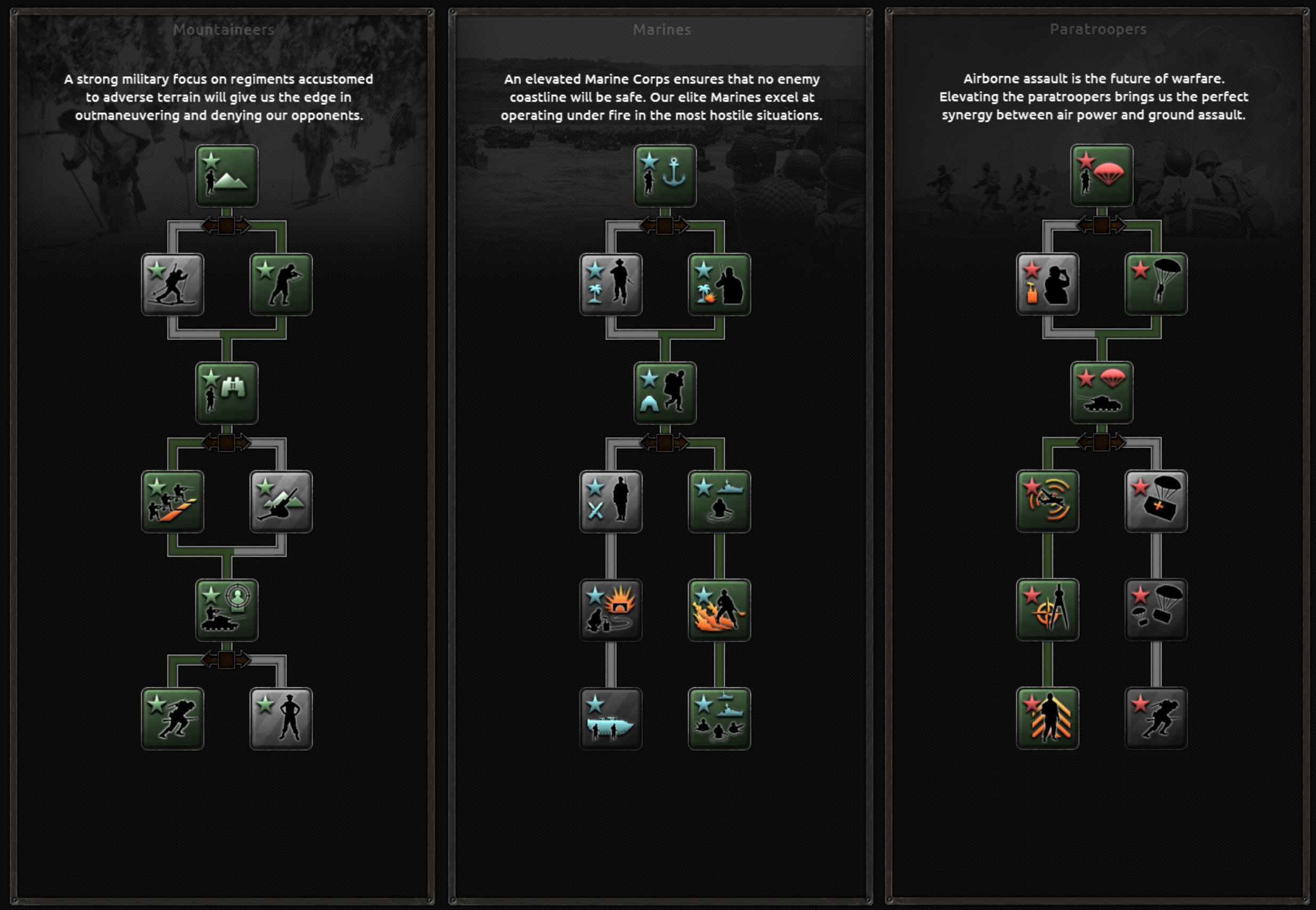
Below is a composite image of the new special forces doctrine trees added by Arms Against Tyranny. Unlocking them unlocks bonuses and unique support companies that boost stats better than their vanilla counterparts (rangers vs horse recon, for example). Generally, one side of the tree enhances the units themselves and the other side enhances terrain modifiers and special forces units broadly.
For the purposes of this article, I unlocked the branches that gave the biggest bonuses to the unit’s core stats. You can see all three special forces branches unlocked, so obviously I did this over multiple playthroughs.
The following chart compares a single battalion of infantry, mountaineers, marines, and paratroopers after all special forces doctrines and technology have been unlocked. Statistical changes are summarized in parentheses.
Right away, you can see that special forces get significant bonuses to organization and slight bonuses to soft attack over vanilla infantry. Their recovery rate is higher, and they use less supply.
| Battalion Attributes | Infantry | Mountain | Marine | Paratroopers |
|---|---|---|---|---|
| HP | 25.0 | 20.0 | 20.0 | 22.0 |
| Org | 60.0 | 95.0 (+25) | 90.0 (+20) | 90.0 (+20) |
| Recovery Rate | 0.30 | 0.40 | 0.40 | 0.40 |
| Weight | 0.5 | 0.5 | 0.5 | 0.5 |
| Supply Use | 0.06 | 0.03 (-0.02) | 0.05 | 0.03 (-0.02) |
| Soft Attack | 6.0 | 7.2 (+1.2) | 6.6 (+0.6) | 7.5 (+1.5) |
| Hard Attack | 1.0 | 1.0 | 1.0 | 1.0 |
| Defense | 22.0 | 24.2 (+2.2) | 22.0 | 22.0 |
| Breakthrough | 3.0 | 3.9 | 3.9 | 3.4 (+0.4) |
| Initiative | 0.00% | 1.00% (+1%) | 0.00% | 0.00% |
| Combat Width | 2 | 1.8 (-0.2) | 2 | 2 |
| Training Time | 90 | 120 | 120 | 150 |
| Infantry Eq. | 100 | 140 | 150 | 130 |
| Terrain Mods | 0 | Hills: +10% movement, +20% attack, +5% defense. Mountain: +20% movement, +35% attack, +10% defense. | Marsh: +30% attack. River: +30% attack. Amphibious: +50% attack. |
In aggregate, however, mountaineers are the unit that comes out on top. They have the highest organization and defense, plus the lowest combat width, which means you can squeeze more divisions into battle (if you choose ‘Holding the Line’ doctrine). They also get a bonus to initiative. Negatives include being tied with marines in terms of breakthrough, and having slightly lower soft attack than paratroopers.
The main consideration is where you will be doing most of the fighting. Paratroops have their uses, but it is an extremely narrow niche. Plus, you have to have air supremacy just to use their paradrop ability. If you are a minor power, you can pretty much forget about using them. Marines also have a narrow niche. They are great if you plan to naval invade, which means you have to have a navy. A lot of minor countries don’t, or it’s so small you’ll never get the naval supremacy needed to conduct a naval invasion. Even a major power like the Soviet Union is better served focusing on mountaineers and paratroopers.
Only mountaineers are useful everywhere and can be employed by any country. Hills and mountains are all over the map. If you plan to do any fighting in the Balkans, Scandinavia, Caucasus Mountains, China, etc., mountain troops are essential. Advanced mountaineer divisions will shred basic infantry in a head-to-head fight in any terrain, but especially in hills or mountains.
Personally, I also love the ranger recon companies and add them to my basic infantry divisions as well. They give bonuses for fighting and moving in rough terrain. Also, if you unlock the Mountain Artillery doctrine, rangers give a +15% soft attack bonus to line artillery.
Below are two simple mid-war infantry division templates, identical in every way except the first is made up of vanilla infantry battalions and the second of mountaineers. There are ranger recon, artillery, and engineer companies attached. All 1940 Weapons & Equipment tech and 1941 artillery tech have been researched. The Mountaineers Special Forces Doctrine tree has been completed, per the example above.
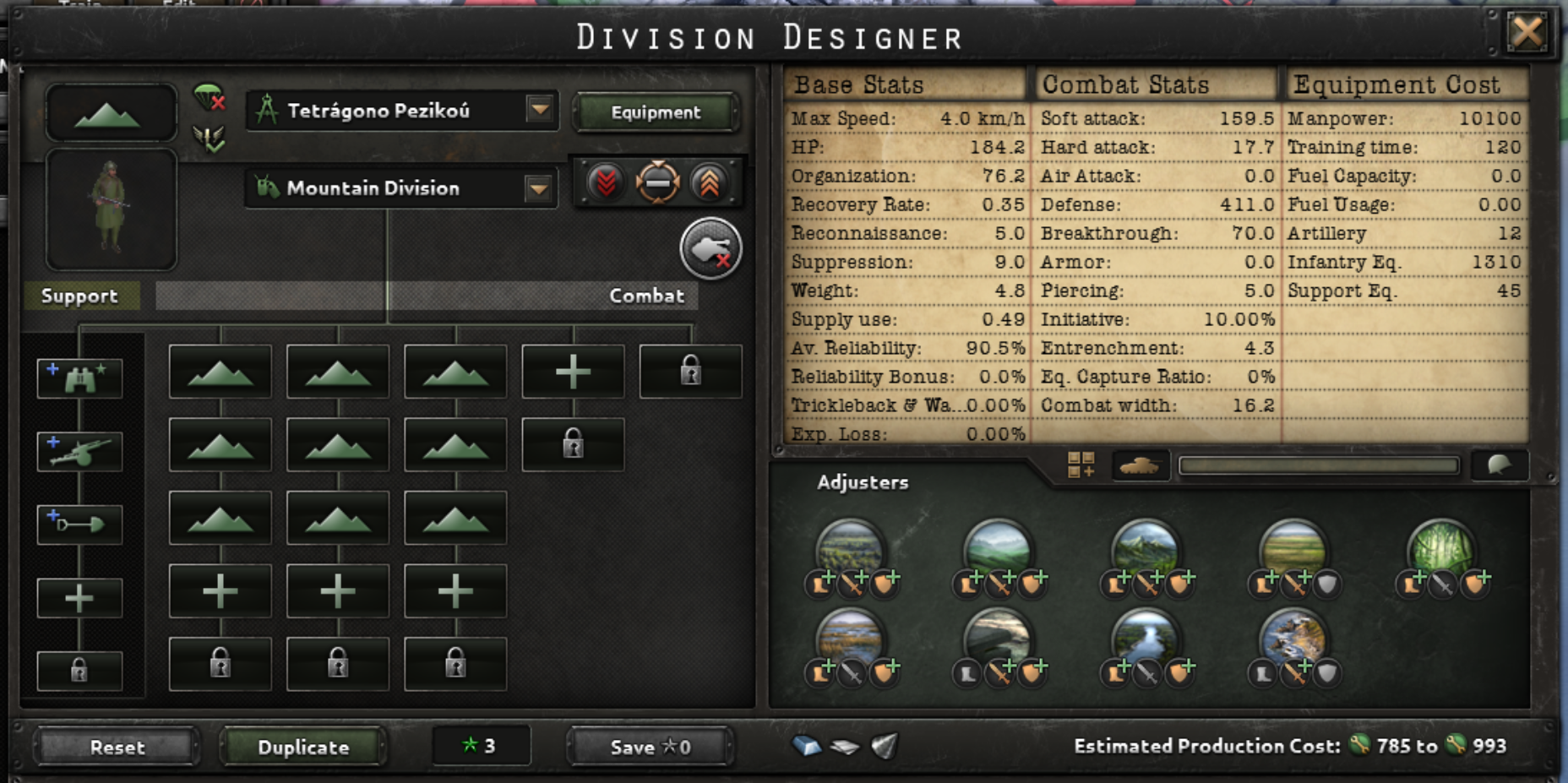
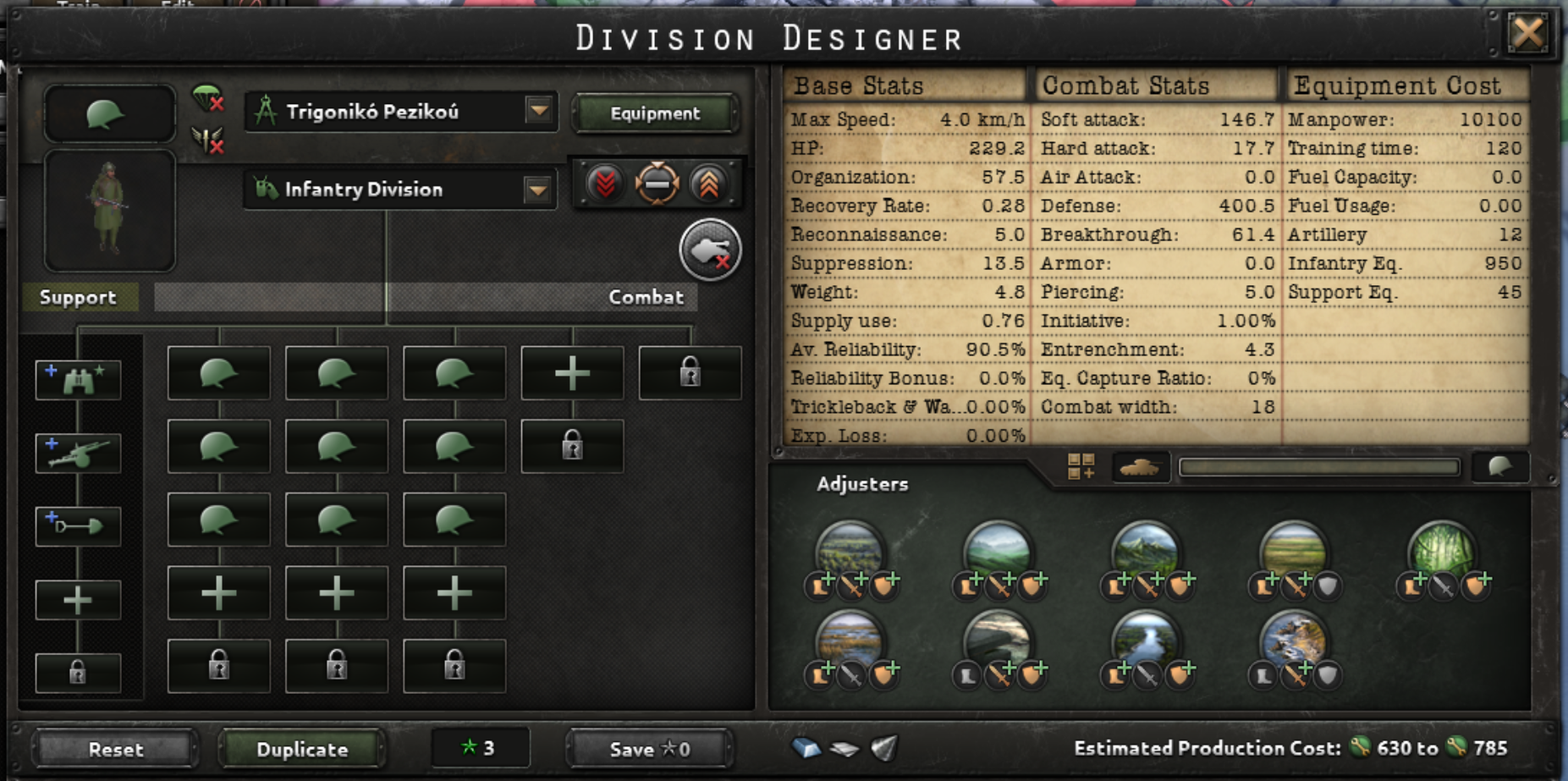
Both templates have identical manpower, training time, artillery, and support equipment requirements. Hard attack, piercing, and average reliability are also identical. Both have a unit hardness of 0%.
The Mountaineer Division excels in 7 areas: organization, recovery rate, supply use, soft attack, defense, breakthrough, and combat width. It can fight longer in more challenging terrain and recover quicker.
The Infantry Division excels in 3 areas: HP, suppression, and infantry equipment requirement. It also has a lower average production cost. Suppression is not a factor in combat, so it really doesn’t add anything.
When you compare the two templates, it’s clear the Mountaineer Division is leagues ahead of the vanilla Infantry Division. Toe to toe, the mountaineers shred vanilla infantry, especially after the addition of Special Forces Doctrines, and especially in hills and mountain terrain. Mountaineers with the addition of a ranger support company have +60% attack and +30% defense in mountain terrain.
It’s best to select the special forces branches that make the most sense with your play style and chosen country, but neglect mountaineers at your own peril. They are tough units that can help turn the tide of the war.

 M.A. Kleen
What are your thoughts?