
Renowned documentarian Ken Burns claims Biden’s legacy rivals FDR. Is this historical insight or partisan nonsense?
Ken Burns’ documentary The Civil War (1990) was a masterpiece that had a profound impact on me as a child. It sparked a lifelong interest in the subject. Even though Burns is not technically a historian, his approach to historical subjects as a documentarian has popularized the field and probably done more to inspire future historians than anything else. That’s why, when I read the following statement he posted on X (formerly Twitter) a few days ago, I almost spit out my drink.
“Joe Biden will go down as one of the great ones, having led the country out of the disastrous term of his predecessor and quietly doing good things for all Americans, red state as well as blue, accomplishments that put him up there, in terms of legislative action, with LBJ and FDR…”
– Ken Burns
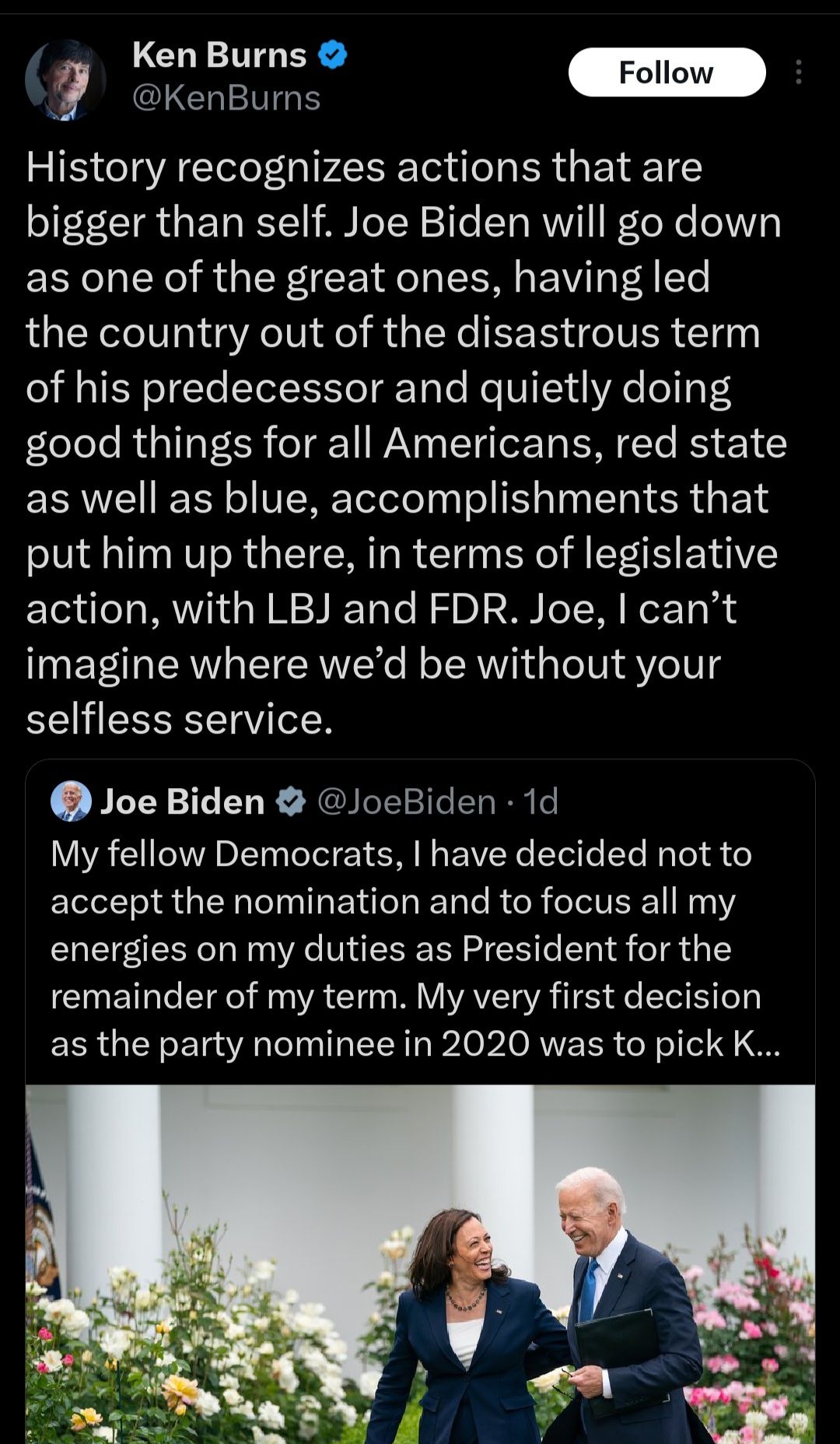
I always assumed Ken Burns leaned left, but it’s one thing to praise Democratic candidates, initiatives, and social issues, and another to fumble over yourself to make what has to be the most hyperbolic and absurd statement I’ve seen in a long time. To claim President Biden’s accomplishments put him on par with FDR and LBJ is partisan hackery of the highest order.
Franklin Delano Roosevelt (1882–1945), popularly known as FDR, was the longest serving president in American history. He served for 12 years until his death, which is the closest we’ve ever come to having a president for life. Naturally, a president will have an impact over three terms, but he served during a particularly tumultuous period–the Great Depression and World War 2. Not only did he totally remake the relationship between the federal government and our economy and expand the size and scope of the federal government and executive power, but he created a Democratic legislative majority that (with a few interruptions) lasted for 58 years.
FDR’s legislative accomplishments and new federal programs are too numerous to mention, but just a few include the Federal Emergency Relief Administration, Public Works Administration, Rural Electrification Administration, Civilian Conservation Corps, Securities and Exchange Commission, Glass–Steagall Act, Social Security Act, and on and on. After his death, the 22nd Amendment was specifically passed to prevent another president from having more than two terms. The United States after FDR was not the same country as it was when he took office.
Only a few presidents have had such a profound impact. George Washington, Thomas Jefferson, Abraham Lincoln, and Andrew Jackson are definitely at the top of the list.
Lyndon B. Johnson, who served for roughly six years after the assassination of John F. Kennedy, I’d place in the ‘B tier’. His administration didn’t have the far-reaching effects of Lincoln or FDR, but his Great Society program did have an outsized impact. The Civil Rights Act of 1964, Voting Rights Act of 1965, and Civil Rights Act of 1968 fundamentally remade race relations in the United States. The Immigration and Nationality Act of 1965 transformed U.S. immigration policy by removing restrictions on who could immigrate here, which led to fundamental demographic change. He also oversaw the creation of Medicare and Medicaid.
Only three pieces of major legislation were passed under President Biden: the American Rescue Plan, Infrastructure Investment and Jobs Act, and the Inflation Reduction Act, all federal spending and tax reform bills that were not qualitatively different from Bush’ Emergency Economic Stabilization Act, Obama’s American Recovery and Reinvestment Act, or Trump’s Tax Cuts and Jobs Act or America’s Water Infrastructure Act. It’s become routine since 2008 for every president to champion some enormous spending bill that’s supposed to “fix” the economy.
Biden also created one federal holiday (Juneteenth) and appointed a single Supreme Court justice, which did not change the ideological makeup of the court. He didn’t create a lasting legislative majority for his party or negotiate any significant trade deals, and he was unceremoniously bullied off his own party’s presidential ticket after winning the primary.
Ken Burns is intimately familiar with this history. His miniseries The Roosevelts (2014) tackled the impact that Teddy Roosevelt and FDR had on our country. So for him to equate President Biden’s accomplishments to those of FDR is perplexing to say the least. It is, to use a cinematic reference, akin to saying Jaws 3-D or Jurassic Park 3 were just as good as the originals. Biden is a president in the same sense that Jurassic Park 3 is a movie. Technically both statements are true. But Jurassic Park 3 did not have the same cultural impact as the original, whatever its merits as a standalone film. To say otherwise is objectively nonsensical by every metric.
This problem goes beyond one man on Twitter. Partisan academics routinely lend their “expertise” to support whatever they think helps their preferred political party. For example, this article in the Washington Post with the headline “Historians say Biden’s withdrawal shows American democracy is working,” which makes about as much sense as “Engineers say the Brooklyn Bridge is really a tunnel.”
Biden’s withdrawal was not an unprecedented coup by wealthy and influential Democrats against the sitting president and chosen candidate of Democratic primary voters, but just something routine that political parties do. Don’t worry, guys, says Eliot Cohen, retired professor at Johns Hopkins University’s School of Advanced International Studies, “We ought to take this as relatively normal.”
You couldn’t pay me to say such absolute nonsense.
It’s one thing to express support for a president, to think he did a good job, that he “saved the country” from his predecessor, etc. It’s another to sacrifice your integrity on the altar of partisan politics by making assertions so laughably absurd they don’t even comport with reality.

 M.A. Kleen
What are your thoughts?