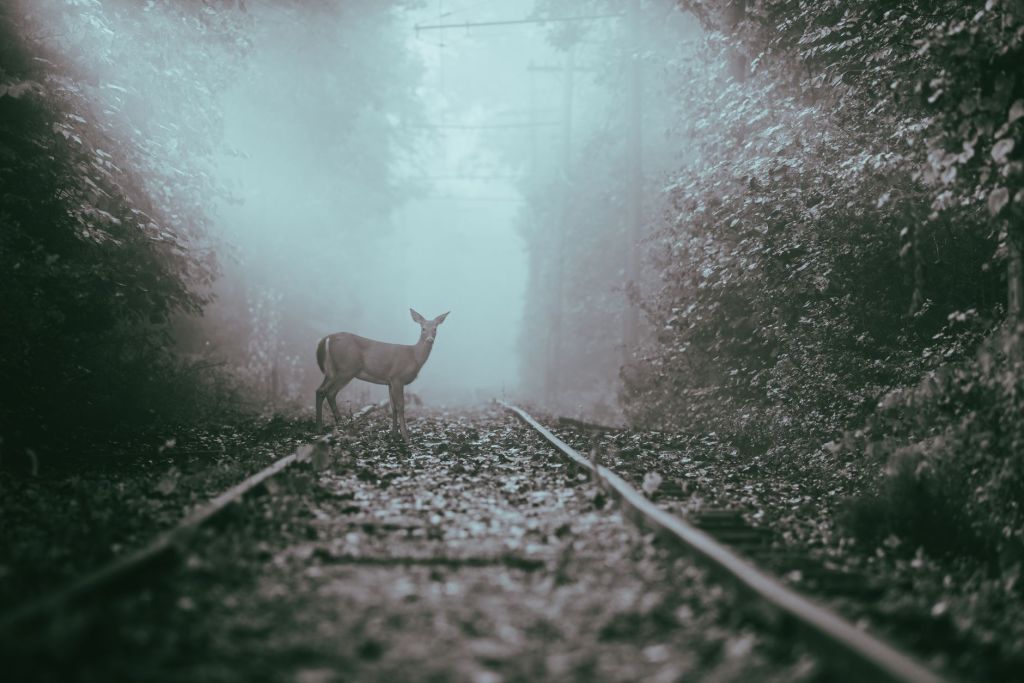
A phantom buggy crosses a covered bridge, a mysterious woman wanders a Gothic library, and a ghostly undertaker offers visitors a glimpse of their own death. From quiet country roads to bustling college campuses, these ten haunted places in Indiana offer a sampling of the Hoosier State’s enduring ghost stories and local legends.
Sim Smith Bridge – Montezuma
Built in 1883, this 84-foot covered bridge spans Leatherwood Creek along 40N, south of Route 36, about six miles west of Rockville. It once stood along the Pikes Peak Highway, which ran from New York to Los Angeles. According to legend, a young mother carrying her baby home to Montezuma reached Sim Smith Bridge at dusk in 1890 and hurried across. A horse and buggy came speeding toward her from the opposite direction.
By the time the driver saw her, it was too late to stop. Mother and child were crushed beneath the horse’s hooves and buggy wheels. Afterward, travelers reported hearing a buggy crossing the bridge, though none emerged. Local fishermen sometimes saw a horse and buggy enter, only to vanish before reaching the other side. Others claimed to glimpse a young woman holding her baby in the shadows, still waiting for a safe passage home.
Laughery Creek Road – Dearborn County
A quiet farmhouse once stood along this road dividing Delaware and Ohio counties. The house is long gone, but the scars of a gruesome crime have proved harder to erase. In May 1941, a man who had twice married into the Agrue family confronted his in-laws with a shotgun, killing Johnson Agrue, his wife, and their two sons. He hid the weapon in a hollow tree but later confessed. Nearly 30 years later, in 1970, the farmhouse mysteriously burned to the ground. Since then, locals have whispered that the Agrue family still haunts Laughery Creek Road, or perhaps their killer does. After dark, even the bravest drivers might think twice about finding out.
Fowler Theatre – Fowler
Fowler Theatre and the town itself take their name from Moses Fowler, a prominent local banker. The Fowler Theatre opened on March 1, 1940, and has been a fixture of community life ever since. Designed as a movie palace, it was one of six theaters in the country chosen to premiere Gone with the Wind. Something of its past seems to linger. Volunteers have reported doors opening on their own, the feeling of being watched, and a rocking chair swaying with no one in it. Several have seen a gray-haired man in a tan raincoat and fedora dash through the theater before disappearing. Old photographs suggest he is Dick Vlastos, the theater’s original owner. His appearances are so frequent that volunteers believe he still keeps watch over his beloved building.
The One-Hundred Steps Cemetery – Brazil
The One-Hundred Steps Cemetery lies between Terre Haute and Brazil, Indiana, off N. County Road 675 W, just south of Route 40. Unmarked on many maps, this secluded rural cemetery holds graves dating to the 1860s, but its concrete stairs draw the curious. Broken and sunken into the grass in places, they promise a grim revelation to anyone willing to climb them at midnight. According to legend, if you count every step and reach the top, a ghostly undertaker will appear and show you a vision of your death. Count carefully on the way down: if the numbers differ, that vision will come true. Those who try to evade the ritual by climbing the hillside instead may feel a phantom hand shove them to the ground.
Edna Collins Bridge – Putnam County
Built in 1922, Edna Collins Bridge spans Little Walnut Creek along County Road 450 N, west of Glenn Flint Lake. It is the only covered bridge in Indiana named after a woman, but the ghost said to linger there is not Edna Collins. According to legend, a young girl played near the creek in the late 1920s while her parents drove into town. On their way home, they would stop at the bridge and honk three times to call her back. One day, she failed to appear. Her father found her body floating in the flooded creek. Visitors have since reported hearing a girl’s laughter near the bridge. Stop your car there and honk three times, the story goes, and her apparition will appear. Some claim she has joined them in the backseat, still answering the familiar call.
University of Notre Dame – South Bend
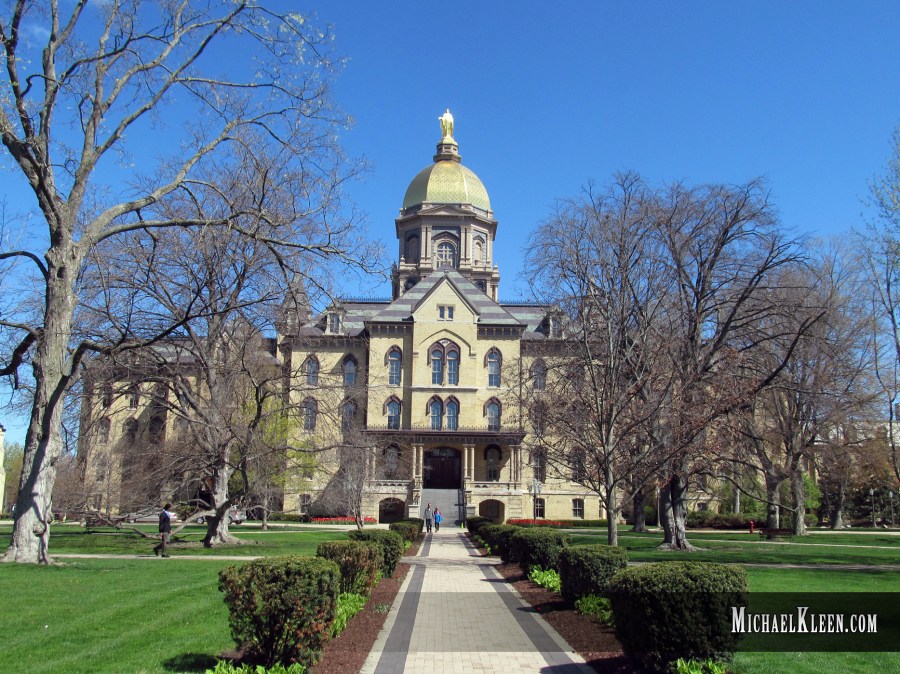
The University of Notre Dame was founded in 1842 by Catholic priest Father Edward Sorin and remained an all-male institution until 1972. Famous for its Fighting Irish football team, the university owes one of its most enduring ghost stories to that athletic legacy. In 1920, George “The Gipper” Gipp became Notre Dame’s first All-American football player. On December 14 of that year, he died of a streptococcal throat infection at just 25.
Students say Gipp still haunts his old room in Washington Hall, now home to the university’s drama club. Reports of falling props and music playing on its own suggest he may have company. One janitor encountered an elderly, balding man who asked for help opening a window, then vanished. Outside, according to another legend, the ghosts of American Indians wander the grounds around Columbus Hall, built on land formerly owned by the Potawatomi.
The Story Inn – Brown County

“One inconvenient location since 1851” is both this country inn’s tagline and an apt description. Reaching it requires a 20-mile drive into the wilderness along State Road 135 from Nashville, Indiana. The Story Inn and its cottages are all that remains of Story, a tiny mining town that faded away in the early 1900s. Restored in the 1960s, the inn sits at the edge of Brown County State Park. For decades, its owners kept logs in each room for guests to record their ghostly encounters. The best-known resident is the “Blue Lady,” believed to be the ghost of Dr. George Story’s wife. According to legend, turning on a blue light in one of the rooms above the restaurant summons her. Hundreds of encounters have been recorded, ranging from an uneasy sense of her presence to sightings and interactions with the apparition. The owner remains skeptical but invites guests to add their own accounts. Those who turn on the light may have something to write about by morning.
Indiana University – Bloomington

Indiana University in Bloomington is the flagship of the Indiana University system and the state’s largest university, with more than 42,000 students. Dating to 1822, it took its current name in 1838 and is known for its Big Ten athletics, particularly men’s basketball. Its long history also includes a few unsettling campus legends. Read Hall is said to harbor two tormented spirits. One is a raven-haired young woman allegedly murdered by her boyfriend, whose ghost appears in a yellow nightgown. The other, known as “Paula,” reportedly took her own life by throwing herself down the stairs. According to campus lore, her bloodcurdling scream echoes through the hall on December 12, the anniversary of her death. The Indiana Memorial Union has its own spectral residents: a phantom dog and the ghosts of several students said to have leapt to their deaths from an upper floor.
Willard Library – Evansville

Willard Library’s “Grey Lady” is Indiana’s most famous ghost. One of the oldest libraries in the Hoosier State, its imposing Victorian Gothic architecture provides a fitting setting for her story. The accounts, however, extend beyond atmosphere. A janitor first spotted the Grey Lady in the basement in 1937, and hundreds of visitors have since claimed to see her misty, gray figure. Others report catching the scent of her perfume or feeling a phantom touch. She is believed to be Louise Carpenter, daughter of the library’s founder, Willard Carpenter. Staff installed live-feed cameras in three rooms, inviting the public to watch for unexplained activity. Viewers have since collected dozens of images purportedly showing an indistinct figure, leaving those watching to wonder who might be moving among the shelves.
Historic Hannah House – Indianapolis
Alexander Hannah, who later became a state legislator, built this red-brick Italianate mansion in 1858. According to legend, the house served as a stop on the Underground Railroad, sheltering slaves fleeing north to Canada before the Civil War. One night, a group sleeping in the basement allegedly perished after someone knocked over an oil lantern, filling the room with flames and smoke. Hannah is said to have buried their ashes in the basement to conceal the tragedy. Their ghosts, the story goes, never left. Visitors report moans, whispers, unexplained shadows, and cold spots belowstairs, while apparitions of Hannah and his wife have been seen on the upper floors. Today, the Historic Hannah House welcomes visitors for tours and events, though some accounts suggest its occupants are not all among the living.
Donate
Enjoy what you read? Please consider making a one-time donation to support my research.
Enjoy what you read? Please consider making a monthly donation to support my research.
Enjoy what you read? Please consider making a yearly donation to support my research.
Choose an amount
Or enter a custom amount
Your contribution is appreciated.
Your contribution is appreciated.
Your contribution is appreciated.
Sources
Davis, Dorothy Salvo. Haunted Tales from The Region: Ghosts of Indiana’s South Shore. History Press, 2010.
Marimen, Mark. Haunted Indiana, Vol. 1. Thunder Bay Press, 1997.
Norman, Michael. Haunted Homeland: A Definitive Collection of North American Ghost Stories. Tor Publishing Group, 2008.
Sankowsky, Lorri and Keri Young. Ghost Hunter’s Guide to Indianapolis. Pelican Publishing Company, 2008.
Willis, Wanda Lou. Haunted Hoosier Tales: Folklore from Indiana’s Spookiest Places. Clerisy Press, 2025.
Zullo, Allan. The Ten Creepiest Places in America. Troll Communications LLC, 1997.


What are your thoughts?