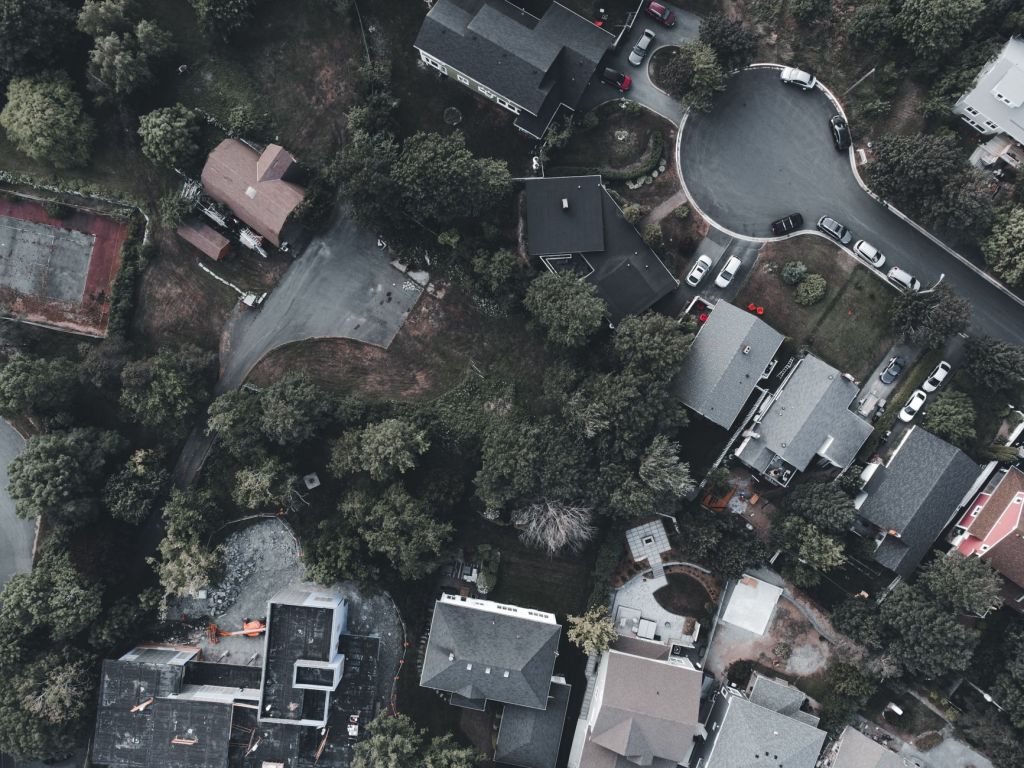
Gothic horror once belonged to crumbling castles and decaying mansions. Then it followed Americans into the suburbs, where picture windows, finished basements, and attached garages offered new places for old fears to hide.
When most people picture a haunted house, they imagine a rambling Victorian mansion perched on a hill, its roofline broken by towers and gables and its windows darkened by heavy curtains. The house has stood for generations. Its halls are lined with portraits of the dead, and somewhere upstairs, a locked room holds the secret of a family’s ruin.
The suburban ranch house appears to be its opposite. Built low to the ground, with wide windows, an open floor plan, and perhaps an attached garage, it was designed for comfort and convenience. It had no ancestral portrait gallery, servants’ quarters, or shadowy east wing. Its rooms were bright, practical, and connected. Everything about it announced a break with the past.
Yet Gothic horror followed Americans into the suburbs. It settled beneath the picture windows, slipped into the basements, and waited behind the garage door.
The ranch house and its descendants, including split-levels, raised ranches, and mass-produced tract homes, helped transform the haunted house for the modern age. In films like Halloween (1978), Poltergeist (1982), A Nightmare on Elm Street (1984), and Paranormal Activity (2007), terror does not descend upon an ancient estate. It invades homes that look remarkably similar to the ones where millions of Americans grew up.
That familiarity is what makes them frightening.
A House Without a Past?
Traditional Gothic homes are frightening because they are old. Their architecture bears the weight of inherited guilt, family curses, and crimes committed by previous generations. Their decay suggests that something buried long ago is pushing its way back to the surface.
The postwar suburban house promised freedom from all that. It was new, efficient, and unburdened by history. Returning veterans and young families could move into freshly built neighborhoods and begin again. The old world, with its crowded tenements, aging family homes, and tangled obligations, could be left behind.
But a house cannot truly exist without a past.
In Poltergeist, the Freeling family lives in Cuesta Verde, a planned California development filled with nearly identical homes. Their house is spacious and comfortable, the product of a booming real estate market and the upwardly mobile lifestyle it promised. When supernatural forces invade, the Freelings discover that their neighborhood was built over a cemetery. The developers moved the headstones but left the bodies behind.
It is a perfect Suburban Gothic crime. The past was not honored or even destroyed, but covered over with drywall, sod, and mortgage payments. The “newness” is a pretense.
Windows Made for Watching
Large windows were among the suburban home’s most appealing features. They filled rooms with sunlight and opened the interior to the yard. Picture windows placed family life on display, turning the home into a kind of showroom for domestic happiness.
After dark, however, those same windows become unsettling. The brightly lit interior is exposed, while anyone standing outside remains hidden.
Suburban Gothic repeatedly exploits this imbalance. Characters watch neighbors through blinds, glimpse strange movements across the street, or notice a figure standing where no one should be. In Halloween, ordinary residential streets become hunting grounds for Michael Myers. He appears between hedges, beyond clotheslines, and outside classroom windows, always close enough to see but distant enough to disappear.
Fences and curtains offer only limited protection. They may hide a family from its neighbors, but they also conceal whoever has entered the yard. The very features meant to provide privacy make it difficult to know what is happening a few feet away.
This is one reason the suburban stalker is so effective. He does not need a secret passageway or hidden staircase. He needs only an unlocked back door, an unlit side yard, and a family accustomed to believing the neighborhood is safe.
The Basement Below
Although the suburban house was meant to reject the gloomy architecture of the past, it retained one unmistakably Gothic space: the basement.
Upstairs, family life is carefully arranged and visible. The kitchen, living room, and bedrooms have familiar purposes. The basement is different. It may serve as a laundry room, workshop, storage area, recreation room, or all four at once. Its unfinished corners accumulate objects the family no longer needs but cannot bring itself to discard.
The basement is where the suburban home keeps its memory.
Old toys, broken furniture, boxes of photographs, Christmas decorations, and appliances from previous decades gather beneath the living space. Pipes run across the ceiling. Furnaces groan in the dark. Small windows sit near ground level, offering only a partial view of anyone approaching from outside.
In A Nightmare on Elm Street, Freddy Krueger’s boiler room gives industrial form to this fear. It is hot and mechanical—a nightmare version of the household basement. In The Gate (1987), children accidentally open a portal to another world in their own backyard, but the resulting evil spreads through the house. Familiar domestic spaces become thresholds to something ancient and uncontrollable.
The Gothic castle had its dungeon. The suburban home has its basement.
The Garage Door
The attached garage further complicates the idea that the suburban house is a secure refuge. It is both inside and outside, part of the house but intended for machines, tools, gasoline, lawn equipment, and trash. Families pass through it every day without giving it much thought.
That uncertainty makes it a natural setting for suspense. A garage door may be left open by accident. Someone can enter unseen and wait beside the car. The automatic opener allows residents to pass from the street into the home without ever stepping outside, but it also creates another point of access.
Garages also embody the isolation of suburban life. The front porch once encouraged contact with passersby. The attached garage allows residents to leave for work, return home, and close the door without speaking to anyone. Neighbors may recognize the car without truly knowing the person inside it.
Terror in the Open Floor Plan
Suburban homes were designed to make family life less formal. Kitchens opened into dining areas. Living rooms flowed into hallways. Parents could prepare dinner while watching children play nearby.
Horror turns that openness against the occupants.
In an older house, a closed door might hold back whatever waits on the other side. In an open-plan home, there are fewer barriers. A sound in the kitchen carries into the family room. A shape moving past the hallway catches the eye. Empty space creates long lines of sight, but it also gives the imagination more room to work.
Paranormal Activity understood this particularly well. Its horror depends on a fixed camera recording a modern home while its occupants sleep. Nothing about the house appears threatening. Its neutral walls, carpeted rooms, and ordinary furnishings seem aggressively safe. Yet the camera encourages viewers to search every doorway and patch of darkness for movement. The film transforms domestic openness into a trap.
Every House Has Secrets
The haunted suburban house represents a different fear from the old mansion on the hill. The mansion warns visitors away. Its decay advertises danger. Anyone who enters does so knowing that something may be wrong.
The ranch house welcomes us home.
Its lawn is trimmed. The television flickers in the family room. Children’s bicycles lie in the driveway, and the garage is filled with the harmless clutter of everyday life. Nothing about it suggests centuries of violence or supernatural corruption.
That is the point. Suburban Gothic brings the haunted house into the world of ordinary families and insists that bright rooms and modern conveniences offer no protection from the past or from one another. The architecture may change, but the old fears remain.


What are your thoughts?